

Vietnam:
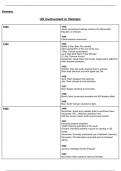
US involvement in Vietnam:
1940 1945:
Japan surrendered making Vietnam the Democratic
Republic of Vietnam.
1949
China became communist
1950 1954:
Battle of Dien Bien Phu started
USA paying 80% of the cost of the war
7 May: French surrendered
June: Ngo Dinh Diem Prime Minister
21 July: Geneva Accord
September: South East Asia Treaty Organisation (SEATO)
Diem became president
1955:
October: Bao Dai spoke against Diem’s policies.
Diem held elections and won again bao Dai
1956:
June: Diem stopped free elections
July: Diem refused to hold elections
1957:
Diem began arresting Communists.
1958:
March: Most communist arrested and 400 leaders killed.
1959:
May: North Vietnam decided to fight.
1960 1960:
November: Some army leaders tried to overthrow Diem
December: NFL: National Liberation front
Half the country wasn’t under government control
1961:
Kennedy became president
12000 Vietcong guerrillas in the south
October: Kennedy ordered a report on sending in US
troops
December: Kennedy authorised use of defoliant chemical
December: US helicopters and pilots sent to transport
ARVN.
1962:
January: Strategic Hamlet Program
1963:
November: More advisors sent by Kennedy
, 2 January: ARVN lost the battle of Ap Bac
6 May: Attack on Buddhist monks
11 June: Buddhist monk set himself on fire
August: raiding of Buddhist temples
1 november: Diem assassinated.
22 november: Kennedy was assassinated.
1970
1980
End of French rule in Vietnam:
March 13th 1954 the battle at Dien Bien Phu started:
Started because Vietnam was a French colony they lost control over.
The vietminh wanted independence.
The USA feared Vietnam would become communist.
Support for Ho Chi Minh was weak in the south and so the french marched in and set up the State of Vietnam ruled by Bao Dai who
was anti-communist.
Then in 1949 China became communist and the USA feared the domino effect.
Fear grew when China sent the Vietminh supplies, advisers, and troops.
The USA began to send French supplies and military advisors (many who were dressed in uniform and were soldiers but were there
to advise).
By 1954 the USA was paying about 80% of the cost of France's war with Vietnam.
Dien Bien Phu:
The French built an airship at Dien Bien Phu to lure the Vietminh into battle, brought 15000 troops and waited for an attack.
They didn’t know they were surrounded by 50000 Vietminh with anti-aircraft guns and other artillery which took months to get into the
mountains. They also had 50000 troops and 200000 civilian workers.
The fight lasted 55 days, on 7th May 1954 the French surrendered.
Why the Vietminh won:
The French asked for USA military aid but President Eisenhower had considered it even considering using atom bombs but he
felt congress would refuse.
The USA had just ended war in Korea with 34000 american lives lost and nothing gained, very few americans wanted another war.
The vietminh knew the area and had unknown accesses and could build traps.
China helped supply them with weapons, 20000 bikes, help with planning and troops.
Local support by the villagers.
They were more committed and worked day and night.
The French underestimated them, the troops were not committed and they were more armed and had their planes shot down.
New government of Vietnam:
The Geneva Accords: (The day after the french surrender representatives from 9 countries met up in Geneva to discuss what
happened in Vietnam. A partial agreement was made on 21st July 1954
Vietnam was temporarily divided along the 17th parallel separated by demilitarised zones no troops could enter.
Ho Chi Min would run the northern part from Hanoi. It was a smaller area of Vietnam that the Vietminh held when the war with
France ended.
Boa Dai would run the southern part from Saigon. Later he made Ngo Dinh Diem Prime Minister in October 1955. Bao Dai then
weant to France and Diem (fiercly anti-communist) ran the country.
Vietnamese troops and people could not move north or south for 300 days after the agreement.
No foreign troops could set bases in either part of the country.
In July 1956 elections would be held across both parts of Vietnam to decide on the government of a united vietnam. No system
was suggested for the elections.
, The countries were Cambodia, China, France, Laos, the Uk, The USA, and South Vietnam.
The USA and South Vietnam, refused to obey the Accords.
North Vietnam wanted to divide Vietnam further south at the 13th parallel and hold elections in 6 months. China pushed it to give in, so
both Vietnamese governments were unhappy with the Accords.
Greater involvement under Eisenhower:
After the Geneva Accords Eisenhower could have brought all the US advisors home, leaving Vietnam to work towards the elections to
reunite the country. Instead, he committed more US aid to South Vietnam, even after the French left.
Domino Theory:
The most significant reason for greater US involvement in Vietnam was fear of communism.
Domino Theory: If Vietnam fell, other countries in Southeast Asia would follow.
Eisenhower set up the South East Asia Treaty Organisation (SEATO) in September 1954 with the USA, UK, France, New
Zealand, Australia, Pakistan, Philippines, and Thailand as members.
They agreed to act together by force if necessary to stop communism spreading in South east asia.
Why was Diem's government weak?
Diem’s government in South Vietnam did not have widespread support. There were doubts that the army would back the goverments
if fighting broke out.
There were still many communists in South Vietnam. They controlled some northern areas.
Other religious, political, criminal groups had many supporters and their own armies.
Diem was Catholic; most Vietnamese were Buddhist. Religious clashes were common and Buddhists assumed Diem favoured
the Catholics, which he did.
Diem mainly gave government jobs to his family members and Catholics. Excluding other groups.
Diem’s government was Siagnon- based. He had little respect for the peasants in the villages and did not make reforms to gain
their support. Many villages were run by corrupt officials, greedy landlords who held most of the land.
Keeping Diem in power:
Eisenhower supported Diem by sending more advisers to train the South Vietnamese Army (ARVN). He wanted the ARVN to win
control of South Vietnam and for the US to fight a limited war (a war where a country supports a side in a conflict by, for example,
sending them supplies and training their troops, but not by sending any of their own troops to fight) without US troops.
He did not want to trigger a war with China and the USSR, which might lead to the use of nuclear weapons.
In October 1955 Bao Dai spoke against Diem’s policies. Diem’s response was to hold a referendum with people voting for him or Bao
Dai as their leader. Diem won.
He said Vietnam was now the republic of Vietnam and he was its president. He changed the government and in june 1956 stopped
villages electing their own officials. He put widely-resented government officials in charge. As Diem grew more unpopular in South
Vietnam, so did the USA.
No elections:
On 16 July 1956 Diem refused to hold elections. He said his government had not existed when the Geneva Accords were agreed, so
he didn't have to obey them. The US supported him fearing a communist government would be elected.
Vietnam stayed divided as it had before but Eisenhower sent more aid (despite warnings). Diem became less and less democratic, US
advisers said he needed to use force to stay in power, after which he could make reforms and hold elections.
However Diem continued to oppress many south Vietnamese but he did not make reforms. He took US money but not US advice.
He assured Eisenhower thay the South Vietnamese people supported him, he may or may not have believed this but he hoped the
USA would.
He began campaigning against opponents, especially communists.
He began to arrest political and religious opponents.
His ‘denounce a communist’ campaign urged people to report communists to the government.
In 1957 he sent the ARVN into the countryside to find and arrest communists. The ARVN arrested about 65000 suspected
communists and killed 2000.
The situation worsens:
US involvement in Vietnam:
1940 1945:
Japan surrendered making Vietnam the Democratic
Republic of Vietnam.
1949
China became communist
1950 1954:
Battle of Dien Bien Phu started
USA paying 80% of the cost of the war
7 May: French surrendered
June: Ngo Dinh Diem Prime Minister
21 July: Geneva Accord
September: South East Asia Treaty Organisation (SEATO)
Diem became president
1955:
October: Bao Dai spoke against Diem’s policies.
Diem held elections and won again bao Dai
1956:
June: Diem stopped free elections
July: Diem refused to hold elections
1957:
Diem began arresting Communists.
1958:
March: Most communist arrested and 400 leaders killed.
1959:
May: North Vietnam decided to fight.
1960 1960:
November: Some army leaders tried to overthrow Diem
December: NFL: National Liberation front
Half the country wasn’t under government control
1961:
Kennedy became president
12000 Vietcong guerrillas in the south
October: Kennedy ordered a report on sending in US
troops
December: Kennedy authorised use of defoliant chemical
December: US helicopters and pilots sent to transport
ARVN.
1962:
January: Strategic Hamlet Program
1963:
November: More advisors sent by Kennedy
, 2 January: ARVN lost the battle of Ap Bac
6 May: Attack on Buddhist monks
11 June: Buddhist monk set himself on fire
August: raiding of Buddhist temples
1 november: Diem assassinated.
22 november: Kennedy was assassinated.
1970
1980
End of French rule in Vietnam:
March 13th 1954 the battle at Dien Bien Phu started:
Started because Vietnam was a French colony they lost control over.
The vietminh wanted independence.
The USA feared Vietnam would become communist.
Support for Ho Chi Minh was weak in the south and so the french marched in and set up the State of Vietnam ruled by Bao Dai who
was anti-communist.
Then in 1949 China became communist and the USA feared the domino effect.
Fear grew when China sent the Vietminh supplies, advisers, and troops.
The USA began to send French supplies and military advisors (many who were dressed in uniform and were soldiers but were there
to advise).
By 1954 the USA was paying about 80% of the cost of France's war with Vietnam.
Dien Bien Phu:
The French built an airship at Dien Bien Phu to lure the Vietminh into battle, brought 15000 troops and waited for an attack.
They didn’t know they were surrounded by 50000 Vietminh with anti-aircraft guns and other artillery which took months to get into the
mountains. They also had 50000 troops and 200000 civilian workers.
The fight lasted 55 days, on 7th May 1954 the French surrendered.
Why the Vietminh won:
The French asked for USA military aid but President Eisenhower had considered it even considering using atom bombs but he
felt congress would refuse.
The USA had just ended war in Korea with 34000 american lives lost and nothing gained, very few americans wanted another war.
The vietminh knew the area and had unknown accesses and could build traps.
China helped supply them with weapons, 20000 bikes, help with planning and troops.
Local support by the villagers.
They were more committed and worked day and night.
The French underestimated them, the troops were not committed and they were more armed and had their planes shot down.
New government of Vietnam:
The Geneva Accords: (The day after the french surrender representatives from 9 countries met up in Geneva to discuss what
happened in Vietnam. A partial agreement was made on 21st July 1954
Vietnam was temporarily divided along the 17th parallel separated by demilitarised zones no troops could enter.
Ho Chi Min would run the northern part from Hanoi. It was a smaller area of Vietnam that the Vietminh held when the war with
France ended.
Boa Dai would run the southern part from Saigon. Later he made Ngo Dinh Diem Prime Minister in October 1955. Bao Dai then
weant to France and Diem (fiercly anti-communist) ran the country.
Vietnamese troops and people could not move north or south for 300 days after the agreement.
No foreign troops could set bases in either part of the country.
In July 1956 elections would be held across both parts of Vietnam to decide on the government of a united vietnam. No system
was suggested for the elections.
, The countries were Cambodia, China, France, Laos, the Uk, The USA, and South Vietnam.
The USA and South Vietnam, refused to obey the Accords.
North Vietnam wanted to divide Vietnam further south at the 13th parallel and hold elections in 6 months. China pushed it to give in, so
both Vietnamese governments were unhappy with the Accords.
Greater involvement under Eisenhower:
After the Geneva Accords Eisenhower could have brought all the US advisors home, leaving Vietnam to work towards the elections to
reunite the country. Instead, he committed more US aid to South Vietnam, even after the French left.
Domino Theory:
The most significant reason for greater US involvement in Vietnam was fear of communism.
Domino Theory: If Vietnam fell, other countries in Southeast Asia would follow.
Eisenhower set up the South East Asia Treaty Organisation (SEATO) in September 1954 with the USA, UK, France, New
Zealand, Australia, Pakistan, Philippines, and Thailand as members.
They agreed to act together by force if necessary to stop communism spreading in South east asia.
Why was Diem's government weak?
Diem’s government in South Vietnam did not have widespread support. There were doubts that the army would back the goverments
if fighting broke out.
There were still many communists in South Vietnam. They controlled some northern areas.
Other religious, political, criminal groups had many supporters and their own armies.
Diem was Catholic; most Vietnamese were Buddhist. Religious clashes were common and Buddhists assumed Diem favoured
the Catholics, which he did.
Diem mainly gave government jobs to his family members and Catholics. Excluding other groups.
Diem’s government was Siagnon- based. He had little respect for the peasants in the villages and did not make reforms to gain
their support. Many villages were run by corrupt officials, greedy landlords who held most of the land.
Keeping Diem in power:
Eisenhower supported Diem by sending more advisers to train the South Vietnamese Army (ARVN). He wanted the ARVN to win
control of South Vietnam and for the US to fight a limited war (a war where a country supports a side in a conflict by, for example,
sending them supplies and training their troops, but not by sending any of their own troops to fight) without US troops.
He did not want to trigger a war with China and the USSR, which might lead to the use of nuclear weapons.
In October 1955 Bao Dai spoke against Diem’s policies. Diem’s response was to hold a referendum with people voting for him or Bao
Dai as their leader. Diem won.
He said Vietnam was now the republic of Vietnam and he was its president. He changed the government and in june 1956 stopped
villages electing their own officials. He put widely-resented government officials in charge. As Diem grew more unpopular in South
Vietnam, so did the USA.
No elections:
On 16 July 1956 Diem refused to hold elections. He said his government had not existed when the Geneva Accords were agreed, so
he didn't have to obey them. The US supported him fearing a communist government would be elected.
Vietnam stayed divided as it had before but Eisenhower sent more aid (despite warnings). Diem became less and less democratic, US
advisers said he needed to use force to stay in power, after which he could make reforms and hold elections.
However Diem continued to oppress many south Vietnamese but he did not make reforms. He took US money but not US advice.
He assured Eisenhower thay the South Vietnamese people supported him, he may or may not have believed this but he hoped the
USA would.
He began campaigning against opponents, especially communists.
He began to arrest political and religious opponents.
His ‘denounce a communist’ campaign urged people to report communists to the government.
In 1957 he sent the ARVN into the countryside to find and arrest communists. The ARVN arrested about 65000 suspected
communists and killed 2000.
The situation worsens:


