Marketisation policies
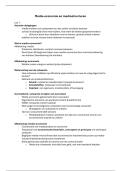
Reflect views of new right theory – suggest introducing competition into education system is best
way to success. Meaning they have to provide better value than their competitors. Those who offer
best standard of education = most popular.
David (1993) described this as parentocracy (ruled by parents). In a system of marketisation, the
power shifts from schools towards the parents.
Overview of marketisation policies:
1988 education reform act:
Introduced by thatcher conservative gov – set out principles of marketisation, e.g. the introduction of
market forces such as consumer choice + competition.
Ways they tried to achieve this:
- Formula funding – the finance of the school was based on the number of pupils enrolling, as
money is allocated per pupil, this enabled good school to attract more pupils and poor
schools incentives to improve.
- Open enrolment – parents no longer restricted to catchment area as they could apply for a
place in any school they wished within a specific area – this allowed more successful skls to
take in more successful pupils and increase achievement of the skl.
- League tables – inform parents on performance of skl in terms of exam results and ofsted
reports – giving parents more choice in schools.
- National curriculum – set out criteria for skls to follow – e.g., making maths, English, science
compulsory. Essential for league tables as schools compared on common criteria. 1Q1
- Ofsted – conducts inspections of schools at least once per 6 years. Reports are published and
weaknesses have to be addressed – again designed to enable parents to make a more
informed choice.
- Business sponsorship of skls – some skls were sponsored by businesses. This gave them
additional funding which could be invested in the performance of the skl and also created
stronger links between the skl and world of industry, this could potentially make skls more
attractive due to potential opportunities in relation to work experience that other skls may
not have.
- Schools opting out of LEA control – gave schools chance to move away from local education
control and have more say on how its run. Means schools can operate in the way they
believe is best to get top results without being restricted by local policies.
Arguably the main agenda of the 1988 ERA was to instil free market values through giving parents a
greater degree of choice about the education that their child received. This was primarily achieved
through the above policies which aimed to supply parents with both the tools and knowledge to
make a more informed decision about which school they sent their child to, thus encouraging
increased competition between schools.
Specialist status schools:
Reflect views of new right theory – suggest introducing competition into education system is best
way to success. Meaning they have to provide better value than their competitors. Those who offer
best standard of education = most popular.
David (1993) described this as parentocracy (ruled by parents). In a system of marketisation, the
power shifts from schools towards the parents.
Overview of marketisation policies:
1988 education reform act:
Introduced by thatcher conservative gov – set out principles of marketisation, e.g. the introduction of
market forces such as consumer choice + competition.
Ways they tried to achieve this:
- Formula funding – the finance of the school was based on the number of pupils enrolling, as
money is allocated per pupil, this enabled good school to attract more pupils and poor
schools incentives to improve.
- Open enrolment – parents no longer restricted to catchment area as they could apply for a
place in any school they wished within a specific area – this allowed more successful skls to
take in more successful pupils and increase achievement of the skl.
- League tables – inform parents on performance of skl in terms of exam results and ofsted
reports – giving parents more choice in schools.
- National curriculum – set out criteria for skls to follow – e.g., making maths, English, science
compulsory. Essential for league tables as schools compared on common criteria. 1Q1
- Ofsted – conducts inspections of schools at least once per 6 years. Reports are published and
weaknesses have to be addressed – again designed to enable parents to make a more
informed choice.
- Business sponsorship of skls – some skls were sponsored by businesses. This gave them
additional funding which could be invested in the performance of the skl and also created
stronger links between the skl and world of industry, this could potentially make skls more
attractive due to potential opportunities in relation to work experience that other skls may
not have.
- Schools opting out of LEA control – gave schools chance to move away from local education
control and have more say on how its run. Means schools can operate in the way they
believe is best to get top results without being restricted by local policies.
Arguably the main agenda of the 1988 ERA was to instil free market values through giving parents a
greater degree of choice about the education that their child received. This was primarily achieved
through the above policies which aimed to supply parents with both the tools and knowledge to
make a more informed decision about which school they sent their child to, thus encouraging
increased competition between schools.
Specialist status schools: