

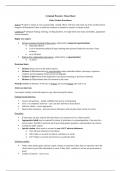
Criminal Practice: Cheat Sheet
Police Station Procedures
Arrival taken to station as soon as practicable, custody officer will seize and retain any items on their person.
Sergent will determine if there is sufficient evidence to remand in custody or release on bail.
Conditions adequate heating, cleaning, washing facilities, two light meals (one main and drinks), appropriate
clinical attention.
Rights of a suspect
To have someone informed of their arrest: authorized by inspector/superintendent
o Indictable offence
o Lead to interference/physical injury/alerting other persons/ hinder the recovery of any
evidence
o up to 36 hours
Right to free, independent legal advice, authorized by a superintendent
o As above
Detention limits
24 hours (from arrival at the police station)
36 hours (+12) authorization by superintendent where indictable offence, necessary to preserve
evidence and investigation being carried out diligently
72 hours (+36) Warrant from magistrates court (same reasoning as previous extension)
96 hours (+72) maximum limit of extension by the court
Periodic reviews of detention the first in 6 hours, the second 9 hours after and so on.
Advice on interview
Can inspect custody record and request a copy when leaving the station.
Options for the interview:
Answer all questions – builds credibility but may be incriminating
Give a ‘no comment’ interview – jury can draw inferences from silence
Selective silence – never appropriate
Hand written statement – prevents adverse inferences and can place their version of events.
Procedure:
If more than one day, must be allowed 8 hours of continous rest in a 24 hour period
Appropriate Adult may be required for minor preference is a parent/guardian, if not may be a
social worker. Entitled to intervene but if preventing proper questions, superintendent can remove.
Carried out under caution
Special caution where need to account for any s34-37 adverse inferences
o S34: Adverse inferences from silence
o S36: Failure to account for objects, substances or marks
o S37: Failure to account for presence at a particular place
Solicitors conduct
Where client admits guilt, solicitor cannot continue to represent if they deny to represent where the
client wants to give false information in court. If they don’t, continue to act but put prosecution to
proof.
Conflict of interest – cease to act
, Sharing information between clients – only where consent given, consistent instructions given and in
their best interests.
When withdrawing do not explain why
Identification procedures
Adverse inferences can be drawn for failure to take part in identification procedures. Video identification used
unless not practicable, the investigating officer must not be involved in this process. Minors 14 and under, their
parents will consent not them.
Not required where:
Suspect admits being at the scene of the crime
It is not disputed that the suspect is already know to the witness
Procedures:
Video at least 8 others of a similar age, appearance and position in life. Where two similar, 12
used. Police must take steps to conceal unique features such as scars
Identification parade same as video
Group identification
Confrontation unusual
First hearings
Triable only on indictment must be dealt with in the Crown Court
Triable either way magistrates will decide if within their powers, where pleading guilty the D can
elect to trial in either court.
Triable summarily only (theft under £200/criminal damage under £5000)
Prosecution can apply for sending without allocation for: serious fraud cases, involving welfare of a child, either
way offence related to one triable only on indictment.
Representation order: CRM14 form to be filled out online for legal aid and must qualify.
1. Interests of justice test: likely to lost liberty, substantial question of law, unable to understand
proceedings, involving tracing, interviewing or cross-examination, interests of another (such as victim
in sexual assault cases).
2. Means: Automatically fulfilled for those receiving income support or under 18 (CRM15 form filled
out)
a. Magistrates: £3,398 or less adjusted income funded
b. Crown Court: for trial, where income is £3,398-£37,500 may contribute to some costs, under
£3398 will have total funding, over £37,500 no funding.
Case Management
Hearing: Standard directions, allowing parties 8 weeks to prepare (14 weeks where expert evidence is
required). PTPH may be used where a preliminary hearing not required but the defendant needs to be arraigned
(plead guilty/not-guilty).
Securing witnesses: Serve CPS with details of all witnesses/ expert report where expert witnesses is standing
Bail
Before conviction: Cannot be remanded in custody for more than 8 clear days at a time, but up to 28 days
where previously remanded for same offence, are before a court and there is a date for the next stage (unlimited
for crown court)
Police Station Procedures
Arrival taken to station as soon as practicable, custody officer will seize and retain any items on their person.
Sergent will determine if there is sufficient evidence to remand in custody or release on bail.
Conditions adequate heating, cleaning, washing facilities, two light meals (one main and drinks), appropriate
clinical attention.
Rights of a suspect
To have someone informed of their arrest: authorized by inspector/superintendent
o Indictable offence
o Lead to interference/physical injury/alerting other persons/ hinder the recovery of any
evidence
o up to 36 hours
Right to free, independent legal advice, authorized by a superintendent
o As above
Detention limits
24 hours (from arrival at the police station)
36 hours (+12) authorization by superintendent where indictable offence, necessary to preserve
evidence and investigation being carried out diligently
72 hours (+36) Warrant from magistrates court (same reasoning as previous extension)
96 hours (+72) maximum limit of extension by the court
Periodic reviews of detention the first in 6 hours, the second 9 hours after and so on.
Advice on interview
Can inspect custody record and request a copy when leaving the station.
Options for the interview:
Answer all questions – builds credibility but may be incriminating
Give a ‘no comment’ interview – jury can draw inferences from silence
Selective silence – never appropriate
Hand written statement – prevents adverse inferences and can place their version of events.
Procedure:
If more than one day, must be allowed 8 hours of continous rest in a 24 hour period
Appropriate Adult may be required for minor preference is a parent/guardian, if not may be a
social worker. Entitled to intervene but if preventing proper questions, superintendent can remove.
Carried out under caution
Special caution where need to account for any s34-37 adverse inferences
o S34: Adverse inferences from silence
o S36: Failure to account for objects, substances or marks
o S37: Failure to account for presence at a particular place
Solicitors conduct
Where client admits guilt, solicitor cannot continue to represent if they deny to represent where the
client wants to give false information in court. If they don’t, continue to act but put prosecution to
proof.
Conflict of interest – cease to act
, Sharing information between clients – only where consent given, consistent instructions given and in
their best interests.
When withdrawing do not explain why
Identification procedures
Adverse inferences can be drawn for failure to take part in identification procedures. Video identification used
unless not practicable, the investigating officer must not be involved in this process. Minors 14 and under, their
parents will consent not them.
Not required where:
Suspect admits being at the scene of the crime
It is not disputed that the suspect is already know to the witness
Procedures:
Video at least 8 others of a similar age, appearance and position in life. Where two similar, 12
used. Police must take steps to conceal unique features such as scars
Identification parade same as video
Group identification
Confrontation unusual
First hearings
Triable only on indictment must be dealt with in the Crown Court
Triable either way magistrates will decide if within their powers, where pleading guilty the D can
elect to trial in either court.
Triable summarily only (theft under £200/criminal damage under £5000)
Prosecution can apply for sending without allocation for: serious fraud cases, involving welfare of a child, either
way offence related to one triable only on indictment.
Representation order: CRM14 form to be filled out online for legal aid and must qualify.
1. Interests of justice test: likely to lost liberty, substantial question of law, unable to understand
proceedings, involving tracing, interviewing or cross-examination, interests of another (such as victim
in sexual assault cases).
2. Means: Automatically fulfilled for those receiving income support or under 18 (CRM15 form filled
out)
a. Magistrates: £3,398 or less adjusted income funded
b. Crown Court: for trial, where income is £3,398-£37,500 may contribute to some costs, under
£3398 will have total funding, over £37,500 no funding.
Case Management
Hearing: Standard directions, allowing parties 8 weeks to prepare (14 weeks where expert evidence is
required). PTPH may be used where a preliminary hearing not required but the defendant needs to be arraigned
(plead guilty/not-guilty).
Securing witnesses: Serve CPS with details of all witnesses/ expert report where expert witnesses is standing
Bail
Before conviction: Cannot be remanded in custody for more than 8 clear days at a time, but up to 28 days
where previously remanded for same offence, are before a court and there is a date for the next stage (unlimited
for crown court)


