SECTION: Abnormality
TOPIC: Psychopathology
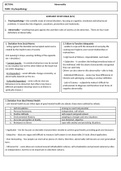
SUMMARY OF KEY IDEAS (K/U)
1. Psychopathology = the scientific study of mental disorders, focusing on cognitive, emotional and behavioural
problems. It researches into diagnosis, causations, preventions and treatments.
2. Abnormality = anything that goes against the unwritten rules of society can be abnormal… There are four main
definitions of abnormality.
1. Deviation from Social Norms 2. Failure to Function Adequately
- acting against the desirable and accepted social norms - unable to cope with the demands of everyday life
created by the implicit rules of society. causing poor hygiene, poor social relationships or
malnutrition.
(not queuing in shops, wearing clothing of the opposite
= High levels of Distress, Unpredictable, Lack Goals
sex = deviation.)
+ Subjective – it considers the feelings/emotional state of
+ Context Specific – it considers behaviour may be normal
the individual, with the above characteristics recognised
in one situation but not the other (bikini at the beach but
they can seek help
not while shopping.)
Others can also observe this abnormality = able to help.
- Era Dependent – social attitudes change constantly, so
- Individual Differences – some may have differences in
abnormality depends on the era
lifestyle and upbringing, creating an unclear definition
- Culturally Dependent – some cultures may see
- Lack of Science – subjectivity makes it difficult for
behaviours to be abnormal, but others may have a
professionals to diagnose and therefore treat forms of
different perception (hearing voices is an illness vs
negative abnormality.
spiritually chosen.)
3. Deviation from Ideal Mental Health
- Low mental health occurs when signs of good mental health are absent, these were outlined by Jahoda.
1. Self Actualistion striving to reach full potential
2. Personal Autonomy independent, self-reliant
3. Positive Attitude self-respect and good esteem
4. Environmental Mastery adapting to changes and new situations
5. Accurate perception of Reality non distorted, objective
6. Resistance to Stress cope with anxiety and provoking situations.
+ Applicable – the list focuses on desirable characteristics needed to achieve good health, providing goals and measures.
- Subjective – ideas are vague and difficult to measure (self esteem is not observable.) It lacks clinical application.
- Over Demanding – few people can meet all six pieces of criteria; therefore, abnormality will become an over-generalised
term.
- Ethnocentric – some ideas are revolved around individualistic cultures, self-actualisation and personal autonomy relies
on independence, but this is not important in collectivist cultures.
TOPIC: Psychopathology
SUMMARY OF KEY IDEAS (K/U)
1. Psychopathology = the scientific study of mental disorders, focusing on cognitive, emotional and behavioural
problems. It researches into diagnosis, causations, preventions and treatments.
2. Abnormality = anything that goes against the unwritten rules of society can be abnormal… There are four main
definitions of abnormality.
1. Deviation from Social Norms 2. Failure to Function Adequately
- acting against the desirable and accepted social norms - unable to cope with the demands of everyday life
created by the implicit rules of society. causing poor hygiene, poor social relationships or
malnutrition.
(not queuing in shops, wearing clothing of the opposite
= High levels of Distress, Unpredictable, Lack Goals
sex = deviation.)
+ Subjective – it considers the feelings/emotional state of
+ Context Specific – it considers behaviour may be normal
the individual, with the above characteristics recognised
in one situation but not the other (bikini at the beach but
they can seek help
not while shopping.)
Others can also observe this abnormality = able to help.
- Era Dependent – social attitudes change constantly, so
- Individual Differences – some may have differences in
abnormality depends on the era
lifestyle and upbringing, creating an unclear definition
- Culturally Dependent – some cultures may see
- Lack of Science – subjectivity makes it difficult for
behaviours to be abnormal, but others may have a
professionals to diagnose and therefore treat forms of
different perception (hearing voices is an illness vs
negative abnormality.
spiritually chosen.)
3. Deviation from Ideal Mental Health
- Low mental health occurs when signs of good mental health are absent, these were outlined by Jahoda.
1. Self Actualistion striving to reach full potential
2. Personal Autonomy independent, self-reliant
3. Positive Attitude self-respect and good esteem
4. Environmental Mastery adapting to changes and new situations
5. Accurate perception of Reality non distorted, objective
6. Resistance to Stress cope with anxiety and provoking situations.
+ Applicable – the list focuses on desirable characteristics needed to achieve good health, providing goals and measures.
- Subjective – ideas are vague and difficult to measure (self esteem is not observable.) It lacks clinical application.
- Over Demanding – few people can meet all six pieces of criteria; therefore, abnormality will become an over-generalised
term.
- Ethnocentric – some ideas are revolved around individualistic cultures, self-actualisation and personal autonomy relies
on independence, but this is not important in collectivist cultures.