Distinction
Protein Biosynthesis
When making a protein there are two main major processes involved. The first process within the two overall
within the gene expression is known as transcription. This involves the formation of messenger RNA (mRNA)
through the copying of the gene’s DNA sequence as they are rewritten. The second stage (process) is known as
translation this involves the translation of a genetic code, through decoding a mRNA and uses its information
to create a polypeptide amino acid chain (translating a genetic code).
There Is some DNA in the body which doesn’t exit the nucleus. Its primary function is to act as a blueprint or a
template for mRNA production. The template or blueprint can transport the instructions from the nucleus to
the cytoplasm. The cytoplasm is where protein synthesis is carried out. Protein synthesis is a biological
function where individual cells build a formation of specific proteins. Assembled proteins and a suitable
surface area for mRNA attachment is due to the ions within ribosomes. Transcription and translation usually
occurs in 3 steps; initiation, elongation, and termination.
Transcription
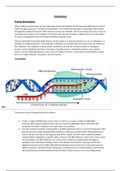
Transcription occurs in steps these are as follows;
1. Firstly, a region of DNA known as the cistron. A cistron is a certain section of a DNA/RNA
molecule within protein synthesis that codes for a specific polypeptide and Is used within the
production for mRNA. Initiation is the beginning of transcription.
2. The main enzyme involved in transcription is an RNA polymerase and it is crucial for the process. RNA
polymerase uses a single-stranded DNA template to synthesize a strand of RNA. RNA polymerase is
used to connect the start of the sequence that will be copied. The DNA which is double stranded
unwinds before unzipping in a specific region, known as the DNA Helicase, ready in the correct region
for transcription. The DNA Helicase is an enzyme that functions by catalysing the breakage of
hydrogen bonds that keep the DNA present in the double helix structure. Hydrogen bonds hold
together base pairs in the middle, DNA without hydrogen bonds would have to be constructed of a
different structure. Only one strand of DNA acts as template where matching mRNA can be formed,
this strand is known as the template strand, the other strand is known as the non-coding strand.
Protein Biosynthesis
When making a protein there are two main major processes involved. The first process within the two overall
within the gene expression is known as transcription. This involves the formation of messenger RNA (mRNA)
through the copying of the gene’s DNA sequence as they are rewritten. The second stage (process) is known as
translation this involves the translation of a genetic code, through decoding a mRNA and uses its information
to create a polypeptide amino acid chain (translating a genetic code).
There Is some DNA in the body which doesn’t exit the nucleus. Its primary function is to act as a blueprint or a
template for mRNA production. The template or blueprint can transport the instructions from the nucleus to
the cytoplasm. The cytoplasm is where protein synthesis is carried out. Protein synthesis is a biological
function where individual cells build a formation of specific proteins. Assembled proteins and a suitable
surface area for mRNA attachment is due to the ions within ribosomes. Transcription and translation usually
occurs in 3 steps; initiation, elongation, and termination.
Transcription
Transcription occurs in steps these are as follows;
1. Firstly, a region of DNA known as the cistron. A cistron is a certain section of a DNA/RNA
molecule within protein synthesis that codes for a specific polypeptide and Is used within the
production for mRNA. Initiation is the beginning of transcription.
2. The main enzyme involved in transcription is an RNA polymerase and it is crucial for the process. RNA
polymerase uses a single-stranded DNA template to synthesize a strand of RNA. RNA polymerase is
used to connect the start of the sequence that will be copied. The DNA which is double stranded
unwinds before unzipping in a specific region, known as the DNA Helicase, ready in the correct region
for transcription. The DNA Helicase is an enzyme that functions by catalysing the breakage of
hydrogen bonds that keep the DNA present in the double helix structure. Hydrogen bonds hold
together base pairs in the middle, DNA without hydrogen bonds would have to be constructed of a
different structure. Only one strand of DNA acts as template where matching mRNA can be formed,
this strand is known as the template strand, the other strand is known as the non-coding strand.