Economy
Sections 1,2,3,4,5, & 6
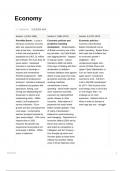
Section 1 (1951-1964) Section 2 (1964-1970) Section 3 (1970-1979)
Post-War Boom: - Lucky in Economic policies and Economic policies: -
timing as economic recovery problems including Currency went decimal -
after war experienced world- devaluation: - Modernisation Barber introduced cuts to
wide at the time - Acceleration of British economy one of the public spending - Barber Boom
in birth rate and growth of key priorities - By 1964 Britain with rapid rise of inflation but
population by 1961, 51 million was lagging behind - Trapped no economic growth =
ppl in Britain, 5% more than 10 in stop-go cycles - Labour stagflation - 1971
years earlier - Sustained inherited a £800 mil deficit - Uneployment edged 1mil -
increase in overseas trade - Only ways of dealing with this= rescue of Rolls Royce and
high levels of earnings in devaluation or deflation Upper Clyde Shipbuilders U-
exports and investments - however deflation went against Turn as ‘lame ducks’ once
Plentiful employment - 1955 desire to step away from stop- again saved - Investment
estimated full employment go policies and stop Lab from seemed to work - Fall from
achieved - Numbers employed meeting manifesto 1mil to 500,000 unemployed
in traditional occupations like commitments of extra by 1973 - Buil oil price crisis
agriculture, fishing, coal spending - Deval make imports and energy crisis in 1973 due
mining and shipbuilding fell - more expensive and help to Yom Kippur War = oil
Expansion in electric and exporters by making British embargo oil x4 more
engineering posts - 1960s goods cheaper in other expensive - National Union of
nearly 5 mil employed in countries - help balance of Miner’s strike to demand a
service industries - Econ payments but would make new huge pay rise - struggle
growth and low unemployment Britain weaker globally - Fear
rose wage - Conservative of ‘party of devaluation’ -
election prospect boosted by Believed in careful planning
‘give away budget’ - 29% more and managing - Department of
imports than in 1951 - economic affairs (DEA) set by
However the growth was Brown but came to nothing
experienced everywhere not and acted as competition to
exclusively in Britain - 1950s Callaghan and the Treasury -
years of optimism Gov brought up prices and
incomes policy to keep down
inflation but another selling
crisis in 66 by National Union
Economy 1
, Section 1 (1951-1964) Section 2 (1964-1970) Section 3 (1970-1979)
of Seamen - cause shock due
to Wilson’s critical attitude
towards the Trade Unions -
Survided 65-66 sterling crisis -
Dock strikes in 67 after war in
Middle East - Val of £ drop by
14% - EEC rejection another
punch in the gut - BY 70s
inflation 12% - 69 balance of
payments surplus by Jenkins
Economy 2
Sections 1,2,3,4,5, & 6
Section 1 (1951-1964) Section 2 (1964-1970) Section 3 (1970-1979)
Post-War Boom: - Lucky in Economic policies and Economic policies: -
timing as economic recovery problems including Currency went decimal -
after war experienced world- devaluation: - Modernisation Barber introduced cuts to
wide at the time - Acceleration of British economy one of the public spending - Barber Boom
in birth rate and growth of key priorities - By 1964 Britain with rapid rise of inflation but
population by 1961, 51 million was lagging behind - Trapped no economic growth =
ppl in Britain, 5% more than 10 in stop-go cycles - Labour stagflation - 1971
years earlier - Sustained inherited a £800 mil deficit - Uneployment edged 1mil -
increase in overseas trade - Only ways of dealing with this= rescue of Rolls Royce and
high levels of earnings in devaluation or deflation Upper Clyde Shipbuilders U-
exports and investments - however deflation went against Turn as ‘lame ducks’ once
Plentiful employment - 1955 desire to step away from stop- again saved - Investment
estimated full employment go policies and stop Lab from seemed to work - Fall from
achieved - Numbers employed meeting manifesto 1mil to 500,000 unemployed
in traditional occupations like commitments of extra by 1973 - Buil oil price crisis
agriculture, fishing, coal spending - Deval make imports and energy crisis in 1973 due
mining and shipbuilding fell - more expensive and help to Yom Kippur War = oil
Expansion in electric and exporters by making British embargo oil x4 more
engineering posts - 1960s goods cheaper in other expensive - National Union of
nearly 5 mil employed in countries - help balance of Miner’s strike to demand a
service industries - Econ payments but would make new huge pay rise - struggle
growth and low unemployment Britain weaker globally - Fear
rose wage - Conservative of ‘party of devaluation’ -
election prospect boosted by Believed in careful planning
‘give away budget’ - 29% more and managing - Department of
imports than in 1951 - economic affairs (DEA) set by
However the growth was Brown but came to nothing
experienced everywhere not and acted as competition to
exclusively in Britain - 1950s Callaghan and the Treasury -
years of optimism Gov brought up prices and
incomes policy to keep down
inflation but another selling
crisis in 66 by National Union
Economy 1
, Section 1 (1951-1964) Section 2 (1964-1970) Section 3 (1970-1979)
of Seamen - cause shock due
to Wilson’s critical attitude
towards the Trade Unions -
Survided 65-66 sterling crisis -
Dock strikes in 67 after war in
Middle East - Val of £ drop by
14% - EEC rejection another
punch in the gut - BY 70s
inflation 12% - 69 balance of
payments surplus by Jenkins
Economy 2