
Task 1- Telescopes and light
Describe 3 types of telescopes
Galileoscope
The part of the Ultraviolet telescope= Wavelength 10nm-400nm
electromagnetic Visible spectrum telescopes= Wavelength 400nm-700nm
spectrum range Infrared telescope=Wavelength 700nm-1mm
covered Far red telescope= Wavelength 30um-450um
This type of telescope is a long wavelength telescope.
Principles of This telescope has 2 convex positive lenses,
operation which are the objective lens and the eyepiece
lens.
2-inch in diameters
25 to 50 power telescope
Mode of operation A galileo telescope is a type of refracting telescope, therefore uses the lenses to
refract and focus light. For it to operate, a star from a distance will send parallel
light into the galileoscope. The eyepiece lens focal point has to be at the position
of the star. The light rays will be parallel when exiting the eyepiece lens.
Whereas, the objective lens makes the image of the star at the focal point, where
the eyepiece lens is facing.
Location of operation The galileoscope is used on earth, so that you can view into outer space from
(space based versus the earth.
earth based)
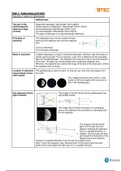
This image shows the moon at 50x, a star
cluster at 25x and Jupiter with its moons at
50x in the Galileoscope.
Ray diagrams (where This image to the left shows that the galileoscope has
light involved) high quality lenses.
The image above shows that there is a converging
lens as the objective lens and there is a diverging lens
for the eyepiece.
The image to the left shows
light from the star from the
distance entering the objective
lens in a parallel direction. In
addition, the focal rays will then
go through the focal point of the
objective lens and therefore
emerge in a parallel direction to go through the eyepiece lens.
Next, it exits the eyepiece. Also, because both of the lenses have the focal
points at the same place the light rays exi in a parallel direction.
Describe 3 types of telescopes
Galileoscope
The part of the Ultraviolet telescope= Wavelength 10nm-400nm
electromagnetic Visible spectrum telescopes= Wavelength 400nm-700nm
spectrum range Infrared telescope=Wavelength 700nm-1mm
covered Far red telescope= Wavelength 30um-450um
This type of telescope is a long wavelength telescope.
Principles of This telescope has 2 convex positive lenses,
operation which are the objective lens and the eyepiece
lens.
2-inch in diameters
25 to 50 power telescope
Mode of operation A galileo telescope is a type of refracting telescope, therefore uses the lenses to
refract and focus light. For it to operate, a star from a distance will send parallel
light into the galileoscope. The eyepiece lens focal point has to be at the position
of the star. The light rays will be parallel when exiting the eyepiece lens.
Whereas, the objective lens makes the image of the star at the focal point, where
the eyepiece lens is facing.
Location of operation The galileoscope is used on earth, so that you can view into outer space from
(space based versus the earth.
earth based)
This image shows the moon at 50x, a star
cluster at 25x and Jupiter with its moons at
50x in the Galileoscope.
Ray diagrams (where This image to the left shows that the galileoscope has
light involved) high quality lenses.
The image above shows that there is a converging
lens as the objective lens and there is a diverging lens
for the eyepiece.
The image to the left shows
light from the star from the
distance entering the objective
lens in a parallel direction. In
addition, the focal rays will then
go through the focal point of the
objective lens and therefore
emerge in a parallel direction to go through the eyepiece lens.
Next, it exits the eyepiece. Also, because both of the lenses have the focal
points at the same place the light rays exi in a parallel direction.





