Williams et al:
Aim:
- To investigate whether imagery based cognitive bias modification
(CBM) can have a positive impact on iCBT outcomes
Procedure:
- 69 ps from Australia
- Screened and interviewed over the phone (online applications)
- Split into treatment group (38) or a control group (31)-
randomised
- Baseline measures were taken for each group:
Primary- Becks depression inventory (BDI-II), patient health
questionnaire depression scale (PHQ-9)
Secondary: WHO disability assessment
- Treatment group- once a day for a week; 20 min sessions of CBM
followed by a 10-week iCBT programme (6 lessons online &
homework)
- At the end of the 11 weeks, took all baseline measure tests again
to test effectiveness of the treatment
Results:
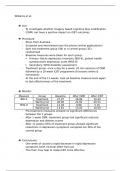
Measure Group Baseline After CBM After iCBT
BDI-II Treatment 27.97 18.96 10.40
Waiting list 28.00 24.82 20.54
PHQ-9 Treatment 12.38 9.88 5.15
Waiting list 13.81 13.03 10.59
- Pre-treatment measures showed no significant differences
between the 2 groups
- After 1 week CBM: treatment group had significant reduced
depression and distress scores
- After 11 weeks: 65% of treatment group showed significant
reductions in depression symptoms compared too 36% of the
control group
Conclusions:
- One week of caused a rapid decrease in rapid depression
symptoms (with minimal effort from ps)
- This then may help to make iCBT more effective
Aim:
- To investigate whether imagery based cognitive bias modification
(CBM) can have a positive impact on iCBT outcomes
Procedure:
- 69 ps from Australia
- Screened and interviewed over the phone (online applications)
- Split into treatment group (38) or a control group (31)-
randomised
- Baseline measures were taken for each group:
Primary- Becks depression inventory (BDI-II), patient health
questionnaire depression scale (PHQ-9)
Secondary: WHO disability assessment
- Treatment group- once a day for a week; 20 min sessions of CBM
followed by a 10-week iCBT programme (6 lessons online &
homework)
- At the end of the 11 weeks, took all baseline measure tests again
to test effectiveness of the treatment
Results:
Measure Group Baseline After CBM After iCBT
BDI-II Treatment 27.97 18.96 10.40
Waiting list 28.00 24.82 20.54
PHQ-9 Treatment 12.38 9.88 5.15
Waiting list 13.81 13.03 10.59
- Pre-treatment measures showed no significant differences
between the 2 groups
- After 1 week CBM: treatment group had significant reduced
depression and distress scores
- After 11 weeks: 65% of treatment group showed significant
reductions in depression symptoms compared too 36% of the
control group
Conclusions:
- One week of caused a rapid decrease in rapid depression
symptoms (with minimal effort from ps)
- This then may help to make iCBT more effective