

Unit 9 assignment 2
Homeostasis
Homeostasis is the maintenance of constant internal conditions in the body so that enzymes
control metabolism effectively. The body has internal and external factors in order to function
properly. Internal factors include water levels, blood glucose concentration and body
temperature and external factors include temperature, salt levels and water, all these factors
need to be maintained for a constant internal environment. We need to maintain a constant
internal environment because we will only be able to function if the internal conditions are
kept within a certain range. Enzymes are one of the most important factors to regulation.
Enzymes are proteins that speed up important chemical reactions in the human body. They
will only function properly under a small range of specific conditions such as body
temperature which is around 37–37.8°C and pH which is around 7. If any conditions are
above or below the specific range, the shape of the active site will change and the enzymes
will not be able to properly function which is why the body must acknowledge changes in the
internal and external conditions. At higher temperatures, the enzyme can denature which is
why they need to maintain an optimum temperature. The inactivity of the enzymes could
cause death. Enzymes also help to break down food in the form of digestive enzymes which
allows the body to absorb the nutrients released so that the body can function.
Feedback systems
Feedback loop
● A feedback loop is the part of a system where some parts or all parts of a system’s
output is circled back many times and therefore used as an input for future functions.
The body has two types of feedback loops, negative and positive feedback.
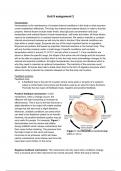
Positive feedback mechanism: In this
mechanism, when a change occurs, the
effectors will start functioning to increase its
effectiveness. This is due to the fact that even a
slight alteration in the output will create another
change that will also have a slight alteration.
Moreover, unstable conditions can arise which
can lead to the feedback system to be harmful.
However, the positive feedback system may be
very useful for people. For example, Figure 1
demonstrates how the uterine wall dilates
during childbirth which causes contractions that
then cause further straining. The pressure from
the baby’s head on the cervix will cause
hormones to be produces, which will make
uterine contractions more intense and force the
head down even further on the cervix
Negative feedback mechanism: This mechanism will only react when conditions change
from a set point and is then returned to the normal set point. When the body’s internal
,conditions change, the effectors adjust the condition to return it to its initial value, which is
how homeostasis occurs in the negative feedback loop. A negative feedback mechanism
has both a set point and an output. An output is a measurement that has to be controlled
such as blood pH, the usual level will then be the set point. After controlling the coordinator
and output, the sensory will compare the initial output to the predetermined point. The output
will finally come within the range of the set point as a result of this sending out an error
signal. The thermoregulation is another example of a negative feedback which can be seen
in figure 2. In thermoregulation, any changes to the fixed temperature away from the set
point (37–37.8°C) triggers the negative feedback loop to counteract that change, to return
the internal temperature back to the set point of 37–37.8°C.
Feedback components:
Set point
● A set point is the physical value that is the centre of change within the normal range.
A normal range is the small range of values that are stable and ideal for health. E.g
the body temperature has a set point of 37°C.
Receptors
● The receptor is the sensing component that monitors and responds to changes in the
environment. E.g sensory receptor, a nerve which sends signals to the central
nervous system when stimulated.
Coordinators
● A coordinator creates a suitable response to a stimulus. E.g the brain and spinal cord
both receive information and process it.
Effectors
● An effector is any tissue or organ that works to preserve homeostasis by bringing
about the necessary modifications after receiving information from the integrating
centre. E.g the kidneys store water if blood pressure is too low.
Nervous and endocrine system
The nervous and endocrine system are the two most important systems in homeostasis.
Electrical impulse can transmit quick messages to the nervous system. On the other hand,
, hormones released by the glands will transmit more passive information via the bloodstream.
Since hormones are circulated throughout the body via blood, hormones will enable the
selection of several tissues. Endocrine glands are the ones that release hormones into the
bloodstream. Hormones also allow for several physiological changes particularly during
puberty. A hormone is transported in the blood until it reaches its target organ once it has
entered the bloodstream. Certain receptors attach to the membrane surface of the target
organs, the membrane will then alter as a result of the binding to the hormone. Figure 3 is a
diagram of the endocrine system for both males and females, the only difference is males
have testicles whereas women have ovaries.
What are endocrine and exocrine glands?
● Endocrine glands are those that have the ability to secrete substances straight into
the bloodstream. For instance, it is well known that the endocrine glands produce
hormones into the bloodstream. However, the secretions of exocrine glands are
moved from the gland to the surface via ducts. The salivary glands is an example of
this, as saliva is released into the mouth after eating.
Gland Location Secretion Mode of action
Thyroid gland The thyroid gland is The thyroid gland The mode of action
found at the base of secretes the of the thyroid gland
the neck hormone thyroxine is to regulate the
metabolic rate and
thermogenesis
Hypothalamus The hypothalamus The hypothalamus The mode of action
Homeostasis
Homeostasis is the maintenance of constant internal conditions in the body so that enzymes
control metabolism effectively. The body has internal and external factors in order to function
properly. Internal factors include water levels, blood glucose concentration and body
temperature and external factors include temperature, salt levels and water, all these factors
need to be maintained for a constant internal environment. We need to maintain a constant
internal environment because we will only be able to function if the internal conditions are
kept within a certain range. Enzymes are one of the most important factors to regulation.
Enzymes are proteins that speed up important chemical reactions in the human body. They
will only function properly under a small range of specific conditions such as body
temperature which is around 37–37.8°C and pH which is around 7. If any conditions are
above or below the specific range, the shape of the active site will change and the enzymes
will not be able to properly function which is why the body must acknowledge changes in the
internal and external conditions. At higher temperatures, the enzyme can denature which is
why they need to maintain an optimum temperature. The inactivity of the enzymes could
cause death. Enzymes also help to break down food in the form of digestive enzymes which
allows the body to absorb the nutrients released so that the body can function.
Feedback systems
Feedback loop
● A feedback loop is the part of a system where some parts or all parts of a system’s
output is circled back many times and therefore used as an input for future functions.
The body has two types of feedback loops, negative and positive feedback.
Positive feedback mechanism: In this
mechanism, when a change occurs, the
effectors will start functioning to increase its
effectiveness. This is due to the fact that even a
slight alteration in the output will create another
change that will also have a slight alteration.
Moreover, unstable conditions can arise which
can lead to the feedback system to be harmful.
However, the positive feedback system may be
very useful for people. For example, Figure 1
demonstrates how the uterine wall dilates
during childbirth which causes contractions that
then cause further straining. The pressure from
the baby’s head on the cervix will cause
hormones to be produces, which will make
uterine contractions more intense and force the
head down even further on the cervix
Negative feedback mechanism: This mechanism will only react when conditions change
from a set point and is then returned to the normal set point. When the body’s internal
,conditions change, the effectors adjust the condition to return it to its initial value, which is
how homeostasis occurs in the negative feedback loop. A negative feedback mechanism
has both a set point and an output. An output is a measurement that has to be controlled
such as blood pH, the usual level will then be the set point. After controlling the coordinator
and output, the sensory will compare the initial output to the predetermined point. The output
will finally come within the range of the set point as a result of this sending out an error
signal. The thermoregulation is another example of a negative feedback which can be seen
in figure 2. In thermoregulation, any changes to the fixed temperature away from the set
point (37–37.8°C) triggers the negative feedback loop to counteract that change, to return
the internal temperature back to the set point of 37–37.8°C.
Feedback components:
Set point
● A set point is the physical value that is the centre of change within the normal range.
A normal range is the small range of values that are stable and ideal for health. E.g
the body temperature has a set point of 37°C.
Receptors
● The receptor is the sensing component that monitors and responds to changes in the
environment. E.g sensory receptor, a nerve which sends signals to the central
nervous system when stimulated.
Coordinators
● A coordinator creates a suitable response to a stimulus. E.g the brain and spinal cord
both receive information and process it.
Effectors
● An effector is any tissue or organ that works to preserve homeostasis by bringing
about the necessary modifications after receiving information from the integrating
centre. E.g the kidneys store water if blood pressure is too low.
Nervous and endocrine system
The nervous and endocrine system are the two most important systems in homeostasis.
Electrical impulse can transmit quick messages to the nervous system. On the other hand,
, hormones released by the glands will transmit more passive information via the bloodstream.
Since hormones are circulated throughout the body via blood, hormones will enable the
selection of several tissues. Endocrine glands are the ones that release hormones into the
bloodstream. Hormones also allow for several physiological changes particularly during
puberty. A hormone is transported in the blood until it reaches its target organ once it has
entered the bloodstream. Certain receptors attach to the membrane surface of the target
organs, the membrane will then alter as a result of the binding to the hormone. Figure 3 is a
diagram of the endocrine system for both males and females, the only difference is males
have testicles whereas women have ovaries.
What are endocrine and exocrine glands?
● Endocrine glands are those that have the ability to secrete substances straight into
the bloodstream. For instance, it is well known that the endocrine glands produce
hormones into the bloodstream. However, the secretions of exocrine glands are
moved from the gland to the surface via ducts. The salivary glands is an example of
this, as saliva is released into the mouth after eating.
Gland Location Secretion Mode of action
Thyroid gland The thyroid gland is The thyroid gland The mode of action
found at the base of secretes the of the thyroid gland
the neck hormone thyroxine is to regulate the
metabolic rate and
thermogenesis
Hypothalamus The hypothalamus The hypothalamus The mode of action


