

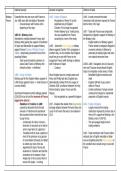
National security Dynastic recognition Defence of trade
Brittany / Extended the one-year truce with France to 1492 - Treaty of Etaples 1486 - A treaty removed the trade
France Jan 1489 soon after the Battle of Bosworth - Recognition of Henry VII as the restrictions that had been imposed by France
- Ensured peace with France at the legitimate king of England before Henry VII’s reign
beginning of his reign - Charles VIII no longer recognised
Perkin Warbeck as a Yorkist prince, 1487 - Trade with France was temporarily
1487-92 - Brittany crisis who was expelled from France disrupted by England’s support for Brittany in
Attempted to mediate between France and according to a term of the treaty the Brittany crisis
Brittany while gaining the support of Ferdinand - English defence of Brittany against
of Spain and Maximilian to support Brittany 1496 - Joined the Holy League, a military France aimed to safeguard England’s
against France (Treaty of Medina Campo alliance against Charles VIII’s campaigns in economic interests in Brittany by
1489) -> temporarily prevented France from northern Italy, on the condition that England protecting its trading rights and claim
acquiring Brittany would not go to war with France to not over natural resources there
- Sent several hundred volunteers to antagonise France while forming an alliance
assist Duke Francis of Brittany who with Ferdinand of Spain 1485 & 1489 - Navigation Acts on Gascony
refused to listen -> ineffective - Cautious wine and Toulouse woad allowed English
ships to monopolise certain areas of trade
1489 - Treaty of Redon Since England was not a major power and - Benefited English merchants and
Brittany paid for the English military support of Arthur and Philip had died, England was trade
6,000 troops against France -> small chance of diplomatically isolated from the League of - England still had to pay custom
success initially Cambrai 1508, an alliance between the Holy duties to France.
Roman Empire, Spain, France and the - Limited usefulness: foreign vessels
Summoned Parliament which willingly granted Papacy continued to transport a substantial
£100,000 in tax to fund the invasion of France - Not recognised as a powerful kingdom proportion of English exports.
(aggressive stance)
- Rebellion in Yorkshire in 1489 1507 - Finalised the details of the Successful 1492 - Treaty of Etaples
caused by discontent from the bad marriage alliance between Princess Mary and - Largely removed the trading
harvest in Yorkshire and resentment Louis XII of France that was to be realised in restrictions imposed by France due to
that counties further north did not have 1514 Henry VII’s support for Brittany in the
to pay the tax Brittany crisis of 1487-92.
- A distraction for Henry VII and a - This encouraged Anglo-French
diversion of resources as he had to trading relations.
send a royal army to suppress it.
- Travelled north to issue a pardon to 1495 - Trade restrictions with France further
most of the prisoners as a gesture reduced due to English neutrality in Italian
of reconciliation (shrewd), but failed wars as England joined the Holy League on
to collect any more of the tax the condition that it would not go to war with
- Appointed the Earl of Surrey his France
lieutenant in Yorkshire and had the
restoration of his estates in East
Anglia rely on his success there to
ensure his loyalty -> cunning
, Military intervention was too small and failed as
Maximilian lost interest in sending an army and
Ferdinand’s promise of a small army of 2,000
from the Treaty of Medina del Campo 1489
arrived to late in 1490
Charles VIII acquired Brittany through his
marriage to Anne of Brittany -> futile efforts
French support of the Yorkist pretender,
Perkin Warbeck from 1491 created the
potential for a French sponsored invasion to
overthrow Henry VII, much like how Henry
defeated Richard III at the Battle of Bosworth in
1485 with French support
1492 - Offensive foreign policy in invasion
of France
- Successfully raised taxation through
Parliament without rebellion
- Cunning planning
- Deliberately timed it late in the
campaigning season
- Spying network: obtained the
knowledge that Charles VIII was
determined to invade Italy ->
besieged Boulogne, forcing
Charles VIII to be quick to agree to
the Treaty of Etaples 1492 ->
promised long-lasting peace & a
pension of £5,000 a year
-> benefited economically and
diplomatically
- Strategic, calculated and flexible
approach was a testament to Henry
VII’s skill in foreign policy which helped
him secure peace with and re-establish
himself against France
Defended national and dynastic interests
Brittany / Extended the one-year truce with France to 1492 - Treaty of Etaples 1486 - A treaty removed the trade
France Jan 1489 soon after the Battle of Bosworth - Recognition of Henry VII as the restrictions that had been imposed by France
- Ensured peace with France at the legitimate king of England before Henry VII’s reign
beginning of his reign - Charles VIII no longer recognised
Perkin Warbeck as a Yorkist prince, 1487 - Trade with France was temporarily
1487-92 - Brittany crisis who was expelled from France disrupted by England’s support for Brittany in
Attempted to mediate between France and according to a term of the treaty the Brittany crisis
Brittany while gaining the support of Ferdinand - English defence of Brittany against
of Spain and Maximilian to support Brittany 1496 - Joined the Holy League, a military France aimed to safeguard England’s
against France (Treaty of Medina Campo alliance against Charles VIII’s campaigns in economic interests in Brittany by
1489) -> temporarily prevented France from northern Italy, on the condition that England protecting its trading rights and claim
acquiring Brittany would not go to war with France to not over natural resources there
- Sent several hundred volunteers to antagonise France while forming an alliance
assist Duke Francis of Brittany who with Ferdinand of Spain 1485 & 1489 - Navigation Acts on Gascony
refused to listen -> ineffective - Cautious wine and Toulouse woad allowed English
ships to monopolise certain areas of trade
1489 - Treaty of Redon Since England was not a major power and - Benefited English merchants and
Brittany paid for the English military support of Arthur and Philip had died, England was trade
6,000 troops against France -> small chance of diplomatically isolated from the League of - England still had to pay custom
success initially Cambrai 1508, an alliance between the Holy duties to France.
Roman Empire, Spain, France and the - Limited usefulness: foreign vessels
Summoned Parliament which willingly granted Papacy continued to transport a substantial
£100,000 in tax to fund the invasion of France - Not recognised as a powerful kingdom proportion of English exports.
(aggressive stance)
- Rebellion in Yorkshire in 1489 1507 - Finalised the details of the Successful 1492 - Treaty of Etaples
caused by discontent from the bad marriage alliance between Princess Mary and - Largely removed the trading
harvest in Yorkshire and resentment Louis XII of France that was to be realised in restrictions imposed by France due to
that counties further north did not have 1514 Henry VII’s support for Brittany in the
to pay the tax Brittany crisis of 1487-92.
- A distraction for Henry VII and a - This encouraged Anglo-French
diversion of resources as he had to trading relations.
send a royal army to suppress it.
- Travelled north to issue a pardon to 1495 - Trade restrictions with France further
most of the prisoners as a gesture reduced due to English neutrality in Italian
of reconciliation (shrewd), but failed wars as England joined the Holy League on
to collect any more of the tax the condition that it would not go to war with
- Appointed the Earl of Surrey his France
lieutenant in Yorkshire and had the
restoration of his estates in East
Anglia rely on his success there to
ensure his loyalty -> cunning
, Military intervention was too small and failed as
Maximilian lost interest in sending an army and
Ferdinand’s promise of a small army of 2,000
from the Treaty of Medina del Campo 1489
arrived to late in 1490
Charles VIII acquired Brittany through his
marriage to Anne of Brittany -> futile efforts
French support of the Yorkist pretender,
Perkin Warbeck from 1491 created the
potential for a French sponsored invasion to
overthrow Henry VII, much like how Henry
defeated Richard III at the Battle of Bosworth in
1485 with French support
1492 - Offensive foreign policy in invasion
of France
- Successfully raised taxation through
Parliament without rebellion
- Cunning planning
- Deliberately timed it late in the
campaigning season
- Spying network: obtained the
knowledge that Charles VIII was
determined to invade Italy ->
besieged Boulogne, forcing
Charles VIII to be quick to agree to
the Treaty of Etaples 1492 ->
promised long-lasting peace & a
pension of £5,000 a year
-> benefited economically and
diplomatically
- Strategic, calculated and flexible
approach was a testament to Henry
VII’s skill in foreign policy which helped
him secure peace with and re-establish
himself against France
Defended national and dynastic interests


