
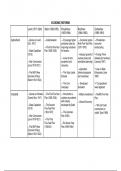
ECONOMIC REFORMS
Lenin (1917-1924) Stalin (1928-1953) hrushchev
K rezhnev
B orbachev
G
(1953-1964) (1964-1982) (1985-1991)
Agricultural Decree on Land
→ →Collectivisation Encourage higher
→ Consumer goods - →
→ 'Perestroika’ -
(Oct. 1917) production rates by Ninth Five-Year Plan economic
→The First Five-Year improving incentives (1971-1975) restructuring
State Capitalism
→ Plan (1928-1932) for farmers.
(1918) Industry (growth of
→ ↳
Foreign Firms
Invest in farm
→ nuclear power and allowed joint ventures
War Communism
→ equipment and centralized planning) (January 1987)
(June 1918-1921) resources
Agriculture
→ ↳
Law on State
The NEP (New
→ The Virgin Lands
→ (internal passports Enterprises (June
Economic Policy) Scheme and incentives) 1987)
(March 1921-1924)
The Corn
→ Developed
→ ↳
”Co-operatives”
Campaign Socialism were legalized
Industrial Decree on Workers →
→ The First Five-Year →
Khrushchev’s Military Investment
→ Twelfth Five-Year
→
Control (Nov. 1917) Plan (1928-1932) solutions to problems Plan
with industry →Second Economy
→State Capitalism →The Second developed by Stalin ”We can’t build
→
(1918) Five-Year Plan communism on
(1933-1937) → The Liberman vodka” (April 1985)
→War Communism Plan (1962)
(June 1918-1921) →The Third
Five-Year Plan →The Seven-Year
→The NEP (New (1938-42) Plan (1959-1965)
Economic Policy)
(March 1921-1924)
, PROBLEMS AND BENEFITS WITH LENIN’S ECONOMIC POLICIES
Reasons for Lenin’s Economic Policies
Increase Bolshevik Support (especially among peasants)
→
→Spred Socialism and the socialist ideology
→Remove Bourgeoisie Oppression & the Capitalist economy
→ Better poor productivity
→ Increase state control
Benefits Problems
Workers Control (1917) Ideological (Redistribution of wealth - socialist)
→ Incompatible with industrial efficiency and
→
Initial decrees - Decree on Land and Decree
→ → Gained Peasant/Workers Control productivity.
on Workers Control → Threat to Bolshevik Control
→ Ideological, socialist redistribution of wealth → Lack of expertise and technical skills
→ Gained peasant/workers support → Free for all when seizing land and commodities
(violent process)
→ Not enough income for the state
State Capitalism (1918) Temporary measures to improve stability and
→ Opposed by some in the party
→
Abolish the decrees
→ production → Needed control in party hands to ensure
→ Vesenkha created to supervise the economy → Used the skills of former owners/managers of supplies went to the Bolshevik war effort.
→ Larger industries and private. Banks industry
nationalised
War Communism (1918-1921) → Ensured a supply for the Red Army Very unpopular - requisitioning led to revolts
→
Increase state control
→ and uprisings in the country
→ Grain requisitioning → Not efficient as no incentive for production
NEP (1921-1924) Improved Production
→ Initial scissor crisis
→
Adress issues of food shortages and famine
→ → Quietened some discontent in the country → Unpopular with many in the party for its failure
→ SEE NOTES → Peasants could sell the surplus for a profit to follow communist ideology
→ Growth of Nepmen


