

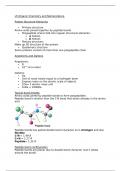
L5 Organic Chemistry and Nomenclature
Protein Structure Hierarchy
Primary structure
Amino acids joined together by peptide bonds
Polypeptide chains fold into regular structural elements:
o α helixes
o β helixes
Tertiary structure:
Make up 3D structure of the protein
Quaternary structure
Some proteins consist of more than one polypeptide chain
Angstroms and Daltons
Angstroms:
Å
10-10 of a meter
Daltons:
Da
Unit of mass nearly equal to a hydrogen atom
Express mass on the atomic scale of objects
1Da= 1 atomic mass unit
1kDa = 1000Da
Typical bond lengths
Amino acids joined by peptide bonds to form polypeptides
Peptide bond is shorter than the C-N bond that exists already in the amino
acid
Peptide bonds has patrial double bond character so is stronger and less
flexible
C-N = 1.49 Å
C=N = 1.27 Å
Peptide= 1.32 Å
Peptide bond configuration
Peptide bonds are planar due to double bond character (can’t rotate
around the bond)
, Two configurations=
Trans (α carbons opposite sides of peptide bond)
Cis (α carbons same side of peptide bond)
Almost all peptide bonds are trans
R groups are on opposite sides of chain to avoid steric clashes
Proline can be Cis
Amino acid residue bonds
Free rotation occurs around single bonds within a residue (amino acid
residues joined by peptide bond)
Structure of each amino acid can be adjusted
Phi= f angle of rotation between nitrogen and α C atom
Psi= y angle of rotation between carbonyl C atom and the α C atom
f And y angles determine path of the polypeptide chain
Gopalasamudram N. Ramachandran found many combinations of angles
can't form due to steric collisions between atoms
Can be visualised on a Ramachandran plot:
There is more variation in the y angles and less variation in the f angles
Rigidity of peptide bond and restricted set of allowed y And f angles
limits the number of structures accessible to the unfolded polypeptide
chain
Secondary structure
Protein Structure Hierarchy
Primary structure
Amino acids joined together by peptide bonds
Polypeptide chains fold into regular structural elements:
o α helixes
o β helixes
Tertiary structure:
Make up 3D structure of the protein
Quaternary structure
Some proteins consist of more than one polypeptide chain
Angstroms and Daltons
Angstroms:
Å
10-10 of a meter
Daltons:
Da
Unit of mass nearly equal to a hydrogen atom
Express mass on the atomic scale of objects
1Da= 1 atomic mass unit
1kDa = 1000Da
Typical bond lengths
Amino acids joined by peptide bonds to form polypeptides
Peptide bond is shorter than the C-N bond that exists already in the amino
acid
Peptide bonds has patrial double bond character so is stronger and less
flexible
C-N = 1.49 Å
C=N = 1.27 Å
Peptide= 1.32 Å
Peptide bond configuration
Peptide bonds are planar due to double bond character (can’t rotate
around the bond)
, Two configurations=
Trans (α carbons opposite sides of peptide bond)
Cis (α carbons same side of peptide bond)
Almost all peptide bonds are trans
R groups are on opposite sides of chain to avoid steric clashes
Proline can be Cis
Amino acid residue bonds
Free rotation occurs around single bonds within a residue (amino acid
residues joined by peptide bond)
Structure of each amino acid can be adjusted
Phi= f angle of rotation between nitrogen and α C atom
Psi= y angle of rotation between carbonyl C atom and the α C atom
f And y angles determine path of the polypeptide chain
Gopalasamudram N. Ramachandran found many combinations of angles
can't form due to steric collisions between atoms
Can be visualised on a Ramachandran plot:
There is more variation in the y angles and less variation in the f angles
Rigidity of peptide bond and restricted set of allowed y And f angles
limits the number of structures accessible to the unfolded polypeptide
chain
Secondary structure


