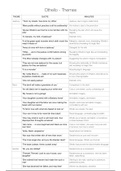
Othello - Themes
THEME QUOTE ANALYSIS
Jealousy ‘’Twixt my sheets ‘has done my office’ Jealousy due to Iago’s relationship
‘Mere prattle without practice is all his soldiership’ His motive is due to the promotion
‘Abuse Othello’s ear that he is too familiar with his Revealing his plan which will cause the
wife’ tragedy
‘O, beware, my lord, of jealousy!’ Dramatic irony
‘It is the green eyed monster which doth mock the Metaphor, dramatic irony, foreboding Othello’s
meat it feeds on’ downfall and revealing his tragic flaw
‘Away at once with love or jealousy’ Disregard for his wife
‘Trifles … are to the jealous confirmations strong Revealing Othello’s tragic flaw and foreboding
as proofs’ the tragedy
‘The Moor already changes with my poison’ Suggesting the extent of Iago’s manipulation
‘They are not ever jealous for the cause, but Showing the irrationality of Othello’s behaviour
jealous for they are jealous’ and revealing his tragic flaw
‘It is a monster’ Adopting Iago’s language
‘My noble Moor is … made of no such baseness Showing the extent of Othello’s downfall as he
as jealous creatures are’ is now unrecognisable
‘One not easily jealous’ Dramatic irony
Race ‘The devil will make a grandsire of you’ Comparison to the devil
‘An old black ram is tupping your white ewe’ Colour connotation, purity contrasting evil
‘My house is not a grange’ Animalistic imagery
‘Your daughter covered with a Barbary horse’ Animalistic imagery, domination
‘Your daughter and the Moor are now making the Graphic and brutal animalistic imagery,
beast with two backs’ connotations with evil
‘To fall in love with what she feared to look on’ Othello as a beast, the devil
‘Your son-in-law is far more fair than black’ Racial language, contrasting Iago’s beliefs
‘One may smell in such a will most rank, foul Othello as unnatural, animalistic connotations,
disproportion throughts unnatural’ contrast between them
‘Her name … is now begrimed and black as mine Colour connotation, she was once pure and
own face’ innocence, but now is ruined
‘Arise, black vengeance’ Supernatural connotations
‘Nor scar that whiter skin of hers than snow’ Desdemona as pure and innocent
‘The more angel she, and you the blacker devil!’ Racial language, Othello as inhuman
‘The base Judean, threw a pearl away’ Othello has proved the discriminative language
Gender ‘Sir, you are robbed’ Desdemona as a possession
‘Thieves! Thieves! Look to your house, your Desdemona as a possession, she has been
daughter’ taken, objectifying
‘She wished that heaven had made her such a Wanting to be male, wanting for adventure,
man’ patriarchal society
‘She has deceived her father, and may thee’ Women as deceptive, secretive
THEME QUOTE ANALYSIS
Jealousy ‘’Twixt my sheets ‘has done my office’ Jealousy due to Iago’s relationship
‘Mere prattle without practice is all his soldiership’ His motive is due to the promotion
‘Abuse Othello’s ear that he is too familiar with his Revealing his plan which will cause the
wife’ tragedy
‘O, beware, my lord, of jealousy!’ Dramatic irony
‘It is the green eyed monster which doth mock the Metaphor, dramatic irony, foreboding Othello’s
meat it feeds on’ downfall and revealing his tragic flaw
‘Away at once with love or jealousy’ Disregard for his wife
‘Trifles … are to the jealous confirmations strong Revealing Othello’s tragic flaw and foreboding
as proofs’ the tragedy
‘The Moor already changes with my poison’ Suggesting the extent of Iago’s manipulation
‘They are not ever jealous for the cause, but Showing the irrationality of Othello’s behaviour
jealous for they are jealous’ and revealing his tragic flaw
‘It is a monster’ Adopting Iago’s language
‘My noble Moor is … made of no such baseness Showing the extent of Othello’s downfall as he
as jealous creatures are’ is now unrecognisable
‘One not easily jealous’ Dramatic irony
Race ‘The devil will make a grandsire of you’ Comparison to the devil
‘An old black ram is tupping your white ewe’ Colour connotation, purity contrasting evil
‘My house is not a grange’ Animalistic imagery
‘Your daughter covered with a Barbary horse’ Animalistic imagery, domination
‘Your daughter and the Moor are now making the Graphic and brutal animalistic imagery,
beast with two backs’ connotations with evil
‘To fall in love with what she feared to look on’ Othello as a beast, the devil
‘Your son-in-law is far more fair than black’ Racial language, contrasting Iago’s beliefs
‘One may smell in such a will most rank, foul Othello as unnatural, animalistic connotations,
disproportion throughts unnatural’ contrast between them
‘Her name … is now begrimed and black as mine Colour connotation, she was once pure and
own face’ innocence, but now is ruined
‘Arise, black vengeance’ Supernatural connotations
‘Nor scar that whiter skin of hers than snow’ Desdemona as pure and innocent
‘The more angel she, and you the blacker devil!’ Racial language, Othello as inhuman
‘The base Judean, threw a pearl away’ Othello has proved the discriminative language
Gender ‘Sir, you are robbed’ Desdemona as a possession
‘Thieves! Thieves! Look to your house, your Desdemona as a possession, she has been
daughter’ taken, objectifying
‘She wished that heaven had made her such a Wanting to be male, wanting for adventure,
man’ patriarchal society
‘She has deceived her father, and may thee’ Women as deceptive, secretive