Topic 18: Organic Chemistry III
Topic 18A: Arenes - benzene
1. understand that the bonding in benzene has been represented using the
Kekulé and the delocalised model, the latter in terms of overlap of p-orbitals
to form π-bonds-bonds
Benzene
Arene: hydrocarbons with one or more rings that have delocalised electrons
Benzene: C6H6 (cyclic)
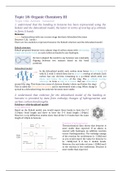
There are two models to represent benzene: the Kekulé structure and the delocalised model.
Kekulé structure
Kekulé proposed benzene was a planar ring of carbon atoms with alternating
single and double bonds so each carbon is bonded to one hydrogen.
He later adapted the model to say benzene was constantly
flipping between two isomers based on the bond
positions.
Delocalised model
In the delocalised model, each carbon atom forms three σ bonds bonds (1
with H, 2 with C) which form due to head-on overlap of orbitals. Each
carbon has one electron remaining in a p-orbital which stick out
above and below the plane of the ring. The p orbitals overlap
sideways to form a ring of π bonds bonds that are delocalised
around the ring. This forms two areas of electron density (above and below the ring).
This is called the delocalised π bonds system and is represented with a ring. When charge is
spread in a delocalised ring, the molecule becomes more stable.
2. understand that evidence for the delocalised model of the bonding in
benzene is provided by data from enthalpy changes of hydrogenation and
carbon-carbon bond lengths
Evidence of delocalised model
X-ray diffraction
Based on the Kekulé model, you would expect three bonds to have the C-C
(154pm) bond length and three to have the C=C bond length (134pm).
However, x-ray diffraction studies show that all the C-C bonds have the same
length of 140pm in benzene
Enthalpy of hydrogenation
Thermochemical data shows that benzene is
more stable than expected. If an alkene is
reacted with hydrogen, an addition reaction
occurs (hydrogenation). The enthalpy change
of the reaction for cyclohexene is -120kJ/mol
so you would expect the value for benzene to
be -360kJ/mol if it has 3 double bonds.
However, the real value is lower (-208kJ/mol)
so the reaction is less exothermic. Benzene is
more stable than expected.
Topic 18A: Arenes - benzene
1. understand that the bonding in benzene has been represented using the
Kekulé and the delocalised model, the latter in terms of overlap of p-orbitals
to form π-bonds-bonds
Benzene
Arene: hydrocarbons with one or more rings that have delocalised electrons
Benzene: C6H6 (cyclic)
There are two models to represent benzene: the Kekulé structure and the delocalised model.
Kekulé structure
Kekulé proposed benzene was a planar ring of carbon atoms with alternating
single and double bonds so each carbon is bonded to one hydrogen.
He later adapted the model to say benzene was constantly
flipping between two isomers based on the bond
positions.
Delocalised model
In the delocalised model, each carbon atom forms three σ bonds bonds (1
with H, 2 with C) which form due to head-on overlap of orbitals. Each
carbon has one electron remaining in a p-orbital which stick out
above and below the plane of the ring. The p orbitals overlap
sideways to form a ring of π bonds bonds that are delocalised
around the ring. This forms two areas of electron density (above and below the ring).
This is called the delocalised π bonds system and is represented with a ring. When charge is
spread in a delocalised ring, the molecule becomes more stable.
2. understand that evidence for the delocalised model of the bonding in
benzene is provided by data from enthalpy changes of hydrogenation and
carbon-carbon bond lengths
Evidence of delocalised model
X-ray diffraction
Based on the Kekulé model, you would expect three bonds to have the C-C
(154pm) bond length and three to have the C=C bond length (134pm).
However, x-ray diffraction studies show that all the C-C bonds have the same
length of 140pm in benzene
Enthalpy of hydrogenation
Thermochemical data shows that benzene is
more stable than expected. If an alkene is
reacted with hydrogen, an addition reaction
occurs (hydrogenation). The enthalpy change
of the reaction for cyclohexene is -120kJ/mol
so you would expect the value for benzene to
be -360kJ/mol if it has 3 double bonds.
However, the real value is lower (-208kJ/mol)
so the reaction is less exothermic. Benzene is
more stable than expected.