BBS3014 Immune responses in health and disease
Case 1: how it all starts
What are the different immune cells and their function?
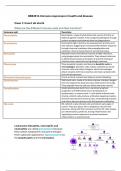
Immune cell Function
Neutrophils Neutrophils, a type of white blood cell, are the first line of
defense against invaders. They recognize pathogens through
surface receptors and destroy them via phagocytosis.
Eosinophils Eosinophils fight infections by releasing toxic proteins and
free radicals, triggering an increased inflammatory response
through chemical mediators like prostaglandins and
cytokines. They're mainly found in connective tissue.
Basophils Basophils store and release enzymes to fight infections,
using phagocytosis like neutrophils. They release histamine
to dilate blood vessels and heparin to prevent clotting at
infection sites, especially during allergic reactions.
Monocytes They recognize invaders and become dendritic cells or
macrophages. Dendritic cells release cytokines to recruit
immune cells and collect antigens, while macrophages
attack invaders with toxic enzymes and clean up dead cells
from the bloodstream.
Platelets/ thrombocytes Forms a clot at a wound and stops or prevent bleeding.
Erythrocytes Red blood cells, made in the bone marrow, transport oxygen
from the lungs to the body and carry CO2 back to the lungs.
They originate from the yolk sac before the bone marrow.
Lymphocytes Small lymphocytes stem from a common lymphoid
progenitor and differentiate into T-lymphocytes, B-
lymphocytes, or plasma cells. T-cells attack infected cells
directly, while B-cells produce antibodies targeting invaders.
Some B-cells become memory cells, remembering invaders,
and others become plasma cells that produce antibodies.
NK-cells NK cells kill virally infected cells and detect early signs of
cancer. They also play a role in pregnancy, found in the
placenta. Along with their cytotoxic activity, NK cells release
pro-inflammatory cytokines, driving inflammation and
regulating immune responses to prevent excessive
inflammation or autoimmunity.
Leukocytes: Basophils, eosinophils and
neutrophils are called granulocytes because
they contain cytoplasmic inclusions that give
them a granular appearance. Agranulocytes are
the lymphocytes and the monocytes.
,Innate and Adaptive Immunity
Defense against microbes is mediated by sequential and coordinated responses
that are called innate and adaptive immunity. Innate immunity (also called natural
immunity or native immunity) is essential for defending against microbes in the first few
hours or days after infection, before adaptive immune responses have developed.
Innate immunity is mediated by mechanisms that are in place even before an infection
occurs (hence innate) and are capable of reacting rapidly to invading microbes.
In contrast to innate immunity, there are other immune responses that are stimulated by
exposure to infectious agents and increase in magnitude and defensive capabilities with
each successive exposure to a particular microbe. Because this form of immunity
develops as a response to infection and thus adapts to the infection, it is called
adaptive immunity (also called specific immunity or acquired immunity). The adaptive
immune system recognizes and reacts to a large number of microbial and nonmicrobial
substances, called antigens. Although many pathogens have evolved to resist the
innate immune response, the stronger and more
specialized adaptive immune responses are capable
of eradicating many of these infections. There are also
numerous connections between innate and adaptive
immune responses. The innate immune response to
microbes provides early danger signals that stimulate
adaptive immune responses. Conversely, adaptive
immune responses often work by enhancing the
protective mechanisms of innate immunity, making
them more capable of effectively combating
microbes.
- Every individual’s immune system is able to recognize, respond to, and eliminate
many foreign (nonself) antigens but does not usually react against that
individual’s own (self) antigens and tissues.
Innate immunity
The innate immune system responds almost immediately to microbes and injured cells,
and repeated exposures induce virtually identical innate immune responses. The
receptors of innate immunity are specific for structures that are common to groups of
related microbes and do not distinguish fine differences among microbes. The principal
components of innate immunity are (1) physical and chemical barriers, such as epithelia
and antimicrobial chemicals produced at epithelial surfaces; (2) phagocytic cells
(neutrophils, macrophages), dendritic cells (DCs), mast cells, natural killer (NK cells),
and other innate lymphoid cells; and (3) blood proteins, including components of the
complement system and other mediators of inflammation. Many innate immune cells,
such as DCs, some macrophages, and mast cells, are tissue resident, and they function
as sentinels to keep watch for microbes that may invade the tissues. The innate immune
response combats microbes by two main strategies—by recruiting phagocytes and other
leukocytes that destroy the microbes, in the process called inflammation; and by
blocking viral replication or killing virus- infected cells by mechanisms distinct from
inflammatory reactions.
,Adaptive immunity
The adaptive immune response is mediated by cells called lymphocytes and their
products. Lymphocytes express highly diverse receptors that are capable of recognizing
a vast number of antigens. There are two major populations of lymphocytes, called B
lymphocytes and T lymphocytes, which mediate different types of adaptive immune
responses. We will first summarize the important properties of the adaptive immune
system and then describe the different types of adaptive immune responses. The
fundamental properties of the adaptive immune system reflect the properties of the
lymphocytes that mediate these responses include: specificity and diversity, memory,
non-reactivity to self (self-tolerance).
Two types of adaptive immunity: Humoral and Cell-mediated immunity
There are two types of adaptive immunity, called humoral
immunity and cell-mediated immunity, which are
mediated by different types of lymphocytes and function
to eliminate different types of microbes
- Humoral immunity is mediated by molecules in
the blood and mucosal secretions, called
antibodies, which are produced by B
lymphocytes. Antibodies recognize microbial
antigens, neutralize the infectivity of the microbes,
and target microbes for elimination by phagocytes
and the complement system. Humoral immunity
is the principal defense mechanism against
microbes and their toxins located outside cells
(e.g., in the lumens of the gastrointestinal and respiratory tracts and in the blood)
because secreted antibodies can bind to these microbes and toxins, neutralize
them, and assist in their elimination.
- Cell-mediated immunity, also called cellular immunity, is mediated by T
lymphocytes. Many microbes are ingested by but survive within phagocytes, and
some microbes, notably viruses, infect and replicate in various host cells. In
these locations the microbes are inaccessible to circulating antibodies. Defense
against such infections is a function of cell-mediated immunity, which promotes
the destruction of microbes inside phagocytes and the killing of infected cells to
eliminate reservoirs of infection.
Embryonic development of the immune system
The fetal immune system develops sequentially, beginning at 16–18 days when the yolk
sac produces early blood cells. By 4 weeks,
hematopoietic cells form in the aorta-gonad-
mesonephros (AGM) region. The liver starts
hematopoiesis at 3 weeks, with macrophages and B
cells appearing by 6–8 weeks. Bone marrow forms at 8
weeks, followed by spleen development. The thymus
forms at 8 weeks, producing naive T cells by 10–11
weeks, with regulatory T cells appearing around 12–14
, weeks. Immunoglobulin production (IgM, IgG, IgE) starts at 10–11 weeks, with IgG
transfer from the placenta intensifying by 32 weeks.
Development of lymphocytes
The place of birth for the T and B-cells is the bone marrow. In the bone marrow there are
hematopoietic stem cells that give rise to all components of the blood such as
platelets, erythrocytes but also leukocytes (immune cells). All of these cells stem from
the hematopoietic stem cell. In the bone marrow there are some growth factors
available that pushes the stem cells to the lymphocyte lineage, which results in a
precursor T-cell or a precursor B-cell. The precursor B-cells stay in the bone marrow
where they will finish their development and mature. The precursor T-cells on the other
hand will migrate to the thymus, which is where they will develop and mature into a
cytotoxic T-cell (CD8) or a T-helper cell (CD4).
During lymphocyte development each B/T lymphocyte gets a unique antigen receptor on
their membrane. For B-cells it is a B-cell receptor and for T-cells it is a T-cell receptor.
- B-cell receptor has two heavy chains and two light chains, the upper part of the
receptor is called the variable region to which it will bind with the pathogen. The
constant region is the lower part of the receptor, and
this part attaches to the membrane of the B-cell. (10 to
the power of 11 potential B-cell receptors).
- The T-cell receptor has a comparable structure
meaning that they also have two protein chains with the
same regions as the B-cell receptor just a different
orientation. (10 to the power of 16 potential T-cell
receptors).
Gene rearrangement is essential to create the huge amount of differing receptors. Each
T- or B-cell has at DNA level multiple V, D, J gene segments to produce the chains of the
antigen receptor. Random selection of V, D and J genes results in each T- and B-cell
having a unique antigen receptor the total population of T- and B-cells consist of an
“endless” repertoire of cells that each recognize another antigen. AID, activation
induced deaminase, is important in this process.
Maturation of lymphocytes
B-cells mature in the bone marrow, whilst T-cells mature in the thymus. When maturing
these cells learn to discriminate between self and non-self hereby learning to be tolerant
to self-antigens. B-cells learn to discriminate between self and non-self in the bone
marrow because self-antigens are present in the bone marrow. This means that your
insulin, heart, liver, etc. protein is expressed meaning that if those antigens bind with the
B-cell receptors an apoptotic signal will be released resulting in that B-cell’s cell death.
So, you only end up with B-cells that is not able to recognize self-antigens, this means
that it can only recognize strange antigens. T-cells maturation is more complicated
since they have to recognize MHC molecules and the pathogens. In the first stage of
maturation T-cells will learn MHC molecules, so in the thymus MHC molecules are
expressed and the T-cell receptor can attach to the MHC molecule, if they attach it is a
good thing since they have to recognize them and they can survive. If the developing T-
Case 1: how it all starts
What are the different immune cells and their function?
Immune cell Function
Neutrophils Neutrophils, a type of white blood cell, are the first line of
defense against invaders. They recognize pathogens through
surface receptors and destroy them via phagocytosis.
Eosinophils Eosinophils fight infections by releasing toxic proteins and
free radicals, triggering an increased inflammatory response
through chemical mediators like prostaglandins and
cytokines. They're mainly found in connective tissue.
Basophils Basophils store and release enzymes to fight infections,
using phagocytosis like neutrophils. They release histamine
to dilate blood vessels and heparin to prevent clotting at
infection sites, especially during allergic reactions.
Monocytes They recognize invaders and become dendritic cells or
macrophages. Dendritic cells release cytokines to recruit
immune cells and collect antigens, while macrophages
attack invaders with toxic enzymes and clean up dead cells
from the bloodstream.
Platelets/ thrombocytes Forms a clot at a wound and stops or prevent bleeding.
Erythrocytes Red blood cells, made in the bone marrow, transport oxygen
from the lungs to the body and carry CO2 back to the lungs.
They originate from the yolk sac before the bone marrow.
Lymphocytes Small lymphocytes stem from a common lymphoid
progenitor and differentiate into T-lymphocytes, B-
lymphocytes, or plasma cells. T-cells attack infected cells
directly, while B-cells produce antibodies targeting invaders.
Some B-cells become memory cells, remembering invaders,
and others become plasma cells that produce antibodies.
NK-cells NK cells kill virally infected cells and detect early signs of
cancer. They also play a role in pregnancy, found in the
placenta. Along with their cytotoxic activity, NK cells release
pro-inflammatory cytokines, driving inflammation and
regulating immune responses to prevent excessive
inflammation or autoimmunity.
Leukocytes: Basophils, eosinophils and
neutrophils are called granulocytes because
they contain cytoplasmic inclusions that give
them a granular appearance. Agranulocytes are
the lymphocytes and the monocytes.
,Innate and Adaptive Immunity
Defense against microbes is mediated by sequential and coordinated responses
that are called innate and adaptive immunity. Innate immunity (also called natural
immunity or native immunity) is essential for defending against microbes in the first few
hours or days after infection, before adaptive immune responses have developed.
Innate immunity is mediated by mechanisms that are in place even before an infection
occurs (hence innate) and are capable of reacting rapidly to invading microbes.
In contrast to innate immunity, there are other immune responses that are stimulated by
exposure to infectious agents and increase in magnitude and defensive capabilities with
each successive exposure to a particular microbe. Because this form of immunity
develops as a response to infection and thus adapts to the infection, it is called
adaptive immunity (also called specific immunity or acquired immunity). The adaptive
immune system recognizes and reacts to a large number of microbial and nonmicrobial
substances, called antigens. Although many pathogens have evolved to resist the
innate immune response, the stronger and more
specialized adaptive immune responses are capable
of eradicating many of these infections. There are also
numerous connections between innate and adaptive
immune responses. The innate immune response to
microbes provides early danger signals that stimulate
adaptive immune responses. Conversely, adaptive
immune responses often work by enhancing the
protective mechanisms of innate immunity, making
them more capable of effectively combating
microbes.
- Every individual’s immune system is able to recognize, respond to, and eliminate
many foreign (nonself) antigens but does not usually react against that
individual’s own (self) antigens and tissues.
Innate immunity
The innate immune system responds almost immediately to microbes and injured cells,
and repeated exposures induce virtually identical innate immune responses. The
receptors of innate immunity are specific for structures that are common to groups of
related microbes and do not distinguish fine differences among microbes. The principal
components of innate immunity are (1) physical and chemical barriers, such as epithelia
and antimicrobial chemicals produced at epithelial surfaces; (2) phagocytic cells
(neutrophils, macrophages), dendritic cells (DCs), mast cells, natural killer (NK cells),
and other innate lymphoid cells; and (3) blood proteins, including components of the
complement system and other mediators of inflammation. Many innate immune cells,
such as DCs, some macrophages, and mast cells, are tissue resident, and they function
as sentinels to keep watch for microbes that may invade the tissues. The innate immune
response combats microbes by two main strategies—by recruiting phagocytes and other
leukocytes that destroy the microbes, in the process called inflammation; and by
blocking viral replication or killing virus- infected cells by mechanisms distinct from
inflammatory reactions.
,Adaptive immunity
The adaptive immune response is mediated by cells called lymphocytes and their
products. Lymphocytes express highly diverse receptors that are capable of recognizing
a vast number of antigens. There are two major populations of lymphocytes, called B
lymphocytes and T lymphocytes, which mediate different types of adaptive immune
responses. We will first summarize the important properties of the adaptive immune
system and then describe the different types of adaptive immune responses. The
fundamental properties of the adaptive immune system reflect the properties of the
lymphocytes that mediate these responses include: specificity and diversity, memory,
non-reactivity to self (self-tolerance).
Two types of adaptive immunity: Humoral and Cell-mediated immunity
There are two types of adaptive immunity, called humoral
immunity and cell-mediated immunity, which are
mediated by different types of lymphocytes and function
to eliminate different types of microbes
- Humoral immunity is mediated by molecules in
the blood and mucosal secretions, called
antibodies, which are produced by B
lymphocytes. Antibodies recognize microbial
antigens, neutralize the infectivity of the microbes,
and target microbes for elimination by phagocytes
and the complement system. Humoral immunity
is the principal defense mechanism against
microbes and their toxins located outside cells
(e.g., in the lumens of the gastrointestinal and respiratory tracts and in the blood)
because secreted antibodies can bind to these microbes and toxins, neutralize
them, and assist in their elimination.
- Cell-mediated immunity, also called cellular immunity, is mediated by T
lymphocytes. Many microbes are ingested by but survive within phagocytes, and
some microbes, notably viruses, infect and replicate in various host cells. In
these locations the microbes are inaccessible to circulating antibodies. Defense
against such infections is a function of cell-mediated immunity, which promotes
the destruction of microbes inside phagocytes and the killing of infected cells to
eliminate reservoirs of infection.
Embryonic development of the immune system
The fetal immune system develops sequentially, beginning at 16–18 days when the yolk
sac produces early blood cells. By 4 weeks,
hematopoietic cells form in the aorta-gonad-
mesonephros (AGM) region. The liver starts
hematopoiesis at 3 weeks, with macrophages and B
cells appearing by 6–8 weeks. Bone marrow forms at 8
weeks, followed by spleen development. The thymus
forms at 8 weeks, producing naive T cells by 10–11
weeks, with regulatory T cells appearing around 12–14
, weeks. Immunoglobulin production (IgM, IgG, IgE) starts at 10–11 weeks, with IgG
transfer from the placenta intensifying by 32 weeks.
Development of lymphocytes
The place of birth for the T and B-cells is the bone marrow. In the bone marrow there are
hematopoietic stem cells that give rise to all components of the blood such as
platelets, erythrocytes but also leukocytes (immune cells). All of these cells stem from
the hematopoietic stem cell. In the bone marrow there are some growth factors
available that pushes the stem cells to the lymphocyte lineage, which results in a
precursor T-cell or a precursor B-cell. The precursor B-cells stay in the bone marrow
where they will finish their development and mature. The precursor T-cells on the other
hand will migrate to the thymus, which is where they will develop and mature into a
cytotoxic T-cell (CD8) or a T-helper cell (CD4).
During lymphocyte development each B/T lymphocyte gets a unique antigen receptor on
their membrane. For B-cells it is a B-cell receptor and for T-cells it is a T-cell receptor.
- B-cell receptor has two heavy chains and two light chains, the upper part of the
receptor is called the variable region to which it will bind with the pathogen. The
constant region is the lower part of the receptor, and
this part attaches to the membrane of the B-cell. (10 to
the power of 11 potential B-cell receptors).
- The T-cell receptor has a comparable structure
meaning that they also have two protein chains with the
same regions as the B-cell receptor just a different
orientation. (10 to the power of 16 potential T-cell
receptors).
Gene rearrangement is essential to create the huge amount of differing receptors. Each
T- or B-cell has at DNA level multiple V, D, J gene segments to produce the chains of the
antigen receptor. Random selection of V, D and J genes results in each T- and B-cell
having a unique antigen receptor the total population of T- and B-cells consist of an
“endless” repertoire of cells that each recognize another antigen. AID, activation
induced deaminase, is important in this process.
Maturation of lymphocytes
B-cells mature in the bone marrow, whilst T-cells mature in the thymus. When maturing
these cells learn to discriminate between self and non-self hereby learning to be tolerant
to self-antigens. B-cells learn to discriminate between self and non-self in the bone
marrow because self-antigens are present in the bone marrow. This means that your
insulin, heart, liver, etc. protein is expressed meaning that if those antigens bind with the
B-cell receptors an apoptotic signal will be released resulting in that B-cell’s cell death.
So, you only end up with B-cells that is not able to recognize self-antigens, this means
that it can only recognize strange antigens. T-cells maturation is more complicated
since they have to recognize MHC molecules and the pathogens. In the first stage of
maturation T-cells will learn MHC molecules, so in the thymus MHC molecules are
expressed and the T-cell receptor can attach to the MHC molecule, if they attach it is a
good thing since they have to recognize them and they can survive. If the developing T-