Thursday 19 – Friday 20 October 2023
Lecture 15 – Genomics of Adaptation: Detecting Selection with Genome Scans
How do you infer adaption from genomes? The presence of directional selection or
constraining/purifying selection
By looking at genomes it is possible to determine whether a gene is under selection but
requires knowledge of the function of the gene and how it translates into the phenotypes
and how the phenotypes operate in the environment of the organism
Assume a large part of the genome is selectively neutral, acts as an internal control
Therefore can compare specific parts of the genome to the rest of the genome
Selection
Purifying Selection – there are new deleterious mutations that are expunged from the
population, resulting in severe genetic diseases
Positive Selection – there are mutations that increases in the population and gradually
becomes fixated
Balancing Selection – there are mutations that have advantages and disadvantages so have
an intermediate frequency within the population, resulting in polymorphisms
e.g. sickle cell when heterozygous has resistance to malaria but when homozygous it
is lethal
These different types of selection leave a particular signature in the DNA
Selective Sweep = fixation of an advantageous mutation in the genome of all populations will
sweep away all the variation/selection (a deficit of selection) due to linkage disequilibrium
, Thursday 19 – Friday 20 October 2023
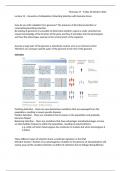
The lines indicate individual DNA sequences or haplotypes, and derived SNP alleles are
depicted as stars. A new advantageous mutation (indicated by a red star) appears initially on
one haplotype. In the absence of recombination, all neutral SNP alleles on the chromosome
in which the advantageous mutation first occurs will also reach a frequency of 100% as the
advantageous mutation become fixed in the population. Likewise, SNP-alleles that do not
occur on this chromosome will be lost, so that all variability has been eliminated in the
region in which the selective sweep occurred. However, new haplotypes can emerge through
recombination, allowing some of the neutral mutations that are linked to the advantageous
mutation to segregate after a completed selective sweep. As the rate of recombination
depends on the physical distance among sites, the effect of a selective sweep on variation in
the genomic regions around it diminishes with distance from the site that is under selection.
Chromosomal segments that are linked to advantageous mutations through recombination
during the selective sweep are coloured yellow. Data that are sampled during the selective
sweep at a time point when the new mutation has not yet reached a frequency of 100%
represent an incomplete selective sweep.
(new advantages mutation, if no recombination in genome and if positively selected – the
mutation will sweep through the population and go to fixation and so eliminate variation
from the population not only at the particular site but also in other sites due to no
recombination so perfect linkage disequilibrium) (there will be a period of a deficit of
selection, until a new variation arises in the genome)
OR
(new advantageous mutation, if there is recombination – there is a region associated with
the mutation that has low genetic variation, the degree of linkage disequilibrium increases
to the background level of variation) (resulting in regions which bond so there is no more
variation = under recent positive selection)
Lecture 15 – Genomics of Adaptation: Detecting Selection with Genome Scans
How do you infer adaption from genomes? The presence of directional selection or
constraining/purifying selection
By looking at genomes it is possible to determine whether a gene is under selection but
requires knowledge of the function of the gene and how it translates into the phenotypes
and how the phenotypes operate in the environment of the organism
Assume a large part of the genome is selectively neutral, acts as an internal control
Therefore can compare specific parts of the genome to the rest of the genome
Selection
Purifying Selection – there are new deleterious mutations that are expunged from the
population, resulting in severe genetic diseases
Positive Selection – there are mutations that increases in the population and gradually
becomes fixated
Balancing Selection – there are mutations that have advantages and disadvantages so have
an intermediate frequency within the population, resulting in polymorphisms
e.g. sickle cell when heterozygous has resistance to malaria but when homozygous it
is lethal
These different types of selection leave a particular signature in the DNA
Selective Sweep = fixation of an advantageous mutation in the genome of all populations will
sweep away all the variation/selection (a deficit of selection) due to linkage disequilibrium
, Thursday 19 – Friday 20 October 2023
The lines indicate individual DNA sequences or haplotypes, and derived SNP alleles are
depicted as stars. A new advantageous mutation (indicated by a red star) appears initially on
one haplotype. In the absence of recombination, all neutral SNP alleles on the chromosome
in which the advantageous mutation first occurs will also reach a frequency of 100% as the
advantageous mutation become fixed in the population. Likewise, SNP-alleles that do not
occur on this chromosome will be lost, so that all variability has been eliminated in the
region in which the selective sweep occurred. However, new haplotypes can emerge through
recombination, allowing some of the neutral mutations that are linked to the advantageous
mutation to segregate after a completed selective sweep. As the rate of recombination
depends on the physical distance among sites, the effect of a selective sweep on variation in
the genomic regions around it diminishes with distance from the site that is under selection.
Chromosomal segments that are linked to advantageous mutations through recombination
during the selective sweep are coloured yellow. Data that are sampled during the selective
sweep at a time point when the new mutation has not yet reached a frequency of 100%
represent an incomplete selective sweep.
(new advantages mutation, if no recombination in genome and if positively selected – the
mutation will sweep through the population and go to fixation and so eliminate variation
from the population not only at the particular site but also in other sites due to no
recombination so perfect linkage disequilibrium) (there will be a period of a deficit of
selection, until a new variation arises in the genome)
OR
(new advantageous mutation, if there is recombination – there is a region associated with
the mutation that has low genetic variation, the degree of linkage disequilibrium increases
to the background level of variation) (resulting in regions which bond so there is no more
variation = under recent positive selection)