
#Examify | #OnlineExams | #TestPrep | #StudyResources | #AcademicSuccess |
#ExamPreparation | #QuizTime | #LearningTools | #Education | #StudentSupport
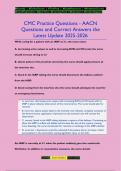
CMC Practice Questions - AACN
Questions and Correct Answers the
Latest Update 2025-2026
While caring for a patient with an IABP at 3:1, the nurse notes:
A. decreasing urine output as well as increasing BUN and CR levels; the nurse
should increase timing to 2:1
B. absent pulses in the proximal extremity; the nurse should apply pressure at
the insertion site.
C. blood in the IABP tubing; the nurse should disconnect the balloon catheter
from the IABP.
D. blood oozing from the insertion site; the nurse should anticipate the need for
an emergency fasciotomy.
✓ A. incorrect. decreasing urine output with increasing BUN and CR levels with an
IABP in place indicates obstruction of the renal arteries. The nurse should plan for
removal.
✓ B. incorrect. absent pulses distal to the insertion site indicates complete occlusion of
the femoral artery. application of pressure to the insertion site will worsen the
obstruction.
✓ C. correct. blood in the IABP tubing indicates a rupture of the balloon. Continuing to
allow the IABP to inflate and deflate will increase the size of the rupture, causing
more bleeding. the nurse should plan for removal or exchange of the IABP catheter.
✓ D. incorrect. a fasciotomy would be indicated if the patient had an increase in fluid
accumulation in the extremities causing significant injury to the limb.
An IABP is currently at 3:1 when the patient suddenly goes into ventricular
fibrillation. In addition to resuscitative measures, the nurse should:
Examify | Smart Grades | Latest update
,#Examify | #OnlineExams | #TestPrep | #StudyResources | #AcademicSuccess |
#ExamPreparation | #QuizTime | #LearningTools | #Education | #StudentSupport
A. change the trigger to internal or pressure support resuscitative measures.
B. increase timing back to 1:1 to increase coronary artery perfusion pressure.
C. put the pump on standby until the return of spontaneous circulation.
D. assess the IABP timing to chest compressions at 1:2.
✓ A. correct. the IABP will not be able to time correctly when a patient is in V-Fib. by
placing the system to trigger on internal or pressure support, it will generate off the
pressure created during compressions.
✓ B. incorrect. attempting to time the IABP back to 1:1 will be counterproductive, as it
will not be able to trigger correctly.
✓ C. incorrect. there is significant risk of clot forming on the IABP when placed in
stand for an indeterminate amount of time.
✓ D. incorrect. the primary goal during resuscitative measures is to attempt to
circulate blood volume as effectively as possible. assessing the timing of the IABP is
unnecessary.
The nurse is reviewing the home medications list for a patient admitted c/o
severe chest pain. serial EKGs and blood testing are negative, so an exercise
stress test is scheduled. which of the following medications may result in a false-
positive finding on the stress test?
A. digitalis (Digoxin)
B. potassium chloride (K-Dur)
C. sotalol (Betapace)
D. diltiazem (Cardiazem)
Examify | Smart Grades | Latest update
,#Examify | #OnlineExams | #TestPrep | #StudyResources | #AcademicSuccess |
#ExamPreparation | #QuizTime | #LearningTools | #Education | #StudentSupport
✓ A. correct. digitalis can cause false-positive EKG changes during a stress test. there is
an association between the development of ST segment depression during stress
testing. the mechanism of this EKG change is not clear. further, digitalis should be
withheld on the day of the test because of its negative chronotropic effects.
✓ B. incorrect.
✓ C & D. incorrect. beta-blockers and calcium channel blockers blunt the heart rate
response to exercise and may prevent achievement of maximum predicted heart
rate. they should be withheld on the day of the test.
A patient is admitted with elevated troponin levels and ST segment elevation in
leads II, III, and aVF. Administration of which of the following should the nurse
anticipate initially?
A. enoxaparin (Lovenox)
B. streptokinase (Strepase)
C. alteplase (Activase)
D. reteplase (Retavase)
✓ A. incorrect. enoxaparin is an alternative to heparin in patients with unstable angina,
NSTEMI or DVT.
✓ B. incorrect. streptokinase is indicated for acute arterial thrombosis or embolism, or
occluded AV cannulas.
✓ C. incorrect. alteplase in indicated for acute ischemic stroke or acute massive
pulmonary embolism.
✓ D. correct. reteplase is indicated for AMI when fibrinolytics are indicated.
Which of the following is a characteristic of diastolic heart failure?
A. inability of the heart muscle to relax.
B. dilation of the ventricular chambers.
C. increased filling of the left ventricle.
Examify | Smart Grades | Latest update
, #Examify | #OnlineExams | #TestPrep | #StudyResources | #AcademicSuccess |
#ExamPreparation | #QuizTime | #LearningTools | #Education | #StudentSupport
D. decreased ability of the ventricle to contract.
✓ A. correct. with diastolic heart failure the left ventricle is unable to relax, leading to
signs and symptoms of heart failure, but the patient maintains a preserved EF as the
muscle retains its ability to contract.
✓ B. incorrect. dilation of the ventricular chambers is a characteristic of systolic heart
failure.
✓ C. incorrect. diastolic heart failure is an abnormality with heart filling. the heart
muscle does not relax normally, and the heart may fill too slowly or asynchronously.
if the left ventricle does not relax properly or is thick and stiff, it does not fill in the
usual manner and blood is drawn back into the left atrium and eventually into the
lungs.
✓ D. incorrect. decreased ability of the ventricle to contract is a symptom of
overextension of the heart muscle in patients with cardiomyopathy.
Following a STEMI, the nurse auscultates a late systolic murmur at the apex.
The nurse should suspect the finding is r/t the new onset of a:
A. right bundle branch block
B. left bundle branch block
C. papillary muscle rupture
D. calcific plaque rupture
✓ A. incorrect. a RBBB would cause an electrical delay in conduction for a wide split
S2.
✓ B. incorrect. a LBBB would cause and electrical delay in ventricular conduction for a
paroxical split S2.
✓ C. correct. a papillary muscle chord rupture results from ischemia to the tissue
supplying the mitral valve. a systolic murmur is heard due to mitral regurgitation.
✓ D. incorrect. plaque rupture would cause an occlusion of the coronary artery that
would not directly cause a new systolic murmur.
The nurse is reviewing the plan of care for a patient with systolic heart failure
who has enalapril (Vasotec), furosemide (Lasix), metoprolol (Lopressor), and
Examify | Smart Grades | Latest update
#ExamPreparation | #QuizTime | #LearningTools | #Education | #StudentSupport
CMC Practice Questions - AACN
Questions and Correct Answers the
Latest Update 2025-2026
While caring for a patient with an IABP at 3:1, the nurse notes:
A. decreasing urine output as well as increasing BUN and CR levels; the nurse
should increase timing to 2:1
B. absent pulses in the proximal extremity; the nurse should apply pressure at
the insertion site.
C. blood in the IABP tubing; the nurse should disconnect the balloon catheter
from the IABP.
D. blood oozing from the insertion site; the nurse should anticipate the need for
an emergency fasciotomy.
✓ A. incorrect. decreasing urine output with increasing BUN and CR levels with an
IABP in place indicates obstruction of the renal arteries. The nurse should plan for
removal.
✓ B. incorrect. absent pulses distal to the insertion site indicates complete occlusion of
the femoral artery. application of pressure to the insertion site will worsen the
obstruction.
✓ C. correct. blood in the IABP tubing indicates a rupture of the balloon. Continuing to
allow the IABP to inflate and deflate will increase the size of the rupture, causing
more bleeding. the nurse should plan for removal or exchange of the IABP catheter.
✓ D. incorrect. a fasciotomy would be indicated if the patient had an increase in fluid
accumulation in the extremities causing significant injury to the limb.
An IABP is currently at 3:1 when the patient suddenly goes into ventricular
fibrillation. In addition to resuscitative measures, the nurse should:
Examify | Smart Grades | Latest update
,#Examify | #OnlineExams | #TestPrep | #StudyResources | #AcademicSuccess |
#ExamPreparation | #QuizTime | #LearningTools | #Education | #StudentSupport
A. change the trigger to internal or pressure support resuscitative measures.
B. increase timing back to 1:1 to increase coronary artery perfusion pressure.
C. put the pump on standby until the return of spontaneous circulation.
D. assess the IABP timing to chest compressions at 1:2.
✓ A. correct. the IABP will not be able to time correctly when a patient is in V-Fib. by
placing the system to trigger on internal or pressure support, it will generate off the
pressure created during compressions.
✓ B. incorrect. attempting to time the IABP back to 1:1 will be counterproductive, as it
will not be able to trigger correctly.
✓ C. incorrect. there is significant risk of clot forming on the IABP when placed in
stand for an indeterminate amount of time.
✓ D. incorrect. the primary goal during resuscitative measures is to attempt to
circulate blood volume as effectively as possible. assessing the timing of the IABP is
unnecessary.
The nurse is reviewing the home medications list for a patient admitted c/o
severe chest pain. serial EKGs and blood testing are negative, so an exercise
stress test is scheduled. which of the following medications may result in a false-
positive finding on the stress test?
A. digitalis (Digoxin)
B. potassium chloride (K-Dur)
C. sotalol (Betapace)
D. diltiazem (Cardiazem)
Examify | Smart Grades | Latest update
,#Examify | #OnlineExams | #TestPrep | #StudyResources | #AcademicSuccess |
#ExamPreparation | #QuizTime | #LearningTools | #Education | #StudentSupport
✓ A. correct. digitalis can cause false-positive EKG changes during a stress test. there is
an association between the development of ST segment depression during stress
testing. the mechanism of this EKG change is not clear. further, digitalis should be
withheld on the day of the test because of its negative chronotropic effects.
✓ B. incorrect.
✓ C & D. incorrect. beta-blockers and calcium channel blockers blunt the heart rate
response to exercise and may prevent achievement of maximum predicted heart
rate. they should be withheld on the day of the test.
A patient is admitted with elevated troponin levels and ST segment elevation in
leads II, III, and aVF. Administration of which of the following should the nurse
anticipate initially?
A. enoxaparin (Lovenox)
B. streptokinase (Strepase)
C. alteplase (Activase)
D. reteplase (Retavase)
✓ A. incorrect. enoxaparin is an alternative to heparin in patients with unstable angina,
NSTEMI or DVT.
✓ B. incorrect. streptokinase is indicated for acute arterial thrombosis or embolism, or
occluded AV cannulas.
✓ C. incorrect. alteplase in indicated for acute ischemic stroke or acute massive
pulmonary embolism.
✓ D. correct. reteplase is indicated for AMI when fibrinolytics are indicated.
Which of the following is a characteristic of diastolic heart failure?
A. inability of the heart muscle to relax.
B. dilation of the ventricular chambers.
C. increased filling of the left ventricle.
Examify | Smart Grades | Latest update
, #Examify | #OnlineExams | #TestPrep | #StudyResources | #AcademicSuccess |
#ExamPreparation | #QuizTime | #LearningTools | #Education | #StudentSupport
D. decreased ability of the ventricle to contract.
✓ A. correct. with diastolic heart failure the left ventricle is unable to relax, leading to
signs and symptoms of heart failure, but the patient maintains a preserved EF as the
muscle retains its ability to contract.
✓ B. incorrect. dilation of the ventricular chambers is a characteristic of systolic heart
failure.
✓ C. incorrect. diastolic heart failure is an abnormality with heart filling. the heart
muscle does not relax normally, and the heart may fill too slowly or asynchronously.
if the left ventricle does not relax properly or is thick and stiff, it does not fill in the
usual manner and blood is drawn back into the left atrium and eventually into the
lungs.
✓ D. incorrect. decreased ability of the ventricle to contract is a symptom of
overextension of the heart muscle in patients with cardiomyopathy.
Following a STEMI, the nurse auscultates a late systolic murmur at the apex.
The nurse should suspect the finding is r/t the new onset of a:
A. right bundle branch block
B. left bundle branch block
C. papillary muscle rupture
D. calcific plaque rupture
✓ A. incorrect. a RBBB would cause an electrical delay in conduction for a wide split
S2.
✓ B. incorrect. a LBBB would cause and electrical delay in ventricular conduction for a
paroxical split S2.
✓ C. correct. a papillary muscle chord rupture results from ischemia to the tissue
supplying the mitral valve. a systolic murmur is heard due to mitral regurgitation.
✓ D. incorrect. plaque rupture would cause an occlusion of the coronary artery that
would not directly cause a new systolic murmur.
The nurse is reviewing the plan of care for a patient with systolic heart failure
who has enalapril (Vasotec), furosemide (Lasix), metoprolol (Lopressor), and
Examify | Smart Grades | Latest update


