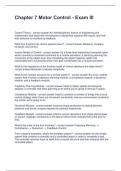
Chapter 7 Motor Control - Exam III
Control Theory - correct answer-An interdisciplinary branch of engineering and
mathematics that deals with the behavior of dynamical systems with inputs, and how
their behavior is modified by feedback.
What four functions do control systems have? - correct answer-Measure, compare,
compute, and correct.
Inverse Model of Control - correct answer-It's a three-level hierarchical movement plan
which converts a movement command to a muscle activation; It starts by planning the
movement at the object level, then translating the object trajectory (path) into
coordinated joint movements which then gets coordinated into a muscle activation.
What is the importance of the inverse model of control starting at the object level? -
correct answer-Because it reduces complexity.
What is the modular structure for a control system? - correct answer-It's a four module
system that involves a trajectory planning module, a compliance module, a dynamics
module, and a feedback module.
Trajectory Planning Module - correct answer-Used to obtain spatial and temporal
aspects; a controller that does planning as to where you're going to end up in space.
Compliance Module - correct answer-Used to combine a number of things into a force
control strategy when there are movement constraints; how our environment constrains
the motion we're going to do.
Dynamics Module - correct answer-Involves torque production to realize planned
positions and forces; torques required for planned trajectories.
Feedback Module - correct answer-Used to correct deviations from these plans based
on sensor readings; corrections to the above (other three modules that come prior to
this).
What's the order of the four modules? - correct answer-Trajectory Planning -->
Compliance --> Dynamics --> Feedback Control
From Latash's examples, what's the simplest system? - correct answer-It's the simple
system that contains a controller and a controlled object in order to complete a task.
The controller receives input (a task) from a neural structure and then interacts with the
controlled object.
Control Theory - correct answer-An interdisciplinary branch of engineering and
mathematics that deals with the behavior of dynamical systems with inputs, and how
their behavior is modified by feedback.
What four functions do control systems have? - correct answer-Measure, compare,
compute, and correct.
Inverse Model of Control - correct answer-It's a three-level hierarchical movement plan
which converts a movement command to a muscle activation; It starts by planning the
movement at the object level, then translating the object trajectory (path) into
coordinated joint movements which then gets coordinated into a muscle activation.
What is the importance of the inverse model of control starting at the object level? -
correct answer-Because it reduces complexity.
What is the modular structure for a control system? - correct answer-It's a four module
system that involves a trajectory planning module, a compliance module, a dynamics
module, and a feedback module.
Trajectory Planning Module - correct answer-Used to obtain spatial and temporal
aspects; a controller that does planning as to where you're going to end up in space.
Compliance Module - correct answer-Used to combine a number of things into a force
control strategy when there are movement constraints; how our environment constrains
the motion we're going to do.
Dynamics Module - correct answer-Involves torque production to realize planned
positions and forces; torques required for planned trajectories.
Feedback Module - correct answer-Used to correct deviations from these plans based
on sensor readings; corrections to the above (other three modules that come prior to
this).
What's the order of the four modules? - correct answer-Trajectory Planning -->
Compliance --> Dynamics --> Feedback Control
From Latash's examples, what's the simplest system? - correct answer-It's the simple
system that contains a controller and a controlled object in order to complete a task.
The controller receives input (a task) from a neural structure and then interacts with the
controlled object.