

DNA and RNA structure summary notes
08 November 2022 14:43
DNA molecules
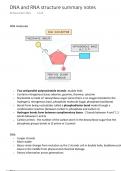
- Two antiparallel polynucleotide strands- double helix
- Contains nitrogenous bases adenine, guanine, thymine, cytosine
- Nucleotide is made of: deoxyribose sugar (since there is no oxygen bonded to the
hydrogen), nitrogenous base, phosphate molecule (sugar phosphate backbone)
- Bonds form being nucleotides called a phosphodiester bond made through a
condensation reaction (between carbon 5, phosphate and carbon 3)
- Hydrogen bonds form between complimentary bases - 2 bonds between A and T, 3
bonds between C and G
- Carbon primes - the number of the carbon atom in the deoxyribose sugar that the
phosphate groups bonds to (3 prime or 5 prime)
DNA:
- Longer strands
- More stable
- Bases rarely change from mutation as the 2 strands coil in double helix, backbone prot
bases in the middle from physical and chemical damage
- Passes information across generations
08 November 2022 14:43
DNA molecules
- Two antiparallel polynucleotide strands- double helix
- Contains nitrogenous bases adenine, guanine, thymine, cytosine
- Nucleotide is made of: deoxyribose sugar (since there is no oxygen bonded to the
hydrogen), nitrogenous base, phosphate molecule (sugar phosphate backbone)
- Bonds form being nucleotides called a phosphodiester bond made through a
condensation reaction (between carbon 5, phosphate and carbon 3)
- Hydrogen bonds form between complimentary bases - 2 bonds between A and T, 3
bonds between C and G
- Carbon primes - the number of the carbon atom in the deoxyribose sugar that the
phosphate groups bonds to (3 prime or 5 prime)
DNA:
- Longer strands
- More stable
- Bases rarely change from mutation as the 2 strands coil in double helix, backbone prot
bases in the middle from physical and chemical damage
- Passes information across generations


