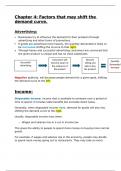
Chapter 4: Factors that may shift the
demand curve.
Advertising:
Businesses try to influence the demand for their products through
advertising and other forms of promotions.
If goods are advertised more heavily, the quantity demanded is likely to
be increased shifting the d-curve to that right.
o Through heavy and successful advertising consumers are convinced that
the given product is unique and has no close substitutes.
Consumers will Become
Successful Quantity
become aware of willing and
Advertising Demanded
the existance of able to buy
increase
the product the product
Negative publicity, will decrease people demand for a given good, shifting
the demand curve to the left.
Income:
Disposable income: income that is available to someone over a period of
time to spend; it includes state benefits but excludes direct taxes.
Generally, when disposable income rises, demand for goods will also rise,
shifting the demand curve to the right.
Usually, disposable income rises when:
Wages and salaries rise or a cut in income tax.
This gives the ability to people to spend more money on buying more normal
goods.
For example, if wages and salaries rise in the economy, people may decide
to spend more money going out to restaurants. They may take an extra
, holiday, or they may buy a new car. These are all normal goods. These are
goods for which demand will rise when income rises.
Normal goods: are goods for which demand we increase if income
increases or fall it income falls.
Inferior goods: goods for which the demand will fall if income rises or rise if
income falls.
e.g. public transport, second-hand cars and clothes.
For example, consumers who generally buy a relatively cheap supermarket
'own label' brand of baked beans may switch to a more expensive brand
when their incomes rise. Therefore, the quantity demanded for the
supermarket 'own label' brand will fall. This would be shown by a shift in the
demand curve to the left.
Recession is a period of temporary economic decline during which
production is reduced.
Workers may experience a fall in their income or even dismissal.
These results to a fall in their demand for normal goods.
Fashion and Tastes:
Over a period of time, demand patterns change because there are changes
in consumer tastes and fashion.
The clothes industry is influenced strongly by changes in fashion. Many of
the clothes bought in one season would not be in demand in later seasons
because they would no longer be in fashion.
e.g. leopard clothes, floral...
Fashions and tastes may be influenced by social changes. For example, in
recent years, millions of people have developed a keen interest in social
media. Social media websites, such as Facebook, Instagram and
Snapchat, have seen a huge increase in demand since their launch.
Price of Substitutes:
demand curve.
Advertising:
Businesses try to influence the demand for their products through
advertising and other forms of promotions.
If goods are advertised more heavily, the quantity demanded is likely to
be increased shifting the d-curve to that right.
o Through heavy and successful advertising consumers are convinced that
the given product is unique and has no close substitutes.
Consumers will Become
Successful Quantity
become aware of willing and
Advertising Demanded
the existance of able to buy
increase
the product the product
Negative publicity, will decrease people demand for a given good, shifting
the demand curve to the left.
Income:
Disposable income: income that is available to someone over a period of
time to spend; it includes state benefits but excludes direct taxes.
Generally, when disposable income rises, demand for goods will also rise,
shifting the demand curve to the right.
Usually, disposable income rises when:
Wages and salaries rise or a cut in income tax.
This gives the ability to people to spend more money on buying more normal
goods.
For example, if wages and salaries rise in the economy, people may decide
to spend more money going out to restaurants. They may take an extra
, holiday, or they may buy a new car. These are all normal goods. These are
goods for which demand will rise when income rises.
Normal goods: are goods for which demand we increase if income
increases or fall it income falls.
Inferior goods: goods for which the demand will fall if income rises or rise if
income falls.
e.g. public transport, second-hand cars and clothes.
For example, consumers who generally buy a relatively cheap supermarket
'own label' brand of baked beans may switch to a more expensive brand
when their incomes rise. Therefore, the quantity demanded for the
supermarket 'own label' brand will fall. This would be shown by a shift in the
demand curve to the left.
Recession is a period of temporary economic decline during which
production is reduced.
Workers may experience a fall in their income or even dismissal.
These results to a fall in their demand for normal goods.
Fashion and Tastes:
Over a period of time, demand patterns change because there are changes
in consumer tastes and fashion.
The clothes industry is influenced strongly by changes in fashion. Many of
the clothes bought in one season would not be in demand in later seasons
because they would no longer be in fashion.
e.g. leopard clothes, floral...
Fashions and tastes may be influenced by social changes. For example, in
recent years, millions of people have developed a keen interest in social
media. Social media websites, such as Facebook, Instagram and
Snapchat, have seen a huge increase in demand since their launch.
Price of Substitutes: