
UNIT 8: LEARNING AIM A
Unit 8: Physiology of Human Body Systems
Learning Aim A: Understand the impact of the disorders of the musculoskeletal system
and their associated corrective treatments
Introduction:
In this report, I will give a detailed description of the structure of the musculoskeletal system and how the bones,
muscles and joints work to bring about movement. I will be detailing three disorders that are caused by a defect
in the musculoskeletal system and a case study evaluating the advantages and disadvantages of a named
disorder and how effective the treatments for the disorder are.
Structure of Musculoskeletal System:
The musculoskeletal system is where the skeleton and muscles work together to move and support the body.
The musculoskeletal system is composed of bones, muscles, joints, cartilage and tendons.
● Axial and Appendicular Skeleton:
- Axial skeleton:
1
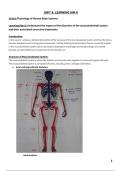
, The main core of the skeletal system is formed by the axial skeleton. The axial skeleton is more
rigid than the appendicular skeleton and includes the vertebral column (spine), cranium (skull),
mandible (lower jaw), maxilla (upper jaw), thoracic cage (rib cage) and sternum (breast bone).
The axial skeleton is made of 80 bones in the body and provides cushioning and support for
organs in the body, as well as the spinal cord and the brain. Muscles that are attached to the axial
skeleton enable the movement of the head and neck.1
The vertebral column is made up of 33 irregularly shaped bones known as vertebrae. There is a
pad of cartilage between each vertebra that prevents the grinding of bones and allows
movement. Vertebrae have an important role in protecting the spinal cord as the spinal cord
includes nerves used in transmitting signals around the body as part of the central nervous
system. The vertebral column is made of 5 columns including the cervical vertebrae, thoracic
vertebrae, lumbar vertebrae, sacrum and coccyx.
- Appendicular skeleton:
The appendicular skeleton is made up of 126 bones in total.2 The function of the appendicular
skeleton is to enable movement of the human body, as well as providing shape to the arms and
legs and maintaining mineral homeostasis in the body.3 The appendicular skeleton includes
bones of the limbs, pelvic girdle, shoulder girdle, ankle, foot, wrist, hand and digit bones. Limb
bones consist of the humerus, ulna and radius in the arm; patella, tibia, fibula and femur in the
1
“Axial Skeleton: What Bones it Makes Up.” Cleveland Clinic, 2 August 2022,
https://my.clevelandclinic.org/health/body/22344-axial-skeleton. Accessed 24 September 2023.
2
“Appendicular Skeleton (126 bones).” SEER Training,
https://training.seer.cancer.gov/anatomy/skeletal/divisions/appendicular.html. Accessed 24 September 2023.
3
“Appendicular Skeleton | Definition, Function & Anatomy - Video & Lesson Transcript.” Study.com, 13 October 2021,
https://study.com/learn/lesson/appendicular-skeleton-definition-function-anatomy.html. Accessed 24 September
2023.
2
, leg; carpals, metacarpals and phalanges in the wrist and hand; tarsals, metatarsals, phalanges
and calcaneus in the foot and ankle; clavicle and scapula in the shoulder girdle; ischium, ilium
and pubis in the pelvic girdle.
Functions of the Skeletal System:
- Support:
The skeleton gives the body support to enable humans to stand upright by acting as a framework for
humans to hold a position upright.
- Protection:
Vital organs are protected by the skeleton including the heart, lungs, liver, brain and spinal cord. The rib
cage protects the lungs, heart and liver. The cranium protects the brain and the spinal cord is protected
by the vertebral column. The skeleton protects these vital organs from external forces such as injuries
and impacts and prevents damage to these organs.
- Movement/ Attachment for skeletal muscles:
Bones of the skeleton are attached to muscles by tendons. Bones and muscles work together to produce
movement. Bones have surfaces that enable muscles to attach to the bone. The periosteum membrane
on the outside of the bone fuses with tendons to provide the attachment between bones and muscles to
produce movement.
3
Unit 8: Physiology of Human Body Systems
Learning Aim A: Understand the impact of the disorders of the musculoskeletal system
and their associated corrective treatments
Introduction:
In this report, I will give a detailed description of the structure of the musculoskeletal system and how the bones,
muscles and joints work to bring about movement. I will be detailing three disorders that are caused by a defect
in the musculoskeletal system and a case study evaluating the advantages and disadvantages of a named
disorder and how effective the treatments for the disorder are.
Structure of Musculoskeletal System:
The musculoskeletal system is where the skeleton and muscles work together to move and support the body.
The musculoskeletal system is composed of bones, muscles, joints, cartilage and tendons.
● Axial and Appendicular Skeleton:
- Axial skeleton:
1
, The main core of the skeletal system is formed by the axial skeleton. The axial skeleton is more
rigid than the appendicular skeleton and includes the vertebral column (spine), cranium (skull),
mandible (lower jaw), maxilla (upper jaw), thoracic cage (rib cage) and sternum (breast bone).
The axial skeleton is made of 80 bones in the body and provides cushioning and support for
organs in the body, as well as the spinal cord and the brain. Muscles that are attached to the axial
skeleton enable the movement of the head and neck.1
The vertebral column is made up of 33 irregularly shaped bones known as vertebrae. There is a
pad of cartilage between each vertebra that prevents the grinding of bones and allows
movement. Vertebrae have an important role in protecting the spinal cord as the spinal cord
includes nerves used in transmitting signals around the body as part of the central nervous
system. The vertebral column is made of 5 columns including the cervical vertebrae, thoracic
vertebrae, lumbar vertebrae, sacrum and coccyx.
- Appendicular skeleton:
The appendicular skeleton is made up of 126 bones in total.2 The function of the appendicular
skeleton is to enable movement of the human body, as well as providing shape to the arms and
legs and maintaining mineral homeostasis in the body.3 The appendicular skeleton includes
bones of the limbs, pelvic girdle, shoulder girdle, ankle, foot, wrist, hand and digit bones. Limb
bones consist of the humerus, ulna and radius in the arm; patella, tibia, fibula and femur in the
1
“Axial Skeleton: What Bones it Makes Up.” Cleveland Clinic, 2 August 2022,
https://my.clevelandclinic.org/health/body/22344-axial-skeleton. Accessed 24 September 2023.
2
“Appendicular Skeleton (126 bones).” SEER Training,
https://training.seer.cancer.gov/anatomy/skeletal/divisions/appendicular.html. Accessed 24 September 2023.
3
“Appendicular Skeleton | Definition, Function & Anatomy - Video & Lesson Transcript.” Study.com, 13 October 2021,
https://study.com/learn/lesson/appendicular-skeleton-definition-function-anatomy.html. Accessed 24 September
2023.
2
, leg; carpals, metacarpals and phalanges in the wrist and hand; tarsals, metatarsals, phalanges
and calcaneus in the foot and ankle; clavicle and scapula in the shoulder girdle; ischium, ilium
and pubis in the pelvic girdle.
Functions of the Skeletal System:
- Support:
The skeleton gives the body support to enable humans to stand upright by acting as a framework for
humans to hold a position upright.
- Protection:
Vital organs are protected by the skeleton including the heart, lungs, liver, brain and spinal cord. The rib
cage protects the lungs, heart and liver. The cranium protects the brain and the spinal cord is protected
by the vertebral column. The skeleton protects these vital organs from external forces such as injuries
and impacts and prevents damage to these organs.
- Movement/ Attachment for skeletal muscles:
Bones of the skeleton are attached to muscles by tendons. Bones and muscles work together to produce
movement. Bones have surfaces that enable muscles to attach to the bone. The periosteum membrane
on the outside of the bone fuses with tendons to provide the attachment between bones and muscles to
produce movement.
3


