
Unit 2- Technology, population and growth
Introduction
Innovation creates temporary rewards for the innovator, providing incentives
for improvements in technology that reduce costs; destroyed by competition
once the innovation diffuses throughout the economy.
Population, the productivity of labour, and living standards may interact to
produce a vicious circle of economic stagnation.
1845; Irish famine- rotting potatoes, famine spread; one million out of 8.5
had died.
Sparked a worldwide relief effort; yet some economists opposed this based
on the early 19th century doctrine, Malthusianism.
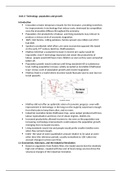
Malthus held that a sustained increase in income per capita would be
impossible; even if technology improved and raised the productivity of
labour, people would still have more children as soon as they were somewhat
better off.
Population growth would continue until living standards fell to subsistence
level, halting population increase; widely accepted as inevitable (Malthusian
trap)- vicious cycle of population growth and income stagnation.
Malthus lived in a world where incomes would fluctuate year to year but not
trend upwards.
Malthus did not offer an optimistic vision of economic progress- even with
improvement in technology; in the long run the majority would earn enough
from their jobs to keep them alive, and no more.
Industrial revolution broke Malthusian trap- same output produced with less
labour (specialisation and DoL); rise of steam engines, textiles etc.
Increased productivity allowed incomes to rise even as the population was
increasing- technology improvements could outpace the population growth
emerging from increased incomes.
Living standards would rise and people would prefer smaller families even
when they earned enough.
Index- the value of some quantitative amount relative to its value at some
other time (the reference period), usually normalised to 100- takes into
account changes in prices over time.
2.1 Economists, historians, and the Industrial Revolution
Based on arguments from Robert Allen, the model asserts that the relatively
high cost of labour, coupled with low cost of local energy sources drove the
structural changes of the industrial revolution.


