

Nucleic Acids
Nucleic acids are found in all cellular organisms as they contain coded information (genetic
information) which controls the biochemical processes of cells. There are two types of nucleic acids:
DNA (deoxyribonucleic acid) and RNA (ribonucleic acid).
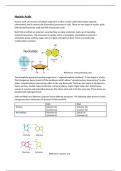
Both DNA and RNA are polymers meaning they are large molecules made up of repeating
subunits/monomers. The monomer of nucleic acid is a nucleotide. Nucleotides consist of a
phosphate group, pentose sugar and an organic/nitrogenous base. These are bonded by
condensation reactions.
Reference: www.pinterest.com
The phosphate group and pentose sugar form a “sugar-phosphate backbone” in the shape of a helix.
The nitrogenous bases branch off the backbones which allows “complementary base pairing” to take
place. Complementary base pairing refers to the way bases pair. There are two types of nitrogenous
bases: purines, double-ringed molecules, and pyrimidines, single ringed molecules. Paired bases
consist of a purine and pyrimidine because this allows each pair to be the same size. These bases are
bonded with hydrogen bonds.
DNA and RNA have different purposes hence different structures. The following table presents which
nitrogenous base molecules are present in DNA and RNA.
DNA RNA
Purines Adenine (A) Adenine (A)
Guanine (G) Guanine (G)
Pyrimidines Thymine (T) Uracil (U)
Cytosine (C) Cytosine (C)
Reference: reasons.org
, There are also differences between the sugar-phosphate backbones:
DNA backbone RNA backbone
-DNA backbones consist of deoxyribose sugar. -RNA backbones consist of ribose sugar.
-Within DNA there are two backbone chains which -RNA only consists of one backbone chain.
are described as anti-parallel because the helixes This allows RNA to carry out its function in
run in opposite directions to each other. This double the process of protein synthesis.
helix structure protects the paired bases by holding
them in place, reducing corruption of genetic
information.
References: thealevelbiologist.co.uk and reasons.org
There is only one type of DNA because it has a specific function. However, there are 4 types of RNA
with structures individual to their different functions:
Messenger RNA (mRNA) → A regular single stranded helix from the 3’ and 5’ end. Copies and
carries the genetic code of a gene from the nucleus to the ribosomes. This allows mRNA to
provide instructions for protein synthesis.
Nucleic acids are found in all cellular organisms as they contain coded information (genetic
information) which controls the biochemical processes of cells. There are two types of nucleic acids:
DNA (deoxyribonucleic acid) and RNA (ribonucleic acid).
Both DNA and RNA are polymers meaning they are large molecules made up of repeating
subunits/monomers. The monomer of nucleic acid is a nucleotide. Nucleotides consist of a
phosphate group, pentose sugar and an organic/nitrogenous base. These are bonded by
condensation reactions.
Reference: www.pinterest.com
The phosphate group and pentose sugar form a “sugar-phosphate backbone” in the shape of a helix.
The nitrogenous bases branch off the backbones which allows “complementary base pairing” to take
place. Complementary base pairing refers to the way bases pair. There are two types of nitrogenous
bases: purines, double-ringed molecules, and pyrimidines, single ringed molecules. Paired bases
consist of a purine and pyrimidine because this allows each pair to be the same size. These bases are
bonded with hydrogen bonds.
DNA and RNA have different purposes hence different structures. The following table presents which
nitrogenous base molecules are present in DNA and RNA.
DNA RNA
Purines Adenine (A) Adenine (A)
Guanine (G) Guanine (G)
Pyrimidines Thymine (T) Uracil (U)
Cytosine (C) Cytosine (C)
Reference: reasons.org
, There are also differences between the sugar-phosphate backbones:
DNA backbone RNA backbone
-DNA backbones consist of deoxyribose sugar. -RNA backbones consist of ribose sugar.
-Within DNA there are two backbone chains which -RNA only consists of one backbone chain.
are described as anti-parallel because the helixes This allows RNA to carry out its function in
run in opposite directions to each other. This double the process of protein synthesis.
helix structure protects the paired bases by holding
them in place, reducing corruption of genetic
information.
References: thealevelbiologist.co.uk and reasons.org
There is only one type of DNA because it has a specific function. However, there are 4 types of RNA
with structures individual to their different functions:
Messenger RNA (mRNA) → A regular single stranded helix from the 3’ and 5’ end. Copies and
carries the genetic code of a gene from the nucleus to the ribosomes. This allows mRNA to
provide instructions for protein synthesis.



