

The Blood Vessels
➢ In the closed circulatory system blood flows continuously to the organs in tubes called blood
vessels.
➢ The blood vessels allow blood to be delivered rapidly and efficiently to all body cells.
➢ There are 5 types of blood vessels: arteries, arterioles, capillaries, venules and veins.
➢ Draw a sketch to show the arrangement of these blood vessels in the human body:
➢ The main blood vessels are the arteries, veins and capillaries. These each have special features
that enable them to carry out their specific functions.
(1) The Arteries
➢ Carry blood at higher pressure away from the heart.
➢ The arteries have a special structure that enables them to carry blood at higher blood
pressure.
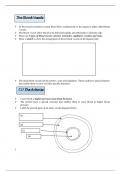
➢ Label the general parts of an artery on the diagram below:
(a)
(b)
(c)
(d)
1
, ➢ The arteries leaving the heart branch off in every direction, and the lumen becomes smaller
the further the arteries are away from the heart.
➢ Blood is pumped out from the heart into the arteries at approximately 70 beats per minute.
➢ Each heartbeat sends a high-pressure flow of blood into the arteries.
➢ Arteries have many special features that enable them to carry blood at higher pressure, so
that they deliver molecules (oxygen, glucose, amino acids etc.) as rapidly as possible to meet
the metabolic demands of a multicellular animal.
(a) An outer layer: The Tunica Adventitia or Tunica Externa
➢
(b) A middle layer: The Tunica Media:
➢
(c) An inner layer: The Tunica Intima:
➢
(d) A hole in the middle: The lumen:
➢
2
➢ In the closed circulatory system blood flows continuously to the organs in tubes called blood
vessels.
➢ The blood vessels allow blood to be delivered rapidly and efficiently to all body cells.
➢ There are 5 types of blood vessels: arteries, arterioles, capillaries, venules and veins.
➢ Draw a sketch to show the arrangement of these blood vessels in the human body:
➢ The main blood vessels are the arteries, veins and capillaries. These each have special features
that enable them to carry out their specific functions.
(1) The Arteries
➢ Carry blood at higher pressure away from the heart.
➢ The arteries have a special structure that enables them to carry blood at higher blood
pressure.
➢ Label the general parts of an artery on the diagram below:
(a)
(b)
(c)
(d)
1
, ➢ The arteries leaving the heart branch off in every direction, and the lumen becomes smaller
the further the arteries are away from the heart.
➢ Blood is pumped out from the heart into the arteries at approximately 70 beats per minute.
➢ Each heartbeat sends a high-pressure flow of blood into the arteries.
➢ Arteries have many special features that enable them to carry blood at higher pressure, so
that they deliver molecules (oxygen, glucose, amino acids etc.) as rapidly as possible to meet
the metabolic demands of a multicellular animal.
(a) An outer layer: The Tunica Adventitia or Tunica Externa
➢
(b) A middle layer: The Tunica Media:
➢
(c) An inner layer: The Tunica Intima:
➢
(d) A hole in the middle: The lumen:
➢
2


