

Essay: Short- and long-term memory
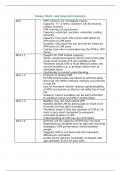
AO1 - STM: memory for immediate events
- Capacity: 7+- 2 items, duration: 18-30 seconds,
coding: acoustic
- LTM: memory of past events
- Capacity: unlimited, duration: unlimited, coding:
semantic
- Capacity: how much info can be held either by
STM store or LTM store
- Duration: how long info can be held for either by
STM store or LTM store
- Coding: how info is translated into the STM or LTM
stores
AO3 x 1 - Support for STM limited capacity
- Simon conducted research which found most ppts
could recall chunks of 8 one-syllable words
- Therefore shows STM is most effective when info
can be chunked e.g. in phrases rather than as
individual items
- Contributes to overall understanding
AO3 x 2 - Criticism of testing STM
- All STM testing tasks are based on artificial tasks
which do not reflect ordinary memory occurrences
in real life
- Lack of mundane realism reduces generalisability
of STM conclusions as they’re not reflective of real
life
- However means variables can be well controlled
to establish cause and effect relationships
AO3 x 3 - Baddley may not have tested LTM
- Baddley tested LTM by asking ppts to recall a list
of words 20 mins after encoding
- Therefore doesn’t fully test duration of LTM as 20
mins is very short compared to proposed
unlimited duration of LTM
- Understanding of LTM may be incomplete
AO3 x 4 - General rule for capacity of STM may not exist
- Depending on variables such as age and chunking
strategies, STM performance varies between
people
- Suggests STM is not fixed and that individual
differences contribute
- Jacobs found capacity noticeably increased with
age (between 8 and 19 year olds)
, Essay: The multi-store model of memory
AO1 - Proposed by Atkinson and Shiffrin
- Environmental stimuli
- Sensory register: where info from each of the
senses is held
- Attention: info which is consciously noticed, all
other sensory info is ignored
- STM store: info is held to be used for immediate
tasks, maintained through maintenance rehearsal
or can be retrieved – info can be displaced by new
info due to limited capacity
- LTM store: potentially unlimited in duration and
capacity, uses elaborative rehearsal to transfer
info from STM to LTM, info is brought into the STM
store via retrieval from the LTM
AO3 x 1 - Case study support – HM
- Had his hippocampus removed and couldn’t form
any new LTMs but could retrieve old memories
from the LTM
- Suggests lost ability for elaborative rehearsal but
could still retrieve, evidence for seperate stores
and functions
- Case study means low generalisability
AO3 x 2 - Supporting evidence
- Beardsley found the prefrontal cortex is active
during STM but not LTM, suggesting they involve
different processes
- Brain scanning so scientific methodology –
contributes to psychology as a science
AO3 x 3 - MSM is too simple
- Researchers argue there must be subdivisions of
STM and LTM stores, as different kinds of memory
(particularly LTM) must be stored differently
- E.g. semantic memory is maintained via
maintenance rehearsal, but this doesn’t make
sense for episodic memory
- Therefore MSM needs more development to
explain different LTM types
AO3 x 4 - Use of artificial tasks – lack of mundane realisms
so poor real world application
- Most memory tasks are lab studies in which ppts
are asked to carry out unrealistic tasks
- Therefore results may not be reflective of real
world memory storage and interaction
AO1 - STM: memory for immediate events
- Capacity: 7+- 2 items, duration: 18-30 seconds,
coding: acoustic
- LTM: memory of past events
- Capacity: unlimited, duration: unlimited, coding:
semantic
- Capacity: how much info can be held either by
STM store or LTM store
- Duration: how long info can be held for either by
STM store or LTM store
- Coding: how info is translated into the STM or LTM
stores
AO3 x 1 - Support for STM limited capacity
- Simon conducted research which found most ppts
could recall chunks of 8 one-syllable words
- Therefore shows STM is most effective when info
can be chunked e.g. in phrases rather than as
individual items
- Contributes to overall understanding
AO3 x 2 - Criticism of testing STM
- All STM testing tasks are based on artificial tasks
which do not reflect ordinary memory occurrences
in real life
- Lack of mundane realism reduces generalisability
of STM conclusions as they’re not reflective of real
life
- However means variables can be well controlled
to establish cause and effect relationships
AO3 x 3 - Baddley may not have tested LTM
- Baddley tested LTM by asking ppts to recall a list
of words 20 mins after encoding
- Therefore doesn’t fully test duration of LTM as 20
mins is very short compared to proposed
unlimited duration of LTM
- Understanding of LTM may be incomplete
AO3 x 4 - General rule for capacity of STM may not exist
- Depending on variables such as age and chunking
strategies, STM performance varies between
people
- Suggests STM is not fixed and that individual
differences contribute
- Jacobs found capacity noticeably increased with
age (between 8 and 19 year olds)
, Essay: The multi-store model of memory
AO1 - Proposed by Atkinson and Shiffrin
- Environmental stimuli
- Sensory register: where info from each of the
senses is held
- Attention: info which is consciously noticed, all
other sensory info is ignored
- STM store: info is held to be used for immediate
tasks, maintained through maintenance rehearsal
or can be retrieved – info can be displaced by new
info due to limited capacity
- LTM store: potentially unlimited in duration and
capacity, uses elaborative rehearsal to transfer
info from STM to LTM, info is brought into the STM
store via retrieval from the LTM
AO3 x 1 - Case study support – HM
- Had his hippocampus removed and couldn’t form
any new LTMs but could retrieve old memories
from the LTM
- Suggests lost ability for elaborative rehearsal but
could still retrieve, evidence for seperate stores
and functions
- Case study means low generalisability
AO3 x 2 - Supporting evidence
- Beardsley found the prefrontal cortex is active
during STM but not LTM, suggesting they involve
different processes
- Brain scanning so scientific methodology –
contributes to psychology as a science
AO3 x 3 - MSM is too simple
- Researchers argue there must be subdivisions of
STM and LTM stores, as different kinds of memory
(particularly LTM) must be stored differently
- E.g. semantic memory is maintained via
maintenance rehearsal, but this doesn’t make
sense for episodic memory
- Therefore MSM needs more development to
explain different LTM types
AO3 x 4 - Use of artificial tasks – lack of mundane realisms
so poor real world application
- Most memory tasks are lab studies in which ppts
are asked to carry out unrealistic tasks
- Therefore results may not be reflective of real
world memory storage and interaction


