

TOPIC 1:
LIFESTYLE, HEALTH AND RISK
1.1 Understand why many animals have a heart and circulation (mass transport
to overcome limitations of diffusion in meeting the requirements of
organisms).
● Mass flow: system transporting substances in bulk over long
distance down a pressure gradient.
● Why is mass flow important?: the increasing size of organisms
means diffusion distance and the amount of material needed
becomes too large: diffusion is SLOW.
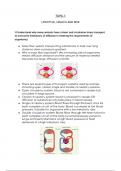
● There are several types of transport systems used by animals
including open, closed, single and double circulatory systems.
● Open circulatory system: blood is not contained in vessels but
circulates in large spaces.
● Closed circulatory system: blood is enclosed in vessels OR
diffusion of substances only take place in blood vessels.
● Single circulatory system: Blood flows through the heart once for
each complete circuit of the body. Blood is pumped at low blood
pressure. Suitable for organisms with a low metabolic rate.
● Double circulatory system: Blood flows through the heart twice for
each complete circuit of the body (i.e simultaneously pumps to
lungs and heart) Maintains a high blood pressure to meet
demands of a high metabolic rate.
, ● Circulatory systems are needed to overcome the limitations of
diffusion and because many organisms have a small surface area
to volume ratio, so diffusion is ultimately insufficient.
● Small animals usually have an open circulatory system due to
their short diffusion distance and because of their low metabolic
rate. However, animals like vertebrae have a closed circulatory
system, where the blood is enclosed in vessels, as this generates
higher blood pressure as the blood is forced along narrow
channels instead of large cavities, so this means that blood can
travel faster.
● Larger animals tend to have double circulatory systems due to the
great diffusion distance and the amount of time it takes for the
blood to have to travel all around the body. Advantages of this
type of circulatory system is that it has greater efficiency as the
oxygenated and deoxygenated blood is separated in different
chambers, so this allows maximum energy to be produced from
respiration and allows the organism to be more active.
1.2 Understand the importance of water as a solvent in transport, including its
dipole nature.
● Water is a polar molecule due to the
oxygen being slightly negative while
the hydrogen is slightly positive, and
the uneven distribution of charge
means one molecule is more positive
than the other.
● Water is a good solvent because it
allows many things to dissolve in it. Polar molecules and ionic
substances dissolve in water because water is dipolar. The forces
of attraction between the delta positive H and the delta negative
O are stronger than the ionic bonds so the ions become hydrated
and completely surrounded by water molecules.
● Water has a high specific heat capacity and so changes of
temperature are very slow which allows living things to maintain
internal temperature and conditions in the body like enzyme
controlled reactions. This is due to the strong hydrogen bonding
that occurs in water.
● Water is cohesive, which allows effective transport of water and
dissolved substances through xylem vessels.
, 1.3 Understand how the structures of blood vessels (capillaries, arteries and veins) relate to
their functions.
Capillaries
● Blood flows more slowly in the capillaries due to its narrow lumen causing more
of the blood to be slowed down by friction against the capillary walls.
● This slower steady flow allows exchange between the blood and the surrounding
cells through the one cell thick layer wall.
● The network of capillaries that lies close to every cell ensures that there is rapid
diffusion between the blood and surrounding cells.
Arteries
● When the heart contracts (systole), blood is forced in the arteries and their
elastic walls stretch to accomodate the blood.
● The thick artery walls can withstand the high pressure generated as the blood
is forced against the walls.
● During diastole, the elasticity of the artery wall causes them to recoil behind the
blood, helping to push the blood forward and smoothing blood flow. The blood
moves along the length of the artery as each section in series stretches and
recoils this way.
Veins
● Blood flows steadily and without pulses in the veins when it is under low
pressure.
● In the vein blood flow is assisted by the contraction of skeletal muscles during
the movement of limbs and breathing.
● Low pressure developed in the thorax when breathing also helps draw back
blood back into the heart from the veins.
1.4 i) Know the cardiac cycle (atrial systole, ventricular systole and cardiac diastole) and relate
the structure and operation of the mammalian heart, including the major blood vessels, to its
function.
ii) Know how the relationship between heart structure and function can be investigated
practically.
i)
LIFESTYLE, HEALTH AND RISK
1.1 Understand why many animals have a heart and circulation (mass transport
to overcome limitations of diffusion in meeting the requirements of
organisms).
● Mass flow: system transporting substances in bulk over long
distance down a pressure gradient.
● Why is mass flow important?: the increasing size of organisms
means diffusion distance and the amount of material needed
becomes too large: diffusion is SLOW.
● There are several types of transport systems used by animals
including open, closed, single and double circulatory systems.
● Open circulatory system: blood is not contained in vessels but
circulates in large spaces.
● Closed circulatory system: blood is enclosed in vessels OR
diffusion of substances only take place in blood vessels.
● Single circulatory system: Blood flows through the heart once for
each complete circuit of the body. Blood is pumped at low blood
pressure. Suitable for organisms with a low metabolic rate.
● Double circulatory system: Blood flows through the heart twice for
each complete circuit of the body (i.e simultaneously pumps to
lungs and heart) Maintains a high blood pressure to meet
demands of a high metabolic rate.
, ● Circulatory systems are needed to overcome the limitations of
diffusion and because many organisms have a small surface area
to volume ratio, so diffusion is ultimately insufficient.
● Small animals usually have an open circulatory system due to
their short diffusion distance and because of their low metabolic
rate. However, animals like vertebrae have a closed circulatory
system, where the blood is enclosed in vessels, as this generates
higher blood pressure as the blood is forced along narrow
channels instead of large cavities, so this means that blood can
travel faster.
● Larger animals tend to have double circulatory systems due to the
great diffusion distance and the amount of time it takes for the
blood to have to travel all around the body. Advantages of this
type of circulatory system is that it has greater efficiency as the
oxygenated and deoxygenated blood is separated in different
chambers, so this allows maximum energy to be produced from
respiration and allows the organism to be more active.
1.2 Understand the importance of water as a solvent in transport, including its
dipole nature.
● Water is a polar molecule due to the
oxygen being slightly negative while
the hydrogen is slightly positive, and
the uneven distribution of charge
means one molecule is more positive
than the other.
● Water is a good solvent because it
allows many things to dissolve in it. Polar molecules and ionic
substances dissolve in water because water is dipolar. The forces
of attraction between the delta positive H and the delta negative
O are stronger than the ionic bonds so the ions become hydrated
and completely surrounded by water molecules.
● Water has a high specific heat capacity and so changes of
temperature are very slow which allows living things to maintain
internal temperature and conditions in the body like enzyme
controlled reactions. This is due to the strong hydrogen bonding
that occurs in water.
● Water is cohesive, which allows effective transport of water and
dissolved substances through xylem vessels.
, 1.3 Understand how the structures of blood vessels (capillaries, arteries and veins) relate to
their functions.
Capillaries
● Blood flows more slowly in the capillaries due to its narrow lumen causing more
of the blood to be slowed down by friction against the capillary walls.
● This slower steady flow allows exchange between the blood and the surrounding
cells through the one cell thick layer wall.
● The network of capillaries that lies close to every cell ensures that there is rapid
diffusion between the blood and surrounding cells.
Arteries
● When the heart contracts (systole), blood is forced in the arteries and their
elastic walls stretch to accomodate the blood.
● The thick artery walls can withstand the high pressure generated as the blood
is forced against the walls.
● During diastole, the elasticity of the artery wall causes them to recoil behind the
blood, helping to push the blood forward and smoothing blood flow. The blood
moves along the length of the artery as each section in series stretches and
recoils this way.
Veins
● Blood flows steadily and without pulses in the veins when it is under low
pressure.
● In the vein blood flow is assisted by the contraction of skeletal muscles during
the movement of limbs and breathing.
● Low pressure developed in the thorax when breathing also helps draw back
blood back into the heart from the veins.
1.4 i) Know the cardiac cycle (atrial systole, ventricular systole and cardiac diastole) and relate
the structure and operation of the mammalian heart, including the major blood vessels, to its
function.
ii) Know how the relationship between heart structure and function can be investigated
practically.
i)


