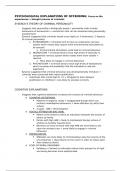
PSYCHOLOGICAL EXPLANATIONS OF OFFENDING: Focus on life
experiences + thought process of criminals
EYSENCK’S THEORY OF CRIMINAL PERSONALITY
- Suggests that personality is biologically based + personality traits include
dimensions of extraversion + neuroticism that can be measured using personality
questionnaire
- Eysenck suggested that criminals would score highly on 3 dimensions / 3 Aspects
of criminal personality
1. EXTRAVERSION = Criminals tend to have an underactive nervous
system which means they require more environmental stimulation to
be aroused
a. Environmental stimulation could lead to criminal behaviour
2. NEUROTICISM = Criminals tend to have high levels of reactivity in
sympathetic nervous system which makes them more volatile +
reactive
a. More likely to engage in criminal behaviour
3. PSYCHOTICISM = Criminals tend to have high levels of testosterone
which increases the probability that the individual is cold and
aggressive
- Eysenck suggested that criminal behaviour was developmentally immature +
criminals were concerned with instant gratification
o Individuals that scored high N + E = struggled to learn delayed
gratification in childhood + less likely to socialise correctly
COGNITIVE EXPLANATIONS
- Suggests that cognitive distortions increases the chances of criminal behaviour
o COGNITIVE DISTORTIONS
Patterns of negative, faulty + exaggerated though which can
reinforce maladaptive behaviours + allow offenders to justify their
actions
2 types : HAB + Minimalisation
o HOSTILE ATTRIBUTION BIAS (HAB)
Refers to the extent to which an individual interprets the actions of
others as hostile
Person with high HAB = likely to misinterpret benign actions of
another as hostility towards them
Becomes an issue as those with high HAB are more likely to act
upon the misread cues + more likely to engage in criminal
behaviour
o MINIMALISATION
Offenders are more likely to minimise/down play the severity of the
circumstances + place blame on the victim in order to reduce guilt
Also viewed as denial
o LEVEL OF MORAL REASONING
Kohlberg = Claimed as indivudals mature their precept ion of right
and wrong becomes more sophisticated
experiences + thought process of criminals
EYSENCK’S THEORY OF CRIMINAL PERSONALITY
- Suggests that personality is biologically based + personality traits include
dimensions of extraversion + neuroticism that can be measured using personality
questionnaire
- Eysenck suggested that criminals would score highly on 3 dimensions / 3 Aspects
of criminal personality
1. EXTRAVERSION = Criminals tend to have an underactive nervous
system which means they require more environmental stimulation to
be aroused
a. Environmental stimulation could lead to criminal behaviour
2. NEUROTICISM = Criminals tend to have high levels of reactivity in
sympathetic nervous system which makes them more volatile +
reactive
a. More likely to engage in criminal behaviour
3. PSYCHOTICISM = Criminals tend to have high levels of testosterone
which increases the probability that the individual is cold and
aggressive
- Eysenck suggested that criminal behaviour was developmentally immature +
criminals were concerned with instant gratification
o Individuals that scored high N + E = struggled to learn delayed
gratification in childhood + less likely to socialise correctly
COGNITIVE EXPLANATIONS
- Suggests that cognitive distortions increases the chances of criminal behaviour
o COGNITIVE DISTORTIONS
Patterns of negative, faulty + exaggerated though which can
reinforce maladaptive behaviours + allow offenders to justify their
actions
2 types : HAB + Minimalisation
o HOSTILE ATTRIBUTION BIAS (HAB)
Refers to the extent to which an individual interprets the actions of
others as hostile
Person with high HAB = likely to misinterpret benign actions of
another as hostility towards them
Becomes an issue as those with high HAB are more likely to act
upon the misread cues + more likely to engage in criminal
behaviour
o MINIMALISATION
Offenders are more likely to minimise/down play the severity of the
circumstances + place blame on the victim in order to reduce guilt
Also viewed as denial
o LEVEL OF MORAL REASONING
Kohlberg = Claimed as indivudals mature their precept ion of right
and wrong becomes more sophisticated