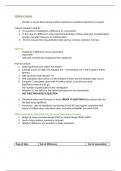
Reductionism vs Holism
Reductionism: explaining and studying a complex behaviour (e.g., SZ) by
social + cultural
breaking it down into its individual parts and studying one part.
- Based on the principle of parsimony (philosophy that the simplest mind
psychological
explanation is the best)
cognition
- Often a reductionist explanation is known as the lowest level of
explanation (tends to be biological explanation e.g., explaining SZ as bio
being caused by neurotransmitters)
- Middle level of explanation environmental reductionism and
cognitive reductionism
- Highest level of explanation is social and cultural explanation
- Psychology itself can be seen as a hierarchy of science (sociology, psychology, biology,
chemistry, and physics)
- Reductionism suggests that lower-level explanations will eventually replace higher level
explanations
-
Levels of explanation
Highest level – cultural and social explanations of behaviour e.g., depression being explained by
a withdrawal from social activities, low energy levels and insomnia, which is viewed as odd by
society
Middle level – psychological explanations of behaviour e.g., depression being explained by
Beck’s negative triad (negative self-schemas, faulty information processing)/ Ellis’ ABC model
(activating event, irrational belief, emotional/ behavioural consequence)
Lower level – biological explanations of behaviour e.g., depression being explained by action of
candidate genes controlling efficiency of synaptic serotonin transport/ neural factors (abnormal
functioning of left Para hippocampal gyrus and lateral frontal lobes)
OCD LEVELS OF EXPLANATION
Socio-cultural level – OCD disrupts social relationships.
Psychological level – the person experiences anxiety.
Physical level – the person is compelled to washing hands multiple times.
Environmental/behavioural level – how the person is learning through experience.
Physiological level – there is abnormal functioning in the frontal lobes.
Neurochemical level – there is an underproduction of serotonin. (biological
reductionism)
Reductionism: explaining and studying a complex behaviour (e.g., SZ) by
social + cultural
breaking it down into its individual parts and studying one part.
- Based on the principle of parsimony (philosophy that the simplest mind
psychological
explanation is the best)
cognition
- Often a reductionist explanation is known as the lowest level of
explanation (tends to be biological explanation e.g., explaining SZ as bio
being caused by neurotransmitters)
- Middle level of explanation environmental reductionism and
cognitive reductionism
- Highest level of explanation is social and cultural explanation
- Psychology itself can be seen as a hierarchy of science (sociology, psychology, biology,
chemistry, and physics)
- Reductionism suggests that lower-level explanations will eventually replace higher level
explanations
-
Levels of explanation
Highest level – cultural and social explanations of behaviour e.g., depression being explained by
a withdrawal from social activities, low energy levels and insomnia, which is viewed as odd by
society
Middle level – psychological explanations of behaviour e.g., depression being explained by
Beck’s negative triad (negative self-schemas, faulty information processing)/ Ellis’ ABC model
(activating event, irrational belief, emotional/ behavioural consequence)
Lower level – biological explanations of behaviour e.g., depression being explained by action of
candidate genes controlling efficiency of synaptic serotonin transport/ neural factors (abnormal
functioning of left Para hippocampal gyrus and lateral frontal lobes)
OCD LEVELS OF EXPLANATION
Socio-cultural level – OCD disrupts social relationships.
Psychological level – the person experiences anxiety.
Physical level – the person is compelled to washing hands multiple times.
Environmental/behavioural level – how the person is learning through experience.
Physiological level – there is abnormal functioning in the frontal lobes.
Neurochemical level – there is an underproduction of serotonin. (biological
reductionism)