Neurons
Neurons
- Cells that conduct nerve impulses are called neurons
- The things that people think and feel, say and do are caused, one way or another, by
electrochemical events occurring within the neurons that make up the nervous
system, particularly those in the brain.
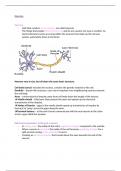
Neurons vary in size, but all share the same basic structure:
Cell body (soma)- includes the nucleus, contains the genetic material of the cell.
Dendrite – branch like structure, carry nerve impulses from neighbouring neurons towards
the cell body.
Axon – carries electrical impulse away from cell body down the length of the neuron.
Myelin sheath – fatty layer that protects the axon and speeds up the electrical
transmission of the impulse.
Nodes of Ranvier – gaps in the myelin sheath speed up transmission of impulse by
forcing it to ‘jump’ across the gaps along the axon.
Terminal buttons – at the end of axon communicate with the next neuron in the chain
across a gap called the synapse.
Electrical transmission firing of a neuron
- In resting state, the inside of the cell is negatively charged compared to the outside.
- When a neuron is activated the inside of the cell becomes positively charged for a
split-second causing action potential to occur.
- Creating an electrical impulse that travels down the axon towards the end of the
neuron.
Neurons
- Cells that conduct nerve impulses are called neurons
- The things that people think and feel, say and do are caused, one way or another, by
electrochemical events occurring within the neurons that make up the nervous
system, particularly those in the brain.
Neurons vary in size, but all share the same basic structure:
Cell body (soma)- includes the nucleus, contains the genetic material of the cell.
Dendrite – branch like structure, carry nerve impulses from neighbouring neurons towards
the cell body.
Axon – carries electrical impulse away from cell body down the length of the neuron.
Myelin sheath – fatty layer that protects the axon and speeds up the electrical
transmission of the impulse.
Nodes of Ranvier – gaps in the myelin sheath speed up transmission of impulse by
forcing it to ‘jump’ across the gaps along the axon.
Terminal buttons – at the end of axon communicate with the next neuron in the chain
across a gap called the synapse.
Electrical transmission firing of a neuron
- In resting state, the inside of the cell is negatively charged compared to the outside.
- When a neuron is activated the inside of the cell becomes positively charged for a
split-second causing action potential to occur.
- Creating an electrical impulse that travels down the axon towards the end of the
neuron.