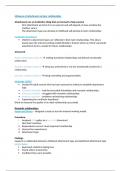
Influence of attachment on later relationships
Attachments are an instinctive thing that are formed to help survival
- First attachment we form it to our parents and will depend on how sensitive the
mothers care is
- The attachment type you develop in childhood will develop in later relationships
Continuity hypothesis
Children’s attachment types are reflected in their later relationships. This idea is
based upon the internal working model (Bowlby’s theory) where an infant’s primarily
attachment forms a model for future relationships
Ainsworth
Secure attachment (type B) seeking functional relationships and behave functionally
within them.
Insecure avoidant (type A) being too uninvolved or not too emotionally involved in a
relationship.
Insecure resistant (type C) being controlling and argumentative.
McCarthy (1999)
Studied 40 adult woman who has been assessed as infants to establish attachment
type.
Securely attached – had the best adult friendships and romantic relationships.
Insecure avoidant – struggled with romantic relationships.
Insecure resistant – problems maintaining relationships.
Supporting the continuity hypothesis
(Hard to measure the quality of an adult relationship accurately)
Romantic relationships:
Hazan and Shaver – designed a study to test the internal working model.
Procedure:
- Analysed 620 replies to a love quiz (American)
- Quiz had 3 sections:
1. Respondents current/ most important relationship
2. General love experiences
3. Attachment type
Findings:
Supports a relationship between childhood attachment type and adulthood attachment type
secure types:
Expressed a belief in lasting love
Found others trustworthy
Confident they were loveable
Attachments are an instinctive thing that are formed to help survival
- First attachment we form it to our parents and will depend on how sensitive the
mothers care is
- The attachment type you develop in childhood will develop in later relationships
Continuity hypothesis
Children’s attachment types are reflected in their later relationships. This idea is
based upon the internal working model (Bowlby’s theory) where an infant’s primarily
attachment forms a model for future relationships
Ainsworth
Secure attachment (type B) seeking functional relationships and behave functionally
within them.
Insecure avoidant (type A) being too uninvolved or not too emotionally involved in a
relationship.
Insecure resistant (type C) being controlling and argumentative.
McCarthy (1999)
Studied 40 adult woman who has been assessed as infants to establish attachment
type.
Securely attached – had the best adult friendships and romantic relationships.
Insecure avoidant – struggled with romantic relationships.
Insecure resistant – problems maintaining relationships.
Supporting the continuity hypothesis
(Hard to measure the quality of an adult relationship accurately)
Romantic relationships:
Hazan and Shaver – designed a study to test the internal working model.
Procedure:
- Analysed 620 replies to a love quiz (American)
- Quiz had 3 sections:
1. Respondents current/ most important relationship
2. General love experiences
3. Attachment type
Findings:
Supports a relationship between childhood attachment type and adulthood attachment type
secure types:
Expressed a belief in lasting love
Found others trustworthy
Confident they were loveable