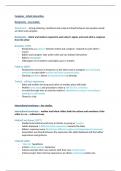
Caregiver - infant interaction
Reciprocity – key studies
Attachment – strong enduring, emotional and reciprocal bond between two people usually
an infant and caregiver.
Reciprocity – infant and mother respond to each other’s signal, and each elicit a response
from the other
Brazelton (1975)
- Reciprocity as a ‘dance’ between infant and caregiver, respond to each other’s
moves
- Babies and caregiver take active roles and can initiate interactions
- Baby is not passive
- Videotapes of 12 mothers and babies up to 5 months
Feldman (2007)
- Reciprocity increases in frequency as the infant and as caregiver pay increasing
attention to each other’s verbal and facial communication
- Showing attention allows strong attachment to develop
Tronick – still face experiment
- Baby and mother sit facing each other as mother plays with baby
- Mother turns away and proceeds to show a still face for 2 minutes
- In result the baby tries to seek the mother’s attention by crying or screaming or
attempts to self-soothe
- Filmed in a lab
Interactional synchrony – key studies
Interactional synchrony – mother and infant reflect both the actions and emotions of the
other in a co – ordinated way
Meltzoff and Moore (1977)
- Studied interactional synchrony in infants as young as 3 weeks
- Adults displayed 3 different facial expressions towards the baby
- Babies’ responses were filmed from different angles and independently observed
- Association was found between the expression the adult displayed and the babies’
expressions and gestures
Meltzoff (2005)
- “Like me” hypothesis
- Infants imitate and see behaviour
- Infants associate their own actions with their own mental states
- Infants project their internal experiences to others performing similar acts
Reciprocity – key studies
Attachment – strong enduring, emotional and reciprocal bond between two people usually
an infant and caregiver.
Reciprocity – infant and mother respond to each other’s signal, and each elicit a response
from the other
Brazelton (1975)
- Reciprocity as a ‘dance’ between infant and caregiver, respond to each other’s
moves
- Babies and caregiver take active roles and can initiate interactions
- Baby is not passive
- Videotapes of 12 mothers and babies up to 5 months
Feldman (2007)
- Reciprocity increases in frequency as the infant and as caregiver pay increasing
attention to each other’s verbal and facial communication
- Showing attention allows strong attachment to develop
Tronick – still face experiment
- Baby and mother sit facing each other as mother plays with baby
- Mother turns away and proceeds to show a still face for 2 minutes
- In result the baby tries to seek the mother’s attention by crying or screaming or
attempts to self-soothe
- Filmed in a lab
Interactional synchrony – key studies
Interactional synchrony – mother and infant reflect both the actions and emotions of the
other in a co – ordinated way
Meltzoff and Moore (1977)
- Studied interactional synchrony in infants as young as 3 weeks
- Adults displayed 3 different facial expressions towards the baby
- Babies’ responses were filmed from different angles and independently observed
- Association was found between the expression the adult displayed and the babies’
expressions and gestures
Meltzoff (2005)
- “Like me” hypothesis
- Infants imitate and see behaviour
- Infants associate their own actions with their own mental states
- Infants project their internal experiences to others performing similar acts