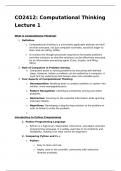
CO2412: Computational Thinking
Lecture 1
What is Computational Thinking?
1. Definition
o Computational thinking is a universally applicable attitude and skill
set that everyone, not just computer scientists, would be eager to
learn and use (Wing, 2006).
o It involves the thought processes required to formulate problems
and their solutions so that the solutions can be effectively executed
by an information-processing agent (Cuny, Snyder, and Wing,
2010).
2. Role of Computers in Problem Solving
o Computers assist in solving problems by executing well-defined
steps. However, before a problem can be tackled by a computer, it
must first be understood and broken down into solvable parts.
3. Four Aspects of Computational Thinking
o Decomposition: Breaking down a complex problem or system into
smaller, more manageable parts.
o Pattern Recognition: Identifying similarities among and within
problems.
o Abstraction: Focusing on the essential information while ignoring
irrelevant details.
o Algorithms: Developing a step-by-step solution to the problem or
rules to follow to solve the problem.
o
Introduction to Python Programming
1. Python Programming Language
o Python is a high-level, interpreted, interactive, and object-oriented
programming language. It is widely used due to its simplicity and
readability, making it an ideal choice for beginners.
2. Comparing Python and C++
o Python:
o Easy to learn and use.
o Highly used in the scientific community with extensive
libraries available.
Lecture 1
What is Computational Thinking?
1. Definition
o Computational thinking is a universally applicable attitude and skill
set that everyone, not just computer scientists, would be eager to
learn and use (Wing, 2006).
o It involves the thought processes required to formulate problems
and their solutions so that the solutions can be effectively executed
by an information-processing agent (Cuny, Snyder, and Wing,
2010).
2. Role of Computers in Problem Solving
o Computers assist in solving problems by executing well-defined
steps. However, before a problem can be tackled by a computer, it
must first be understood and broken down into solvable parts.
3. Four Aspects of Computational Thinking
o Decomposition: Breaking down a complex problem or system into
smaller, more manageable parts.
o Pattern Recognition: Identifying similarities among and within
problems.
o Abstraction: Focusing on the essential information while ignoring
irrelevant details.
o Algorithms: Developing a step-by-step solution to the problem or
rules to follow to solve the problem.
o
Introduction to Python Programming
1. Python Programming Language
o Python is a high-level, interpreted, interactive, and object-oriented
programming language. It is widely used due to its simplicity and
readability, making it an ideal choice for beginners.
2. Comparing Python and C++
o Python:
o Easy to learn and use.
o Highly used in the scientific community with extensive
libraries available.