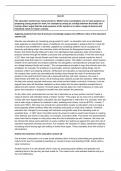
Item B
The education system has many functions. Whilst some sociologists see its main purpose as
preparing young people for work, for example by acting as a bridge between the family and
society others argue that the main purpose of the system is to meet a range of diverse and
individual needs in today’s society.
Applying material from item B and your knowledge analyse two different roles of the education
system (10)
Marxists see education as “preparing young people for work”, as education acts as an ideological
state apparatus to indoctrinate values of obedience into young people to prepare them for a work life
of boredom and unfulfillment. It benefits capitalism by socialising children into an acceptance of
hierarchy and taking orders from teachers which will become the Bourgeoisie bosses later in life.
Bowles and Gintis develop Althusser's idea of an ideological state apparatus state school helps to
produce workers through the hidden curriculum and correspondence principle. From their own study
of 237 New York high schools Bowles and Gintis conclude that schools reward exactly the kind of
personality traits that make for a submissive, compliant worker. The hidden curriculum, which teaches
children to be submissive and respect authority runs alongside a correspondence principle that “acts
as a bridge between family and society”. The correspondence principle is ways that schools mirror the
workplace, for example, the emphasis on punctuality, extrinsic satisfaction (doing things only for
rewards), uniform and obeying authority. All Marxists see education as reproducing and legitimising
the unequal class system by persuading the working class through the myth of meritocracy their
position in the world and their future job is deserved and their own fault. However, this view is
deterministic and Willis has shown not all working class students accept their positions. Willis studied
the lads who actively rejected meritocracy and school and the hidden curriculum. However, it can be
argued these lads still benefited capitalism as they slotted into the jobs capitalism needed them to
(dead end and routine). However, feminists argue marxists place too much emphasis on class and
ignore how education is designed to benefit men and maintain the patriarchy.
On the other hand, postmodernists see the role of education as a more positive one that “meets a
range of diverse and individual needs in today’s society”. They argue as we move into a postmodern
society with more fragmentation, education has also fragmented to reflect this. For example, there are
now a wide range of options for students to take, enabling more choice, such as BTECs, A levels, T
levels and CTECs. We have now moved into a post-fordism society so education's role is to equip a
technologically skilled workforce filled with creativity and based on small niche markets. Therefore,
education has changed to encourage self motivation and growth away from alienating work on
assembly lines. In 1997 when Tony Blair came into power he said he would invest heavily in creating
more diversity and choice in education, for example, Curriculum 2000. This shows how postmodernist
views have had an impact on how policy views the role of education as well. However, this view can
be criticised for being overly optimistic as many coalition Gov policies go against the views the role of
education represents diversity and choice. For example, the emphasis on Ebacc (traditional subjects),
increasing school leaving age and making A levels linear again. These examples show how choice is
still restricted.
Outline two functions of the education system (4)
One function of education is to create social solidarity which it does by transmitting one generation's
culture to the next for example by teaching our country's history and teaching PSHE, which instils a
value consensus.
Another function is to role allocate which it does by assessing pupils abilities and aptitudes and
matching them to the job they are best suited for. This makes sure most talented students end up in
the most skillful jobs.
The education system has many functions. Whilst some sociologists see its main purpose as
preparing young people for work, for example by acting as a bridge between the family and
society others argue that the main purpose of the system is to meet a range of diverse and
individual needs in today’s society.
Applying material from item B and your knowledge analyse two different roles of the education
system (10)
Marxists see education as “preparing young people for work”, as education acts as an ideological
state apparatus to indoctrinate values of obedience into young people to prepare them for a work life
of boredom and unfulfillment. It benefits capitalism by socialising children into an acceptance of
hierarchy and taking orders from teachers which will become the Bourgeoisie bosses later in life.
Bowles and Gintis develop Althusser's idea of an ideological state apparatus state school helps to
produce workers through the hidden curriculum and correspondence principle. From their own study
of 237 New York high schools Bowles and Gintis conclude that schools reward exactly the kind of
personality traits that make for a submissive, compliant worker. The hidden curriculum, which teaches
children to be submissive and respect authority runs alongside a correspondence principle that “acts
as a bridge between family and society”. The correspondence principle is ways that schools mirror the
workplace, for example, the emphasis on punctuality, extrinsic satisfaction (doing things only for
rewards), uniform and obeying authority. All Marxists see education as reproducing and legitimising
the unequal class system by persuading the working class through the myth of meritocracy their
position in the world and their future job is deserved and their own fault. However, this view is
deterministic and Willis has shown not all working class students accept their positions. Willis studied
the lads who actively rejected meritocracy and school and the hidden curriculum. However, it can be
argued these lads still benefited capitalism as they slotted into the jobs capitalism needed them to
(dead end and routine). However, feminists argue marxists place too much emphasis on class and
ignore how education is designed to benefit men and maintain the patriarchy.
On the other hand, postmodernists see the role of education as a more positive one that “meets a
range of diverse and individual needs in today’s society”. They argue as we move into a postmodern
society with more fragmentation, education has also fragmented to reflect this. For example, there are
now a wide range of options for students to take, enabling more choice, such as BTECs, A levels, T
levels and CTECs. We have now moved into a post-fordism society so education's role is to equip a
technologically skilled workforce filled with creativity and based on small niche markets. Therefore,
education has changed to encourage self motivation and growth away from alienating work on
assembly lines. In 1997 when Tony Blair came into power he said he would invest heavily in creating
more diversity and choice in education, for example, Curriculum 2000. This shows how postmodernist
views have had an impact on how policy views the role of education as well. However, this view can
be criticised for being overly optimistic as many coalition Gov policies go against the views the role of
education represents diversity and choice. For example, the emphasis on Ebacc (traditional subjects),
increasing school leaving age and making A levels linear again. These examples show how choice is
still restricted.
Outline two functions of the education system (4)
One function of education is to create social solidarity which it does by transmitting one generation's
culture to the next for example by teaching our country's history and teaching PSHE, which instils a
value consensus.
Another function is to role allocate which it does by assessing pupils abilities and aptitudes and
matching them to the job they are best suited for. This makes sure most talented students end up in
the most skillful jobs.