
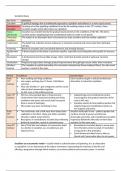
Socialism Boxes
Key Term Definition
Socialism A political ideology that is traditionally opposed to capitalism and believes in a more equal society.
Revolutionary Growing out of the appalling conditions faced by the working-classes in the 19 th century, these
Socialists socialists sought radical alternatives to capitalism.
Social Socialism was transformed by the gradual improvements in the conditions of the WC. This led to
Democrats socialist parties adopting legal and constitutional tactics in order to win power.
Third-Way The notion of an alternative form of economics to state socialism and free-market capitalism.
socialism
Collectivism The belief that collective human endeavour is of greater practical and moral value than individual
striving.
Fraternity Bonds of sympathy and comradeship between and amongst humans.
Egalitarianis A theory based on the desire to promote equality, especially social inequality and equality of outcome.
m
Revolution A fundamental and irreversible change, often a brief but dramatic period of upheaval. Systemic
change.
Gradualism Progress brought about through gradual improvements through legal means rather than revolution.
Workers’ The complete or partial ownership of an economic enterprise by those employed there. Can also mean
Control workers’ control of the state.
Period Conditions Socialist Ideas
Early Poor working and living conditions. Early socialists sought a radical/revolutionary
19th Low wages, working days 12 hours, child labour alternative to industrial capitalism.
Century common.
Most city-dwellers 1st gen immigrants and few social
clubs to bind communities together.
No WC voice in the political process
Late 19th WC lives show gradual signs of improvement – Adopted legal and constitutional tactics,
Century social reforms have improved working and living encouraged by the gradual extension of the
conditions and sports and social clubs have given vote to WC men.
them a sense of belonging Socialists started to form political parties that
WC people now have something to lose adopted legal and constitutional tactics to
win support and power.
Early Two world wars and a shift away from laissez-faire Socialist world split in two – political parties that
20th capitalism in the West. Many gvts (often socialist) continue to look to govern and become
Century introduce radical social reforms. electorally successful, and revolutionary socialists
Resurgence in revolutionary socialist ideas following inspired by Bolsheviks who take on their ideas
Bolshevik revolution, mainly in colonised areas. verbatim (in the same way).
Late 20th End of Cold War and collapse of communism leads Revolutionary Socialists begin to move away
Century to a decline in socialism as a revolutionary and from Marxist-Leninist concept of revolution
electoral force. and go back to first principles.
Social Democrats often have to take on
Liberal and Conservative ideas to win power.
Socialism as an economic model = Usually linked to collectivisation and planning; it is an alternative
to capitalism. It is an instrument of the labour movement, representing the interests of the WC and
offering a programme through which workers can achieve political and economic power. It consists
, of a broad cluster of ideas, values and theories, based largely around the twin concepts of
collectivism and social equality.
General Socialist Views
Human Human nature is plastic and flexible. Human behaviour tells us about the society in which we live. Human
Nature skills and attributes are learnt from society; in the right society, for humans anything is possible. Human
beings cannot be thought of as self-sufficient and atomistic (made up of many simple elements). People are
perfectible. They take an optimistic view – individuals are naturally cooperative, altruistic and generous.
Humans naturally seek solidarity, fraternity and comradeship. However, mankind’s true nature has been
diluted by time and circumstance.
Economy Capitalism creates greed, selfishness and competitiveness.
Society Society should be organised in order to promote collectivism. Some socialists have a utopian view of society
which sees humans as social creatures capable of overcoming social and economic problems by drawing on
the power of the community rather than individual effort. Individuals are the product of the society into
which they were born. Society is an independent construct formed by impersonal forces which shapes the
individuals inside it.
Liberty Share a belief to liberate humans from oppression.
Equality Believe in ‘foundational’ equality – men and women are born equal and deserve equal opportunities in life.
The state should treat everyone equally so as to ensure that everyone has level chance to fulfil their
potential. Socialists argue that a society which allows inequality of outcome in one generation will be a
society that produces inequality of opportunity in the next generation.
The Reject the ‘traditional’ state (defined by monarchical absolutism and the divine right of rulers). Reject
State anarchism, believing that a certain type of state can secure significant progress in terms of freedom and
foundational equality. Without a strong state, it will be impossible to bring about a fairer and more equal
society. Reduction of state power would most likely produce increased social and economic inequality.
Social An individual’s status, priorities and prospects are shaped by the class they are born into. Society’s classes
Class tend to be profoundly unequal in terms of power and influence. Unless there is a narrowing of the gap
between social classes, society will continue to lack fraternity, cooperation and solidarity.
Socialist Subtradition Ideas
The State
Revolutionary A centralised state should be the vehicle for collective Marx – the state will eventually
action. The state would always serve the interests of “wither away”
whichever class controlled the economy.
Social Elected government should promote collectivism alongside Crosland - Democratic socialist
Democrats individualism in order to reform capitalism. The defects of governments (e.g. Labour 1945-51)
capitalism can be rectified through state intervention. prove that the existing state can be
Welfare can humanise capitalism as it provides a way of used to effect radical, socialist change.
sharing common wealth to reduce inequality.
Third Way The existing state can be used to steer society towards Giddens – The existing liberal state
socialist values and the traditional state in a capitalist should be improved, redistributing and
society requires constitutional reform rather than abolition. decentralising political power whilst
encouraging greater political
participation.
Equality
Revolutionary Equality of outcome, where rewards should be equal Marx & Engels – “from each according
regardless of contribution to production. All individuals to his ability to each according to his
should receive the same rewards as long as they make a needs”
contribution to the best of their ability. We are all entitled
to be treated equally by the state and to exercise our rights
Key Term Definition
Socialism A political ideology that is traditionally opposed to capitalism and believes in a more equal society.
Revolutionary Growing out of the appalling conditions faced by the working-classes in the 19 th century, these
Socialists socialists sought radical alternatives to capitalism.
Social Socialism was transformed by the gradual improvements in the conditions of the WC. This led to
Democrats socialist parties adopting legal and constitutional tactics in order to win power.
Third-Way The notion of an alternative form of economics to state socialism and free-market capitalism.
socialism
Collectivism The belief that collective human endeavour is of greater practical and moral value than individual
striving.
Fraternity Bonds of sympathy and comradeship between and amongst humans.
Egalitarianis A theory based on the desire to promote equality, especially social inequality and equality of outcome.
m
Revolution A fundamental and irreversible change, often a brief but dramatic period of upheaval. Systemic
change.
Gradualism Progress brought about through gradual improvements through legal means rather than revolution.
Workers’ The complete or partial ownership of an economic enterprise by those employed there. Can also mean
Control workers’ control of the state.
Period Conditions Socialist Ideas
Early Poor working and living conditions. Early socialists sought a radical/revolutionary
19th Low wages, working days 12 hours, child labour alternative to industrial capitalism.
Century common.
Most city-dwellers 1st gen immigrants and few social
clubs to bind communities together.
No WC voice in the political process
Late 19th WC lives show gradual signs of improvement – Adopted legal and constitutional tactics,
Century social reforms have improved working and living encouraged by the gradual extension of the
conditions and sports and social clubs have given vote to WC men.
them a sense of belonging Socialists started to form political parties that
WC people now have something to lose adopted legal and constitutional tactics to
win support and power.
Early Two world wars and a shift away from laissez-faire Socialist world split in two – political parties that
20th capitalism in the West. Many gvts (often socialist) continue to look to govern and become
Century introduce radical social reforms. electorally successful, and revolutionary socialists
Resurgence in revolutionary socialist ideas following inspired by Bolsheviks who take on their ideas
Bolshevik revolution, mainly in colonised areas. verbatim (in the same way).
Late 20th End of Cold War and collapse of communism leads Revolutionary Socialists begin to move away
Century to a decline in socialism as a revolutionary and from Marxist-Leninist concept of revolution
electoral force. and go back to first principles.
Social Democrats often have to take on
Liberal and Conservative ideas to win power.
Socialism as an economic model = Usually linked to collectivisation and planning; it is an alternative
to capitalism. It is an instrument of the labour movement, representing the interests of the WC and
offering a programme through which workers can achieve political and economic power. It consists
, of a broad cluster of ideas, values and theories, based largely around the twin concepts of
collectivism and social equality.
General Socialist Views
Human Human nature is plastic and flexible. Human behaviour tells us about the society in which we live. Human
Nature skills and attributes are learnt from society; in the right society, for humans anything is possible. Human
beings cannot be thought of as self-sufficient and atomistic (made up of many simple elements). People are
perfectible. They take an optimistic view – individuals are naturally cooperative, altruistic and generous.
Humans naturally seek solidarity, fraternity and comradeship. However, mankind’s true nature has been
diluted by time and circumstance.
Economy Capitalism creates greed, selfishness and competitiveness.
Society Society should be organised in order to promote collectivism. Some socialists have a utopian view of society
which sees humans as social creatures capable of overcoming social and economic problems by drawing on
the power of the community rather than individual effort. Individuals are the product of the society into
which they were born. Society is an independent construct formed by impersonal forces which shapes the
individuals inside it.
Liberty Share a belief to liberate humans from oppression.
Equality Believe in ‘foundational’ equality – men and women are born equal and deserve equal opportunities in life.
The state should treat everyone equally so as to ensure that everyone has level chance to fulfil their
potential. Socialists argue that a society which allows inequality of outcome in one generation will be a
society that produces inequality of opportunity in the next generation.
The Reject the ‘traditional’ state (defined by monarchical absolutism and the divine right of rulers). Reject
State anarchism, believing that a certain type of state can secure significant progress in terms of freedom and
foundational equality. Without a strong state, it will be impossible to bring about a fairer and more equal
society. Reduction of state power would most likely produce increased social and economic inequality.
Social An individual’s status, priorities and prospects are shaped by the class they are born into. Society’s classes
Class tend to be profoundly unequal in terms of power and influence. Unless there is a narrowing of the gap
between social classes, society will continue to lack fraternity, cooperation and solidarity.
Socialist Subtradition Ideas
The State
Revolutionary A centralised state should be the vehicle for collective Marx – the state will eventually
action. The state would always serve the interests of “wither away”
whichever class controlled the economy.
Social Elected government should promote collectivism alongside Crosland - Democratic socialist
Democrats individualism in order to reform capitalism. The defects of governments (e.g. Labour 1945-51)
capitalism can be rectified through state intervention. prove that the existing state can be
Welfare can humanise capitalism as it provides a way of used to effect radical, socialist change.
sharing common wealth to reduce inequality.
Third Way The existing state can be used to steer society towards Giddens – The existing liberal state
socialist values and the traditional state in a capitalist should be improved, redistributing and
society requires constitutional reform rather than abolition. decentralising political power whilst
encouraging greater political
participation.
Equality
Revolutionary Equality of outcome, where rewards should be equal Marx & Engels – “from each according
regardless of contribution to production. All individuals to his ability to each according to his
should receive the same rewards as long as they make a needs”
contribution to the best of their ability. We are all entitled
to be treated equally by the state and to exercise our rights


