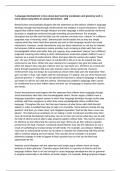
‘Language development is less about just learning vocabulary and grammar and is
more about using them in social interactions.’ (30)
Behaviourists would partially disagree with the statement as they believe children's language
develops through learning through reinforcement and imitation in social interactions. Skinner
argued that children learn through imitation and their language is either positively reinforced
by praise or negatively reinforced through rewording and punishment. For example,
throughout the text Mia and Karl both use the common concrete noun “cheese” in a different
pragmatic way of meaning ‘smile’. Behaviourists would explain this as they are simply
copying what they have heard their parents say and so their language results from social
interactions. However, social interactionist may see these utterances as not due to imitation
but because children experience routine activities such as taking a photo with their more
knowledgeable others and rather than just copying, they understand ‘cheese’ has a different
pragmatic meaning when taking a photo. Behaviourisst would also explain children's use of
manners as a result of reinforcement. When Karl gives Mia the camera she replies “thank
you”, the use of these manners have no real benefit to Mia so it can be argued she was
reinforced to use them. When she uses manners her caregivers may give her praise and
when she doesn’t they may give criticism such as ‘say thank you’, therefore as a result and
learnt through experience Mia now uses manners due to being reinforced. However,
reinforcement may not always be successful as shown when Dad uses the imperative “then
give it to Mia” to Karl. Karl replies with the verb phrase “I’m taking”, the use of the first person
personal pronoun “I”, indicates he has ignored his Dad and is using his language to disagree
and state it is still his turn with the camera. Showing how children's language often cannot
be conditioned due to their selfish nature and their use of language to express their actions
and needs.
Social interactionists would agree with the statement that children learn language through
social interactions with their more knowledgeable others. Bruner argues children have a
language acquisition support system in which their language develops through routine play
activities with their caregivers in which their more knowledgeable others scaffold their
language. Throughout the text, the Dad uses features of what Snow calls child directed
speech in order to scaffold their play to help it run smoothly. Some features include the tag
question “and then you share okay” and mitigated imperative “Karl let Mia have a turn now
please”. The Dad puts an emphasis on turn taking in order to help Karl and Mia close their
zone of proximal development (what they can do on their own versus what they can do with
the help of others) and be able to play properly together without help. This can be shown to
be effective as Karl offers Mia the camera and says “there you go Mia” without a specific
prompt from the Dad. However, functional based theories may see this utterance as not a
result of scaffolding but instead simply to fulfil needs. For example, according to Halliday it
may have an interactional function as he wants to maintain his relationship with Mia and be
able to continue playing and turn taking. This may also be an example of a positive
politeness strategy in order to appeal to Mia’s positive face so Karl can be liked and
appreciated by her.
Nativists would disagree with the statement and simply argue children have an innate
tendency to learn grammar. Chomsky argues that there is a poverty of stimulus and the
language children hear is not rich enough to cause language development and so grammar
is acquired universally in all children at similar stages. For example, Bellugi proposed stages
more about using them in social interactions.’ (30)
Behaviourists would partially disagree with the statement as they believe children's language
develops through learning through reinforcement and imitation in social interactions. Skinner
argued that children learn through imitation and their language is either positively reinforced
by praise or negatively reinforced through rewording and punishment. For example,
throughout the text Mia and Karl both use the common concrete noun “cheese” in a different
pragmatic way of meaning ‘smile’. Behaviourists would explain this as they are simply
copying what they have heard their parents say and so their language results from social
interactions. However, social interactionist may see these utterances as not due to imitation
but because children experience routine activities such as taking a photo with their more
knowledgeable others and rather than just copying, they understand ‘cheese’ has a different
pragmatic meaning when taking a photo. Behaviourisst would also explain children's use of
manners as a result of reinforcement. When Karl gives Mia the camera she replies “thank
you”, the use of these manners have no real benefit to Mia so it can be argued she was
reinforced to use them. When she uses manners her caregivers may give her praise and
when she doesn’t they may give criticism such as ‘say thank you’, therefore as a result and
learnt through experience Mia now uses manners due to being reinforced. However,
reinforcement may not always be successful as shown when Dad uses the imperative “then
give it to Mia” to Karl. Karl replies with the verb phrase “I’m taking”, the use of the first person
personal pronoun “I”, indicates he has ignored his Dad and is using his language to disagree
and state it is still his turn with the camera. Showing how children's language often cannot
be conditioned due to their selfish nature and their use of language to express their actions
and needs.
Social interactionists would agree with the statement that children learn language through
social interactions with their more knowledgeable others. Bruner argues children have a
language acquisition support system in which their language develops through routine play
activities with their caregivers in which their more knowledgeable others scaffold their
language. Throughout the text, the Dad uses features of what Snow calls child directed
speech in order to scaffold their play to help it run smoothly. Some features include the tag
question “and then you share okay” and mitigated imperative “Karl let Mia have a turn now
please”. The Dad puts an emphasis on turn taking in order to help Karl and Mia close their
zone of proximal development (what they can do on their own versus what they can do with
the help of others) and be able to play properly together without help. This can be shown to
be effective as Karl offers Mia the camera and says “there you go Mia” without a specific
prompt from the Dad. However, functional based theories may see this utterance as not a
result of scaffolding but instead simply to fulfil needs. For example, according to Halliday it
may have an interactional function as he wants to maintain his relationship with Mia and be
able to continue playing and turn taking. This may also be an example of a positive
politeness strategy in order to appeal to Mia’s positive face so Karl can be liked and
appreciated by her.
Nativists would disagree with the statement and simply argue children have an innate
tendency to learn grammar. Chomsky argues that there is a poverty of stimulus and the
language children hear is not rich enough to cause language development and so grammar
is acquired universally in all children at similar stages. For example, Bellugi proposed stages