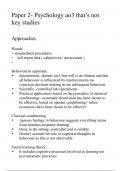
Paper 2- Psychology ao3 that’s not
key studies
Approaches
Wundt:
+ standardised procedures
⁃ self report data ( subjectivity/ not accurate )
⁃
Behaviourist approach:
• deterministic: skinner says free will is an illusion and that
all behaviour is influenced by reinforcement- no
conscious decision making in our subsequent behaviour
• Scientific- controlled lab experiments
• Practical application- based on the principles of classical
conditioning> systematic densitstion has been shown to
be effective, based on operant conditioning> token
economies have been shown to be effective
Classical conditioning
• Ignores biology in behaviour suggests everything stems
from stimulus-response learning
• Done in lab setting- controlled and is reliable
• Doesn’t account for role or cognition thoughts in
behaviour as this is not observable
Social learning theory:
• it includes cognitive processes involved in learning not
just automatic processes
, • Only accounts for immediate effects doesn’t look at the
long term change of behaviour also only conducted on
children behaviour not adults
• Still ignores biology- behaviour may be innate not just
environmentally determined
• Uses lab studies so good control and cna determine cause
and effect but May not reflect real life situations so lacks
ecological validty
Cognitive approach:
• Lacks ecological validity> conducted in labs and the
thought processes measured could be argued to be
artificial due to the context and tasks performed
• Deterministic> suggests ppl are mechanistic and lack free
will, does recognise internal processes that behaviourism
doesn’t do
• Over simplified> theoretical models can simplify
complex processes. For example role of emotion is
sometimes overlooked and so a computer analogy is not a
valid way of explaining mental processes
• Schemas and theoretical models are hard to scientifically
measure
The biological approach:
• been tested using highly scientific methods such as brain
scans and twin/ family studies> objective
• Has many practical applications> use of drugs to treat
mental illness SSRIs
• Does not take into account the influence of the
environment on behaviour- looks purely on nature not
nurture
key studies
Approaches
Wundt:
+ standardised procedures
⁃ self report data ( subjectivity/ not accurate )
⁃
Behaviourist approach:
• deterministic: skinner says free will is an illusion and that
all behaviour is influenced by reinforcement- no
conscious decision making in our subsequent behaviour
• Scientific- controlled lab experiments
• Practical application- based on the principles of classical
conditioning> systematic densitstion has been shown to
be effective, based on operant conditioning> token
economies have been shown to be effective
Classical conditioning
• Ignores biology in behaviour suggests everything stems
from stimulus-response learning
• Done in lab setting- controlled and is reliable
• Doesn’t account for role or cognition thoughts in
behaviour as this is not observable
Social learning theory:
• it includes cognitive processes involved in learning not
just automatic processes
, • Only accounts for immediate effects doesn’t look at the
long term change of behaviour also only conducted on
children behaviour not adults
• Still ignores biology- behaviour may be innate not just
environmentally determined
• Uses lab studies so good control and cna determine cause
and effect but May not reflect real life situations so lacks
ecological validty
Cognitive approach:
• Lacks ecological validity> conducted in labs and the
thought processes measured could be argued to be
artificial due to the context and tasks performed
• Deterministic> suggests ppl are mechanistic and lack free
will, does recognise internal processes that behaviourism
doesn’t do
• Over simplified> theoretical models can simplify
complex processes. For example role of emotion is
sometimes overlooked and so a computer analogy is not a
valid way of explaining mental processes
• Schemas and theoretical models are hard to scientifically
measure
The biological approach:
• been tested using highly scientific methods such as brain
scans and twin/ family studies> objective
• Has many practical applications> use of drugs to treat
mental illness SSRIs
• Does not take into account the influence of the
environment on behaviour- looks purely on nature not
nurture