Describe and evaluate research into caregiver-infant interactions (6+10).
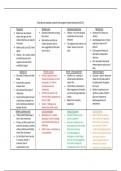
Reciprocity Brazleton et al Interactional Synchrony Meltzoff et al
• Babies have ‘alert phases’ • Describes interactions as being • Feldman – this is the temporal • Observed IS in infants and
where they signal to their like a dance coordination of micro-level mothers
mothers that they are ready for • Both mother and child can behaviour • Adult displayed one of 3 facial
interaction initiate interaction and it’s • This happens when mother and expressions and one of 3
• Mothers pick up on 2/3 of alert been suggested that they take infants’ actions mirror each gestures
signals turns to do so other • Child response filmed and
• Feldman – At 3 months, mother observed by independent
and infant become more observers
responsive to each other’s • Clear association discovered
verbal/facial signals between gesture and action of
baby
Isabella et al Difficult to assess Parent – infant attachment Attachment figures
• Observed 30 mothers and their • All that’s observed is the is • Schaffer et al – majority of • Grossman – parent’s behaviour
babies changes in expression or hand infants become attached to impact on child and quality of
• Assessed the synchrony movement so it’s hard to mother first the attachments throughout
between them accurately assess the • 75% of infants, attachment to their teens
• Also observed the quality of relationship father happened by 18 months • Mothers’ attachment more
relationship • Hard to know what it’s like was shown through separation significant, quality of father’s
• Found that the higher the level from the infant’s perspective as anxiety play more important in
of synchrony, the greater the they can’t talk • Babies form secondary developing adolescent
level of emotional attachment • Gratier – Findings across attachment attachments
between the two. studies show similar results
Fathers as primary carers Lack of consistency Biological approach Socially sensitive
• Tiffany Fields filmed babies in • MacCallum et al – children • Why don’t fathers become • Certain families & reactions
face-to-face interactions. growing up in same sex/single primary caregivers? from mothers are significant.
• Primary c-g fathers spent more parent families don’t grow up • Because of traditional roles Some child rearing practices
time than secondary c-g fathers differently being reinforced of the mother seen as putting a child in a
smiling, imitating, and holding • Father’s role as a secondary c-g being more nurturing socially disadvantaged position
infants, like the mothers is not significant • Could be biological as • Mothers returning to world too
• So, the fathers have a key role oestrogen can create higher soon could be seen as
in nurturing. Gender is levels of nurturing suggesting restricting opportunities for
irrelevant, level of the female is biologically interactional synchrony
responsiveness is key predisposed to take on this role • Implications for maternity leave
, Outline and Evaluate Schaffer’s stages of attachment (6+10).
Schaffer et al Findings Asocial stage Indiscriminate attachment
• 60 babies from Glasgow and • 25 and 32 weeks, 50% infants • Babies behaving similarly to • Babies start to show preference
working-class families were had separation anxiety towards non-human objects and for people rather than objects.
visited every month for a year adult (specific attachment). This humans. • Recognise and prefer family
and at 18 months old. attachment towards the person • They show some preference to members.
• Mothers questioned about the the infant shared the most humans, who have a more • Accept cuddles and comfort
baby’s progress in seven facial expressions/gestures calming influence. from any adult.
everyday separations. This = • By 40 weeks, 80% of babies • Babies are also happier when in • Don’t show separation
measure of separation anxiety. formed a specific attachment the presence of humans anxiety/stranger anxiety.
Also examined stranger anxiety and 30% of babies had formed • Attachment to anybody who
multiple attachments offers them comfort/ security
Specific attachment Multiple attachments Method Evaluation Strengths
• Babies start to show separation • babies form attachments with • Schaffer et al used self-report • Longitudinal study so the same
anxiety and stranger anxiety. other adults who they met on a and observation. children were followed up.
• Become distressed when regular basis. • Observations took place in the • Better internal validity than
separated from primary carer in • This is secondary attachment infants’ homes. (natural) cross-section as there’s fewer
65% of cases. • 29% of children developed • Stranger anxiety reported in confounding variables
• Most formed specific secondary attachment within a response to researchers’ • Less individual differences as
attachment to them month of forming specific presence in room, but they babies are the PPs
• This is the carer that responds attachment. might not be strangers • Sample size of 60 babies is
to the baby’s signals the best • After a year, most babies had anymore. large, producing lots of data
and interacts the most formed multiple attachments • The mum might be dishonest
Limitations Issues with asocial stage More limitations
• However, the use of the same • Asocial stage debatable as • Most evidence suggests
district, in the same city, with babies form many attachments multiple attachments follow
the same social class of families during this time. specific attachment stage
is a limitation. • Isn’t much observable (Bolwby 1969).
• It also took place in the 1960s behaviour at this stage in • Not clear when multiple
so results do not generalise well development so observations attachment stage starts to
as they could be culturally and could be interpreted poorly form.
historically biased. • So, it could be that the • Other psychologists suggest in
• Lacks temporal validity evidence cannot be relied upon Collectivist cultures, multiple
attachments are made
Reciprocity Brazleton et al Interactional Synchrony Meltzoff et al
• Babies have ‘alert phases’ • Describes interactions as being • Feldman – this is the temporal • Observed IS in infants and
where they signal to their like a dance coordination of micro-level mothers
mothers that they are ready for • Both mother and child can behaviour • Adult displayed one of 3 facial
interaction initiate interaction and it’s • This happens when mother and expressions and one of 3
• Mothers pick up on 2/3 of alert been suggested that they take infants’ actions mirror each gestures
signals turns to do so other • Child response filmed and
• Feldman – At 3 months, mother observed by independent
and infant become more observers
responsive to each other’s • Clear association discovered
verbal/facial signals between gesture and action of
baby
Isabella et al Difficult to assess Parent – infant attachment Attachment figures
• Observed 30 mothers and their • All that’s observed is the is • Schaffer et al – majority of • Grossman – parent’s behaviour
babies changes in expression or hand infants become attached to impact on child and quality of
• Assessed the synchrony movement so it’s hard to mother first the attachments throughout
between them accurately assess the • 75% of infants, attachment to their teens
• Also observed the quality of relationship father happened by 18 months • Mothers’ attachment more
relationship • Hard to know what it’s like was shown through separation significant, quality of father’s
• Found that the higher the level from the infant’s perspective as anxiety play more important in
of synchrony, the greater the they can’t talk • Babies form secondary developing adolescent
level of emotional attachment • Gratier – Findings across attachment attachments
between the two. studies show similar results
Fathers as primary carers Lack of consistency Biological approach Socially sensitive
• Tiffany Fields filmed babies in • MacCallum et al – children • Why don’t fathers become • Certain families & reactions
face-to-face interactions. growing up in same sex/single primary caregivers? from mothers are significant.
• Primary c-g fathers spent more parent families don’t grow up • Because of traditional roles Some child rearing practices
time than secondary c-g fathers differently being reinforced of the mother seen as putting a child in a
smiling, imitating, and holding • Father’s role as a secondary c-g being more nurturing socially disadvantaged position
infants, like the mothers is not significant • Could be biological as • Mothers returning to world too
• So, the fathers have a key role oestrogen can create higher soon could be seen as
in nurturing. Gender is levels of nurturing suggesting restricting opportunities for
irrelevant, level of the female is biologically interactional synchrony
responsiveness is key predisposed to take on this role • Implications for maternity leave
, Outline and Evaluate Schaffer’s stages of attachment (6+10).
Schaffer et al Findings Asocial stage Indiscriminate attachment
• 60 babies from Glasgow and • 25 and 32 weeks, 50% infants • Babies behaving similarly to • Babies start to show preference
working-class families were had separation anxiety towards non-human objects and for people rather than objects.
visited every month for a year adult (specific attachment). This humans. • Recognise and prefer family
and at 18 months old. attachment towards the person • They show some preference to members.
• Mothers questioned about the the infant shared the most humans, who have a more • Accept cuddles and comfort
baby’s progress in seven facial expressions/gestures calming influence. from any adult.
everyday separations. This = • By 40 weeks, 80% of babies • Babies are also happier when in • Don’t show separation
measure of separation anxiety. formed a specific attachment the presence of humans anxiety/stranger anxiety.
Also examined stranger anxiety and 30% of babies had formed • Attachment to anybody who
multiple attachments offers them comfort/ security
Specific attachment Multiple attachments Method Evaluation Strengths
• Babies start to show separation • babies form attachments with • Schaffer et al used self-report • Longitudinal study so the same
anxiety and stranger anxiety. other adults who they met on a and observation. children were followed up.
• Become distressed when regular basis. • Observations took place in the • Better internal validity than
separated from primary carer in • This is secondary attachment infants’ homes. (natural) cross-section as there’s fewer
65% of cases. • 29% of children developed • Stranger anxiety reported in confounding variables
• Most formed specific secondary attachment within a response to researchers’ • Less individual differences as
attachment to them month of forming specific presence in room, but they babies are the PPs
• This is the carer that responds attachment. might not be strangers • Sample size of 60 babies is
to the baby’s signals the best • After a year, most babies had anymore. large, producing lots of data
and interacts the most formed multiple attachments • The mum might be dishonest
Limitations Issues with asocial stage More limitations
• However, the use of the same • Asocial stage debatable as • Most evidence suggests
district, in the same city, with babies form many attachments multiple attachments follow
the same social class of families during this time. specific attachment stage
is a limitation. • Isn’t much observable (Bolwby 1969).
• It also took place in the 1960s behaviour at this stage in • Not clear when multiple
so results do not generalise well development so observations attachment stage starts to
as they could be culturally and could be interpreted poorly form.
historically biased. • So, it could be that the • Other psychologists suggest in
• Lacks temporal validity evidence cannot be relied upon Collectivist cultures, multiple
attachments are made