

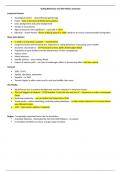
Voting Behaviour and the Media: Summary
Long term factors:
Sociological factors – class/ethnicity/gender/age
Pulzer: ‘Class is the basis of British party politics’
Class dealignment and party dealignment
Gender is inconsistent
Age has become more significant – especially in 2017
Ethnicity - Enoch Powell - Rivers of Blood speech in 1968 called for an end to commonwealth immigration
Short term factors:
‘a week is a long time in politics’ – Harold Wison
Long term factors are becoming less important as voting behaviour is becoming more volatile
Economic circumstance – 1979 industrial unrest, 2008, 2010 budget deficit
Popularity of party leaders and the effectiveness of their campaigning
Valancy issue
Media interests
Specific policies – issue voting, Brexit
Impact of opinion polls – can have a bandwagon effect or boomerang effect (shy tory voters)
Turnout:
2001: 59.4%
Apathy, alienation, abstention
Hapathy – in 2001
Turnout higher in older voters and in rural and middle-class areas
The Media:
Big influence due to partisan dealignment and the reduction in long term factors
The Sun (biggest circulation) – 1992 headline ‘It was the Sun wot won it’ – important on what a newspaper
backs
Declining readership – sun circulation has halved since 2010
Social media – online advertising, including voting databases – London mayor advert for the Conservatives
was ridiculed online.
1997 – Spin doctors (Allister Campbell)
Region - Increasingly important factor due to devolution
Assembly elections - dominated by Sinn Fein/DUP/Alliance - no Labour
In Scotland and Wales you have a larger range of choice
Long term factors:
Sociological factors – class/ethnicity/gender/age
Pulzer: ‘Class is the basis of British party politics’
Class dealignment and party dealignment
Gender is inconsistent
Age has become more significant – especially in 2017
Ethnicity - Enoch Powell - Rivers of Blood speech in 1968 called for an end to commonwealth immigration
Short term factors:
‘a week is a long time in politics’ – Harold Wison
Long term factors are becoming less important as voting behaviour is becoming more volatile
Economic circumstance – 1979 industrial unrest, 2008, 2010 budget deficit
Popularity of party leaders and the effectiveness of their campaigning
Valancy issue
Media interests
Specific policies – issue voting, Brexit
Impact of opinion polls – can have a bandwagon effect or boomerang effect (shy tory voters)
Turnout:
2001: 59.4%
Apathy, alienation, abstention
Hapathy – in 2001
Turnout higher in older voters and in rural and middle-class areas
The Media:
Big influence due to partisan dealignment and the reduction in long term factors
The Sun (biggest circulation) – 1992 headline ‘It was the Sun wot won it’ – important on what a newspaper
backs
Declining readership – sun circulation has halved since 2010
Social media – online advertising, including voting databases – London mayor advert for the Conservatives
was ridiculed online.
1997 – Spin doctors (Allister Campbell)
Region - Increasingly important factor due to devolution
Assembly elections - dominated by Sinn Fein/DUP/Alliance - no Labour
In Scotland and Wales you have a larger range of choice


