

Acute Kidney Injury and Renal Conditions
Acute Kidney Injury
Definition
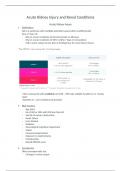
AKI is a syndrome with multiple potential causes (often multifactorial)
One or more of:
- Rise in serum creatinine of 26+micromol/L in 48 hours
- Rise in serum creatinine of 50%+ within 7 days (1.5x baseline)
- Fall in urine output to less than 0.5ml/kg/hour for more than 6 hours
*AKI is measured with creatinine not GFR – GFR only reliable if patient is in ‘steady
state’
*Baseline Cr = pre-morbid renal function
Risk factors
- Age (65+)
- Hx of AKI or CKD with GFR less than 60
- SSx/Hx of urinary obstruction
- Heart failure
- Liver disease
- Diabetes
- Neurological/cognitive impairment
- Sepsis
- Immunocompromised
- Exposure to nephrotoxins
- Perioperative
- Raised NEWS2 score
Symptoms
Often asymptomatic but:
- Changes in urine output
, - Confusion/drowsiness
- Nausea/vomiting
- Fluid accumulation
- Dark, concentrated urine
History
- Systematically well/unwell
- Infective symptoms
- Hypovolaemia
- Urinary
- PMH, DH, FH, SH, ROS…
*Known history of CKD?
*Recent treatment with trimethoprim (antibiotic)?
*Recently completed a pregnancy?
Fluid Balance Assessment
Hypovolaemic, euvolaemic, hypervolaemic
1. Inspection:
Cyanosis (peripheral vasoconstriction – hypovolaemia), SOB (pulmonary oedema
– fluid overload, pallor (anaemia – haemorrhage/poor perfusion), malar flush
(red discolouration of cheeks – mitral stenosis), oedema
2. Palpation:
Temperature (cool – poor peripheral perfusion > hypovolaemia), CRT (2+ - poor
peripheral perfusion > hypovolaemia), skin turgor (decreased – dehydrated)
3. Pulses:
Radial – regular? rate? – tachycardia > hypovolaemia
Brachial – thready pulse > hypovolaemia
4. Blood pressure:
Hypertension > hypervolaemia
Hypotension > hypovolaemia
Postural hypotension > hypovolaemia
5. Jugular venous pressure:
Raised > venous hypertension/hypervolaemia
*The sternal angle and the top of the pulsation
point should not be above 3cm in healthy patients
>
6. Face:
Sunken eyes (hypovolaemia), conjunctival pallor
(anaemia), dry mucus membranes (hypovolaemia)
Acute Kidney Injury
Definition
AKI is a syndrome with multiple potential causes (often multifactorial)
One or more of:
- Rise in serum creatinine of 26+micromol/L in 48 hours
- Rise in serum creatinine of 50%+ within 7 days (1.5x baseline)
- Fall in urine output to less than 0.5ml/kg/hour for more than 6 hours
*AKI is measured with creatinine not GFR – GFR only reliable if patient is in ‘steady
state’
*Baseline Cr = pre-morbid renal function
Risk factors
- Age (65+)
- Hx of AKI or CKD with GFR less than 60
- SSx/Hx of urinary obstruction
- Heart failure
- Liver disease
- Diabetes
- Neurological/cognitive impairment
- Sepsis
- Immunocompromised
- Exposure to nephrotoxins
- Perioperative
- Raised NEWS2 score
Symptoms
Often asymptomatic but:
- Changes in urine output
, - Confusion/drowsiness
- Nausea/vomiting
- Fluid accumulation
- Dark, concentrated urine
History
- Systematically well/unwell
- Infective symptoms
- Hypovolaemia
- Urinary
- PMH, DH, FH, SH, ROS…
*Known history of CKD?
*Recent treatment with trimethoprim (antibiotic)?
*Recently completed a pregnancy?
Fluid Balance Assessment
Hypovolaemic, euvolaemic, hypervolaemic
1. Inspection:
Cyanosis (peripheral vasoconstriction – hypovolaemia), SOB (pulmonary oedema
– fluid overload, pallor (anaemia – haemorrhage/poor perfusion), malar flush
(red discolouration of cheeks – mitral stenosis), oedema
2. Palpation:
Temperature (cool – poor peripheral perfusion > hypovolaemia), CRT (2+ - poor
peripheral perfusion > hypovolaemia), skin turgor (decreased – dehydrated)
3. Pulses:
Radial – regular? rate? – tachycardia > hypovolaemia
Brachial – thready pulse > hypovolaemia
4. Blood pressure:
Hypertension > hypervolaemia
Hypotension > hypovolaemia
Postural hypotension > hypovolaemia
5. Jugular venous pressure:
Raised > venous hypertension/hypervolaemia
*The sternal angle and the top of the pulsation
point should not be above 3cm in healthy patients
>
6. Face:
Sunken eyes (hypovolaemia), conjunctival pallor
(anaemia), dry mucus membranes (hypovolaemia)


