BRAIN AND COGNITION WEEK 11- problem solving
Problem solving research… AIM
- To study the basic processes involved in problem solving
- Without contamination from other cognitive processes
- Cofounding factors: previous experience, knowledge
Behaviourism – behaviour can be explained by stimulus-response links. Problem solving seen as trial
and error, reproduction of learned responses.
E.g. THORNDIKE 1911 showed that animals learn the correct behaviour from trial and error
- hungry cats had to dins a way out of their cage to get food
- they needed dozens of trials to form a close association between behaviour sequence and its
consequences
GESTALT PSYCH- theories first developed to account for perception, then applied to problem solving.
But theoretical explanations are weak. Problem solving is both reproductive and productive and
involves restructuring. Previous knowledge though can hinder problem solving e.g. it makes insight
harder.
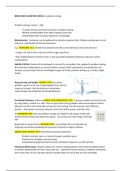
Restructuring and insight- MAIER’S 1993 two-string
problem- goals is to tie two strings together that seem to
hang too far apart- hint (brushing one string helps
restructuring). Also illustrates functional fixedness.
Functional fixedness- (follow up) BIRCH AND RABINOWITZ 1951- 2 groups complete electrical circuit
by using either a switch or a relay. Ptps are given the 2-string problem with several objects at their
disposal and after some hints they swung one of the strings. But the 2 groups chose different
devices… relay group= set string using the switch and switch group= used the relay.
Or DUNCKERS 1926 nine-not problem- people are fixated on the shape of dots and
assume the lines must stay within the square – we can join all 9 dots using 4 lines like
this:
Represented change theory OHLSSON 1992= uses Gestalt ideas and provides an
elaborate mechanism explaining the processes involved in insight problems.
NEWELL AND SIMONS 1972 information-processing approach:
- Problem solving is seen as a search through a problem space
- Emphasis on strategies used by people
- Computational approach that has led to simulation programs e.g. GPS and Soar
Internal problem space- people construct an internal representation of the external problem space.
It includes representation of start, goal, rules etc… capacity of human memory is limited, particularly
LTM, hence why we use selective search to quickly weed out move that are not reasonable
Problem solving research… AIM
- To study the basic processes involved in problem solving
- Without contamination from other cognitive processes
- Cofounding factors: previous experience, knowledge
Behaviourism – behaviour can be explained by stimulus-response links. Problem solving seen as trial
and error, reproduction of learned responses.
E.g. THORNDIKE 1911 showed that animals learn the correct behaviour from trial and error
- hungry cats had to dins a way out of their cage to get food
- they needed dozens of trials to form a close association between behaviour sequence and its
consequences
GESTALT PSYCH- theories first developed to account for perception, then applied to problem solving.
But theoretical explanations are weak. Problem solving is both reproductive and productive and
involves restructuring. Previous knowledge though can hinder problem solving e.g. it makes insight
harder.
Restructuring and insight- MAIER’S 1993 two-string
problem- goals is to tie two strings together that seem to
hang too far apart- hint (brushing one string helps
restructuring). Also illustrates functional fixedness.
Functional fixedness- (follow up) BIRCH AND RABINOWITZ 1951- 2 groups complete electrical circuit
by using either a switch or a relay. Ptps are given the 2-string problem with several objects at their
disposal and after some hints they swung one of the strings. But the 2 groups chose different
devices… relay group= set string using the switch and switch group= used the relay.
Or DUNCKERS 1926 nine-not problem- people are fixated on the shape of dots and
assume the lines must stay within the square – we can join all 9 dots using 4 lines like
this:
Represented change theory OHLSSON 1992= uses Gestalt ideas and provides an
elaborate mechanism explaining the processes involved in insight problems.
NEWELL AND SIMONS 1972 information-processing approach:
- Problem solving is seen as a search through a problem space
- Emphasis on strategies used by people
- Computational approach that has led to simulation programs e.g. GPS and Soar
Internal problem space- people construct an internal representation of the external problem space.
It includes representation of start, goal, rules etc… capacity of human memory is limited, particularly
LTM, hence why we use selective search to quickly weed out move that are not reasonable