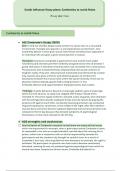
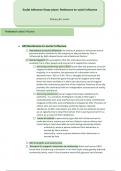
● A01 Zimbardo’s Study (1973)
Aim: to find out whether people would conform to social roles in a simulated
environment. If people were placed in a simulated prison environment , how
would they behave in their given social roles (These are behaviours expected of
an individual who occupies a given social position or status)
Procedure: Volunteers completed a psychometric test and 24 most stable
volunteers paid and took part then randomly assigned social roles of prisoner /
guard. Took place in stanford university which was converted into a mock prison.
The prisoners were arrested formally, stripsearched and issued uniforms to
heighten reality. They were dehumanised, humiliated and referred to by number
only. Guards were given uniforms and reflective glasses to reinforce the
boundaries between the 2 social roles within the social hierarchy. There was no
physical violence allowed, guards had to keep prisoners in line.
Zimbardo observer and superintendent. Study planned to last 2 weeks
Findings: Guards' behaviour became increasingly sadistic, grew increasingly
tyrannical and abusive, so study was stopped after 6 days instead of the
intended 14. Prisoners ripped uniforms, shouted, swore at guards, who retaliated
with fire extinguishers.Guards employed 'divide and rule' tactics by playing the
prisoners off against each other, constantly harassing prisoners. eg, conducted
frequent headcounts, sometimes in the middle of the night. After their rebellion
was put down, prisoners became subdued, depressed and anxious.A prisoner was
released on the 1st day because they showed symptoms of psychological
disturbance. 2 more were released on the 4th day.
● A03 strengths and weaknesses
One limitation of Zimbardo’s research is that there are major ethical issues
within the experiment.For example, when a participant asked Zimbardo to leave,
he responded in his role as a superintendent, worried about the running of his
prison, rather than a researcher with an ethical responsibility towards his
participants and the student truly thought he couldn't leave. As a result of
Zimbardo’s ‘duel role’, ethical guidelines were breached, for example, the right to
withdraw. The participant in question was later said to become emotionally
disturbed, meaning he was not protected against psychological harm which he
should have been. Despite the ethical issues, Zimbardo did debrief his
Aim: to find out whether people would conform to social roles in a simulated
environment. If people were placed in a simulated prison environment , how
would they behave in their given social roles (These are behaviours expected of
an individual who occupies a given social position or status)
Procedure: Volunteers completed a psychometric test and 24 most stable
volunteers paid and took part then randomly assigned social roles of prisoner /
guard. Took place in stanford university which was converted into a mock prison.
The prisoners were arrested formally, stripsearched and issued uniforms to
heighten reality. They were dehumanised, humiliated and referred to by number
only. Guards were given uniforms and reflective glasses to reinforce the
boundaries between the 2 social roles within the social hierarchy. There was no
physical violence allowed, guards had to keep prisoners in line.
Zimbardo observer and superintendent. Study planned to last 2 weeks
Findings: Guards' behaviour became increasingly sadistic, grew increasingly
tyrannical and abusive, so study was stopped after 6 days instead of the
intended 14. Prisoners ripped uniforms, shouted, swore at guards, who retaliated
with fire extinguishers.Guards employed 'divide and rule' tactics by playing the
prisoners off against each other, constantly harassing prisoners. eg, conducted
frequent headcounts, sometimes in the middle of the night. After their rebellion
was put down, prisoners became subdued, depressed and anxious.A prisoner was
released on the 1st day because they showed symptoms of psychological
disturbance. 2 more were released on the 4th day.
● A03 strengths and weaknesses
One limitation of Zimbardo’s research is that there are major ethical issues
within the experiment.For example, when a participant asked Zimbardo to leave,
he responded in his role as a superintendent, worried about the running of his
prison, rather than a researcher with an ethical responsibility towards his
participants and the student truly thought he couldn't leave. As a result of
Zimbardo’s ‘duel role’, ethical guidelines were breached, for example, the right to
withdraw. The participant in question was later said to become emotionally
disturbed, meaning he was not protected against psychological harm which he
should have been. Despite the ethical issues, Zimbardo did debrief his