

APM PMQ Revision
APM PMQ REVISION
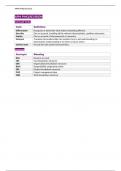
Command Verbs:
Verb Definition
Differentiate Recognise or determine what makes something different.
Describe Give an account, including all the relevant characteristics, qualities and events.
Explain Give an account of the purpose(s) or reason(s).
Interpret Translate information/data into another form to aid understanding, to
demonstrate understanding or to inform a future action.
Outline/state Set out the main points/characteristics.
Acronyms:
Acronym Meaning
BAU Business as usual
CBS Cost breakdown structure
OBS Organisational breakdown structure
RAM Responsibility assignment matrix
PBS Product breakdown structure
PMP Project management plan
WBS Work breakdown structure
,APM PMQ Revision
MODULE 1 – SITUATIONAL CONTEXT
STRUCTURE OF ORGANISATIONS AND PROJECTS
1.1 - Differentiate between types of permanent and temporary organisation structures (including
functional, matrix, and project
Possible Exam Questions:
Questions Prompts
Explain three differences between the following 1. Line management structure
types of organisational structure: 2. The kind of work that they are doing
• Functional 3. The speed with which they can enact change
• Matrix
Marks: 30 marks (10 marks each)
Explain three differences between the following 1. Line management structure
types of organisational structure: 2. Longevity of the organisation
• Functional 3. The kind of work that they are doing
• Project
Marks: 30 marks (10 marks each)
Permanent/Temporary Definitions:
Organizational structures define how roles, responsibilities, and power are assigned and controlled to
achieve strategic objectives, and how information flows between different levels of management.
1 Permanent Organisation Structure
Stable team – good for routine/operational work as it provides a stable environment to support
decision making and the flow of information across an organisation
Business as usual (BAU) or operations within an organisation are permanent structures that
need specific resources to carry out routine tasks. In this case, a stable team is best to fulfil the
role. By being stable, the team will be specialists within the role and therefore bring efficiencies
to the tasks
2 Temporary Organisation Structure
Temporary teams set up for specific initiatives e.g projects
Projects are temporary, as is the participating team. The team can be sourced from different
functional units or source people from outside the business. The number of team members can
vary from project concept through to transition to the wider business.
A project environment is temporary, where the tasks are varied and unique, therefore the
environment is more suited to temporary teams who bring different skills to the tasks as
required.
The matrix structure is one of the most common temporary structures used to manage projects, where
authority is balanced between the functional line manager and the project manager. The project
manager works across both temporary and permanent structures.
,APM PMQ Revision
Matrix/Functional/Project Definitions
1 Matrix Organisation Structure
A matrix structure is chosen for companies when it benefits them to share skills across different
departments. This allows the team to tap experts from different areas of business on one larger
project without hiring more talent or redesigning the organization
PM’s typically have authority for the project and functional managers have authority over the
welfare of staff and efficiency of their department – balance of authority between both. Need to
ensure good interpersonal relationships and effective communication (more complex than in
functional). PM is not line manager so no structural power to get things done - relies on project
managers understanding of how they can influence others in the absence of organizational
authority within line management.
Projects resourced from drawing full or part time staff from individual departments
Strengths:
Brings together highly skilled team members from different departments, allowing the
organization to capitalize on the resources it already has rather than seeking expertise and
recruiting project team members from outside of the organization
Equal focus on task completion and staff development
Project is likely to be visible to the whole organization, rather than just an individual
department as in the functional structure
Weaknesses:
When an individual is working on the project, they are reporting to the project manager as
well as their functional line manager (dual reporting) and there can be a conflict of
priorities/objectives/management styles
Decisions must go through multiple people before being approved
Confusion surrounding roles and responsibilities
More expensive
2 Functional Organisation Structure
Organises the company into different departments based on areas of expertise, and groups
employees by specialty, skill or related roles, these people work together to carry out the same
or similar functions
o Example – Lawyers in Legal and Marketers in Marketing
Functional managers have complete control and head up single discipline departments that
functional staff report to
Ideal for small, routine, mainly internal projects close to BAU activity rather than for incremental
improvement
Strengths:
Expertise and learning is easily shared
Clear reporting structure
Good where focus of organisation is ‘running the company’
Weaknesses:
, APM PMQ Revision
Projects are a distraction
No single point of contact – leads to inconsistent communication
Staff may focus on their own areas when making a decision on a project
Hard to collaborate with other functions as they aren’t used to it – often there are already
conflicts here between functions
Staff are more loyal to functional managers
3 Project Organisation Structure
Project manager has complete authority over work and staff are assigned full time to a specific
project
Projects form the majority of the work and the PM may also have responsibility for the
wellbeing and development of staff
Common for organisations with project based staff e.g consultancies
Organisations is made up of projects, each having a project manager or project director,
depending on the size of the project, reporting directly to the board of what is often a holding
company.
The structure consists of groups of people who are all dedicated only to the project assigned
and report to the project director daily.
All work is project related and once the project is completed (projects using this structure may
last for many years) that part of the organisation ceases to exist
Project may have their own equivalent of BAU service lines e.g procurement, finance, HR etc
Strengths:
PM is single point of contact and has authority, meaning different functional disciplines are
likely to integrate better
Focus is just on the project
Clear project processes combined with well-defined roles and responsibilities mean that
teams become technically proficient
Weaknesses:
Staff become insecure as project ends
Inefficient resource utilisation
Sharing of experience is difficult
The very strong job security while the project is being carried out is then a weakness at
project completion when there is no longer a requirement for the people who were
employed in delivery
Projects can also become very insular and not communicate with each other this can lead to
underutilization of staff overall as availability in one project is not used to solve a need in
anothe
Once each project is completed, teams will leave on mass and the organization may not get
the opportunity to maintain the learning gained by the individuals while working on the
project.
Differences between functional/matrix/project
APM PMQ REVISION
Command Verbs:
Verb Definition
Differentiate Recognise or determine what makes something different.
Describe Give an account, including all the relevant characteristics, qualities and events.
Explain Give an account of the purpose(s) or reason(s).
Interpret Translate information/data into another form to aid understanding, to
demonstrate understanding or to inform a future action.
Outline/state Set out the main points/characteristics.
Acronyms:
Acronym Meaning
BAU Business as usual
CBS Cost breakdown structure
OBS Organisational breakdown structure
RAM Responsibility assignment matrix
PBS Product breakdown structure
PMP Project management plan
WBS Work breakdown structure
,APM PMQ Revision
MODULE 1 – SITUATIONAL CONTEXT
STRUCTURE OF ORGANISATIONS AND PROJECTS
1.1 - Differentiate between types of permanent and temporary organisation structures (including
functional, matrix, and project
Possible Exam Questions:
Questions Prompts
Explain three differences between the following 1. Line management structure
types of organisational structure: 2. The kind of work that they are doing
• Functional 3. The speed with which they can enact change
• Matrix
Marks: 30 marks (10 marks each)
Explain three differences between the following 1. Line management structure
types of organisational structure: 2. Longevity of the organisation
• Functional 3. The kind of work that they are doing
• Project
Marks: 30 marks (10 marks each)
Permanent/Temporary Definitions:
Organizational structures define how roles, responsibilities, and power are assigned and controlled to
achieve strategic objectives, and how information flows between different levels of management.
1 Permanent Organisation Structure
Stable team – good for routine/operational work as it provides a stable environment to support
decision making and the flow of information across an organisation
Business as usual (BAU) or operations within an organisation are permanent structures that
need specific resources to carry out routine tasks. In this case, a stable team is best to fulfil the
role. By being stable, the team will be specialists within the role and therefore bring efficiencies
to the tasks
2 Temporary Organisation Structure
Temporary teams set up for specific initiatives e.g projects
Projects are temporary, as is the participating team. The team can be sourced from different
functional units or source people from outside the business. The number of team members can
vary from project concept through to transition to the wider business.
A project environment is temporary, where the tasks are varied and unique, therefore the
environment is more suited to temporary teams who bring different skills to the tasks as
required.
The matrix structure is one of the most common temporary structures used to manage projects, where
authority is balanced between the functional line manager and the project manager. The project
manager works across both temporary and permanent structures.
,APM PMQ Revision
Matrix/Functional/Project Definitions
1 Matrix Organisation Structure
A matrix structure is chosen for companies when it benefits them to share skills across different
departments. This allows the team to tap experts from different areas of business on one larger
project without hiring more talent or redesigning the organization
PM’s typically have authority for the project and functional managers have authority over the
welfare of staff and efficiency of their department – balance of authority between both. Need to
ensure good interpersonal relationships and effective communication (more complex than in
functional). PM is not line manager so no structural power to get things done - relies on project
managers understanding of how they can influence others in the absence of organizational
authority within line management.
Projects resourced from drawing full or part time staff from individual departments
Strengths:
Brings together highly skilled team members from different departments, allowing the
organization to capitalize on the resources it already has rather than seeking expertise and
recruiting project team members from outside of the organization
Equal focus on task completion and staff development
Project is likely to be visible to the whole organization, rather than just an individual
department as in the functional structure
Weaknesses:
When an individual is working on the project, they are reporting to the project manager as
well as their functional line manager (dual reporting) and there can be a conflict of
priorities/objectives/management styles
Decisions must go through multiple people before being approved
Confusion surrounding roles and responsibilities
More expensive
2 Functional Organisation Structure
Organises the company into different departments based on areas of expertise, and groups
employees by specialty, skill or related roles, these people work together to carry out the same
or similar functions
o Example – Lawyers in Legal and Marketers in Marketing
Functional managers have complete control and head up single discipline departments that
functional staff report to
Ideal for small, routine, mainly internal projects close to BAU activity rather than for incremental
improvement
Strengths:
Expertise and learning is easily shared
Clear reporting structure
Good where focus of organisation is ‘running the company’
Weaknesses:
, APM PMQ Revision
Projects are a distraction
No single point of contact – leads to inconsistent communication
Staff may focus on their own areas when making a decision on a project
Hard to collaborate with other functions as they aren’t used to it – often there are already
conflicts here between functions
Staff are more loyal to functional managers
3 Project Organisation Structure
Project manager has complete authority over work and staff are assigned full time to a specific
project
Projects form the majority of the work and the PM may also have responsibility for the
wellbeing and development of staff
Common for organisations with project based staff e.g consultancies
Organisations is made up of projects, each having a project manager or project director,
depending on the size of the project, reporting directly to the board of what is often a holding
company.
The structure consists of groups of people who are all dedicated only to the project assigned
and report to the project director daily.
All work is project related and once the project is completed (projects using this structure may
last for many years) that part of the organisation ceases to exist
Project may have their own equivalent of BAU service lines e.g procurement, finance, HR etc
Strengths:
PM is single point of contact and has authority, meaning different functional disciplines are
likely to integrate better
Focus is just on the project
Clear project processes combined with well-defined roles and responsibilities mean that
teams become technically proficient
Weaknesses:
Staff become insecure as project ends
Inefficient resource utilisation
Sharing of experience is difficult
The very strong job security while the project is being carried out is then a weakness at
project completion when there is no longer a requirement for the people who were
employed in delivery
Projects can also become very insular and not communicate with each other this can lead to
underutilization of staff overall as availability in one project is not used to solve a need in
anothe
Once each project is completed, teams will leave on mass and the organization may not get
the opportunity to maintain the learning gained by the individuals while working on the
project.
Differences between functional/matrix/project


