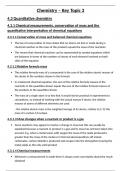
Chemistry – Key Topic 3
4.3 Quantitative chemistry
4.3.1 Chemical measurements, conservation of mass and the
quantitative interpretation of chemical equations
4.3.1.1 Conservation of mass and balanced chemical equations
The law of conservation of mass states that no atoms are lost or made during a
chemical reaction so the mass of the products equals the mass of the reactants
This means that chemical reactions can be represented by symbol equations which
are balances in terms of the numbers of atoms of each element involved on both
sides of the equation
4.3.1.2 Relative formula mass
The relative formula mass of a compounds is the sum of the relative atomic masses of
the atoms in the numbers shown in the formula
In a balanced chemical equation, the sum of the relative formula masses of the
reactants in the quantities shown equals the sum of the relative formula masses of
the products in the quantities shown
The mass of a single atom is so tiny that it would not be practical in experiments to
calculations, so instead of working with the actual masses if atoms, the relative
masses of atoms of different elements are used
- the relative atomic mass is the weighted average of its atoms, relative to 1/12 the
mass of a carbon-12 isotope
4.3.1.3 Mass changes when a reactant or product is a gas
Some reactions may appear to involve a change in mass but this can usually be
explained because a reactant or product is a gas and its mass has not been taken into
account. E.g. when a metal reacts with oxygen the mass of the oxide produced is
greater than the mass of the metal or in thermal decompositions off metals
carbonates, carbon dioxide is produced and escapes into the atmosphere leaving the
metal oxide as the only solid product
4.3.1.4 Chemical measurements
Whenever a measurement is made there is always some uncertainty about the result
obtained
4.3 Quantitative chemistry
4.3.1 Chemical measurements, conservation of mass and the
quantitative interpretation of chemical equations
4.3.1.1 Conservation of mass and balanced chemical equations
The law of conservation of mass states that no atoms are lost or made during a
chemical reaction so the mass of the products equals the mass of the reactants
This means that chemical reactions can be represented by symbol equations which
are balances in terms of the numbers of atoms of each element involved on both
sides of the equation
4.3.1.2 Relative formula mass
The relative formula mass of a compounds is the sum of the relative atomic masses of
the atoms in the numbers shown in the formula
In a balanced chemical equation, the sum of the relative formula masses of the
reactants in the quantities shown equals the sum of the relative formula masses of
the products in the quantities shown
The mass of a single atom is so tiny that it would not be practical in experiments to
calculations, so instead of working with the actual masses if atoms, the relative
masses of atoms of different elements are used
- the relative atomic mass is the weighted average of its atoms, relative to 1/12 the
mass of a carbon-12 isotope
4.3.1.3 Mass changes when a reactant or product is a gas
Some reactions may appear to involve a change in mass but this can usually be
explained because a reactant or product is a gas and its mass has not been taken into
account. E.g. when a metal reacts with oxygen the mass of the oxide produced is
greater than the mass of the metal or in thermal decompositions off metals
carbonates, carbon dioxide is produced and escapes into the atmosphere leaving the
metal oxide as the only solid product
4.3.1.4 Chemical measurements
Whenever a measurement is made there is always some uncertainty about the result
obtained