
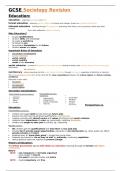
GCSE Sociology Revision
Education:
education - acquiring knowledge and skills
formal education - learning specific subjects in schools and colleges, known as organised institutions
informal education - learning through life experience and being with others, such as parents, adults and other
children
this is also called the hidden curriculum
Why Education?
to gain qualifications
to learn skills and knowledge
to create a workforce
to follow the law
to provide a foundation for the future
to learn norms and value
Important Roles of Education
secondary socialisation
social cohesion
social control
social mobility
needs of the economy
social cohesion - a sense of belonging to the wider society, feeling included, with shared values and a common goal,
also known
as solidarity
meritocracy - where everyone has the same chance to achieve through hard work, regardless of ethnicity or class etc.
The correspondence principle is the name for the close resemblance between the school regime and future working
conditions.
Education in four roles:
economic
achievement
socialisation
social control
Secondary Socialisation:
From Parents (Primary Socialisation): From School (Secondary
Socialisation):
manners social skills
opinions responsibility
independence discipline
safety opinions
morals specific knowledge
maturity societal
standards Perspectives on
Education:
Functionalists (consensus):
children are taught skills to help them get future jobs
anyone can work hard to get good qualifications, meritocracy
creates a society with shared norms and values (Durkheim) and social cohesion
students learn importance of rules, eg. punctuality, installing discipline
children are taught to take part in society, eg. citizenship
Marxists (conflict):
WC children get the qualifications that lead them to low paid jobs
schools don’t provide equal opportunities, education is not meritocratic eg. richer pupils can afford
private schools and tutors
students learn to ‘know their place’ / accept their social class
students are trained to ‘do as they’re told’ by authority, continuing capitalism
radical political views are rejected to prevent change
History of Education:
The British government spends £80 million on education, learning through the formal and hidden
curriculum.
Before
1870: - not compulsory or formally organised
- some taught in church
- rich paid for private schools and tutors
1870: - made compulsory and free
Education:
education - acquiring knowledge and skills
formal education - learning specific subjects in schools and colleges, known as organised institutions
informal education - learning through life experience and being with others, such as parents, adults and other
children
this is also called the hidden curriculum
Why Education?
to gain qualifications
to learn skills and knowledge
to create a workforce
to follow the law
to provide a foundation for the future
to learn norms and value
Important Roles of Education
secondary socialisation
social cohesion
social control
social mobility
needs of the economy
social cohesion - a sense of belonging to the wider society, feeling included, with shared values and a common goal,
also known
as solidarity
meritocracy - where everyone has the same chance to achieve through hard work, regardless of ethnicity or class etc.
The correspondence principle is the name for the close resemblance between the school regime and future working
conditions.
Education in four roles:
economic
achievement
socialisation
social control
Secondary Socialisation:
From Parents (Primary Socialisation): From School (Secondary
Socialisation):
manners social skills
opinions responsibility
independence discipline
safety opinions
morals specific knowledge
maturity societal
standards Perspectives on
Education:
Functionalists (consensus):
children are taught skills to help them get future jobs
anyone can work hard to get good qualifications, meritocracy
creates a society with shared norms and values (Durkheim) and social cohesion
students learn importance of rules, eg. punctuality, installing discipline
children are taught to take part in society, eg. citizenship
Marxists (conflict):
WC children get the qualifications that lead them to low paid jobs
schools don’t provide equal opportunities, education is not meritocratic eg. richer pupils can afford
private schools and tutors
students learn to ‘know their place’ / accept their social class
students are trained to ‘do as they’re told’ by authority, continuing capitalism
radical political views are rejected to prevent change
History of Education:
The British government spends £80 million on education, learning through the formal and hidden
curriculum.
Before
1870: - not compulsory or formally organised
- some taught in church
- rich paid for private schools and tutors
1870: - made compulsory and free


