
• Wrong document? Swap it for free
  • Written by students who passed
  • Immediately available after payment
  • Read online or as PDF
Sell
Where do you study
Your language
Start selling Create your account
Document preview thumbnail
Preview 1 out of 3 pages
Exam (elaborations)

RHIT PRACTICE TEST 1 DOMAIN 3- data analytics and use

Document preview thumbnail
Preview 1 out of 3 pages

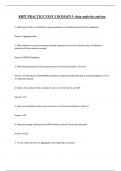
RHIT PRACTICE TEST 1 DOMAIN 3- data analytics and use 1. What type of data is collected on large populations of individuals and stored in databases? Answer: Aggregate data. 2. What database is used to compare hospital-acquired urinary tract infection rates for Medicare patients with the national average? Answer: MEDPAR database. 3. What data provides the best comparison for Community Hospital's UTI rate? Answer: All individuals in the MEDPAR database except those admitted with a principal diagnosis of UTI or infectious disease. 4. What is the median of the numbers 47, 20, 11, 33, 30, 30, 35, and 50? Answer: 31.5. 5. How many inpatient service days were there at Community Hospital on May 2? Answer: 242. 6. What percentage represents the H&P timeliness rate at Community Hospital? Answer: 95.5%. 7. To use a data element for aggregation and reporting, it must be: Answer: Abstracted and indexed. 8. What is the definition of a primary key in a database table? Answer: A unique identifier that uniquely identifies each row in a table. 9. What should be done if a hospital's quality goal is not met, as shown by audit data? Answer: Determine whether there was a medical or other reason why patients were not given aspirin. 10. What type of organization does David work for, using health record data to prove or disprove treatment efficacy? Answer: Research organization. 11. How does an internal user utilize secondary data? Answer: By benchmarking with other facilities. 12. What is the next step in data acquisition after determining the types of cases to be included in a registry? Answer: Case abstracting. 13. Why is HCUP advantageous for research purposes? Answer: It contains data on all payer types. 14. What type of activity would you monitor when reviewing audit trails of access to patient information? Answer: Every access to every data element or document type, whether the person viewed, created, updated, or deleted the information, and physical location on the network where the access occurred. 15. What is the first step in analyzing data? Answer: Know your objectives or purpose of the data analysis. 16. When a distribution is skewed, what happens to the mean? Answer: It gravitates in the direction of the extreme values, making a long tail when a distribution is skewed to the right side, which is called a positively skewed distribution.

Content preview

RHIT PRACTICE TEST 1 DOMAIN 3- data analytics and use


1. What type of data is collected on large populations of individuals and stored in databases?


Answer: Aggregate data.


2. What database is used to compare hospital-acquired urinary tract infection rates for Medicare
patients with the national average?


Answer: MEDPAR database.


3. What data provides the best comparison for Community Hospital's UTI rate?


Answer: All individuals in the MEDPAR database except those admitted with a principal diagnosis of UTI
or infectious disease.


4. What is the median of the numbers 47, 20, 11, 33, 30, 30, 35, and 50?


Answer: 31.5.


5. How many inpatient service days were there at Community Hospital on May 2?


Answer: 242.


6. What percentage represents the H&P timeliness rate at Community Hospital?


Answer: 95.5%.


7. To use a data element for aggregation and reporting, it must be:

Document information

Uploaded on
July 23, 2024
Number of pages
3
Written in
2023/2024
Type
Exam (elaborations)
Contains
Questions & answers
£7.96

Wrong document? Swap it for free Within 14 days of purchase and before downloading, you can choose a different document. You can simply spend the amount again.
Written by students who passed
Immediately available after payment
Read online or as PDF

Seller avatar
Reputation scores are based on the amount of documents a seller has sold for a fee and the reviews they have received for those documents. There are three levels: Bronze, Silver and Gold. The better the reputation, the more your can rely on the quality of the sellers work.
bestscores1
4.4
(5)
Sold
20
Followers
0
Items
1369
Last sold
1 month ago


Why students choose Stuvia

Created by fellow students, verified by reviews

Quality you can trust: written by students who passed their exams and reviewed by others who've used these revision notes.

Didn't get what you expected? Choose another document

No problem! You can straightaway pick a different document that better suits what you're after.

Pay as you like, start learning straight away

No subscription, no commitments. Pay the way you're used to via credit card and download your PDF document instantly.

Student with book image

“Bought, downloaded, and smashed it. It really can be that simple.”

Alisha Student

Working on your references?

Create accurate citations in APA, MLA and Harvard with our free citation generator.

Working on your references?

Frequently asked questions
