Section C Comparison - Practice Essay
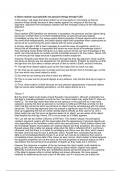
To what extent is justice served in the crime narratives you have read?
Plan (Poetry & Atonement)
YES; in BORG, Wooldridge took a life and so should be sentenced to death. Justice
is transient (and in all the crime narratives) so at the time Wilde was a criminal.
Wilde's account is only subjective.
NO; how can taking a life be justice? Transient justice can lead to injustice as
seen by the minor change of law in Atonement just two years before. In BORG,
Wilde's polemic makes crime seem universal, suggesting it's a crime to love.
NO; justice is completely absent in Browning's poetry and Atonement. McEwan's
cryptic lines force us to focus on the injustice of the situation. Even Briony's
punishment is not proportional.
YES; perhaps an element of societal justice in Browning's poetry, again justice is
transient so difficult to determine justice of different eras. Duke was exempt
from criminal punishment in cautionary tales era.
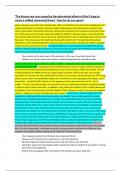
Response
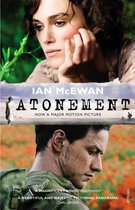
Arguably, there is an absence of justice in Browning's poetry, The Ballad of
Reading Gaol, and Atonement. Nevertheless, we have to consider the contrasting
definitions of justice in different eras, which may encourage change to our modern
retrospective approach in determining whether justice is served.
Indeed, while today Wilde's imprisonment for his homosexual activity may seem
absurdly unjust, it's undeniable that the law of the era, which after all is heavily
influenced by the views of the common people, was followed and hence he was
sentenced accordingly. Although Wilde attempts to dismiss Wooldridge's crime through
the use of oxymoronic adjectives 'great or little thing', it appears unfathomable to us as
the reader that such a brutal and 'pre-meditated' murder according to Judge Hawkins
could be dismissed in such a way. Justice is centred on removing the choice of the
criminal, and Wooldridge's execution is the ultimate representation of losing all of one's
right, so one could argue that justice is absolutely achieved in The Ballad of Reading
Gaol.
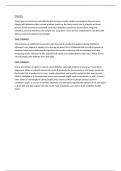
However, it's widely accepted today that the punishment of death for any crime
is disproportional, and therefore we cannot consider Wooldridge's execution an
example of justice as the State is carrying out a crime which the majority of the
population would never contemplate. Wilde's repetition of what Wooldridge 'does not'
do instead of what he can do is a sign that he is completely devoid of all life and choice,
losing his 'soul' in the process. In Atonement, we are forced to accept that Briony will
suffer 'vascular dementia' before a similarly mandatory death. Despite Briony's
assertion that she will never 'let (Cecilia & Robbie) forgive (her)', we perhaps feel more
sympathy for her because of the 'unjust' medical affliction which will consign her to a
death even more horrific than that of the two recipients of her atonement.
Wilde also manages to make crime seem universal as he declares that 'each man
kills the thing he loves'; the use of the word 'each' here suggests every single citizen is
guilty of the crime, and yet they are allowed to sustain their judgmental lives of freedom
in the hypocrisy of Victorian society. We could consider Wilde's 'crime' in particular a
simple expression of love, and yet only he and his surrogate 'brothers' (the other
inmates) are punished. Speaking to Ross about his poem, Wilde regarded canto 5 as the
beginning of the 'propaganda' which he 'desired to make' as he began to challenge
whether 'Laws are right' - here, Wilde attempts to end his poem on a politically incisive
note by mounting a powerful polemic against the flawed justice system, and due to his
account of his imprisonment we get a true feeling of the injustice of the whole situation.
We can hence draw clear parallels to Atonement as Robbie's unfulfilled expression of
To what extent is justice served in the crime narratives you have read?
Plan (Poetry & Atonement)
YES; in BORG, Wooldridge took a life and so should be sentenced to death. Justice
is transient (and in all the crime narratives) so at the time Wilde was a criminal.
Wilde's account is only subjective.
NO; how can taking a life be justice? Transient justice can lead to injustice as
seen by the minor change of law in Atonement just two years before. In BORG,
Wilde's polemic makes crime seem universal, suggesting it's a crime to love.
NO; justice is completely absent in Browning's poetry and Atonement. McEwan's
cryptic lines force us to focus on the injustice of the situation. Even Briony's
punishment is not proportional.
YES; perhaps an element of societal justice in Browning's poetry, again justice is
transient so difficult to determine justice of different eras. Duke was exempt
from criminal punishment in cautionary tales era.
Response
Arguably, there is an absence of justice in Browning's poetry, The Ballad of
Reading Gaol, and Atonement. Nevertheless, we have to consider the contrasting
definitions of justice in different eras, which may encourage change to our modern
retrospective approach in determining whether justice is served.
Indeed, while today Wilde's imprisonment for his homosexual activity may seem
absurdly unjust, it's undeniable that the law of the era, which after all is heavily
influenced by the views of the common people, was followed and hence he was
sentenced accordingly. Although Wilde attempts to dismiss Wooldridge's crime through
the use of oxymoronic adjectives 'great or little thing', it appears unfathomable to us as
the reader that such a brutal and 'pre-meditated' murder according to Judge Hawkins
could be dismissed in such a way. Justice is centred on removing the choice of the
criminal, and Wooldridge's execution is the ultimate representation of losing all of one's
right, so one could argue that justice is absolutely achieved in The Ballad of Reading
Gaol.
However, it's widely accepted today that the punishment of death for any crime
is disproportional, and therefore we cannot consider Wooldridge's execution an
example of justice as the State is carrying out a crime which the majority of the
population would never contemplate. Wilde's repetition of what Wooldridge 'does not'
do instead of what he can do is a sign that he is completely devoid of all life and choice,
losing his 'soul' in the process. In Atonement, we are forced to accept that Briony will
suffer 'vascular dementia' before a similarly mandatory death. Despite Briony's
assertion that she will never 'let (Cecilia & Robbie) forgive (her)', we perhaps feel more
sympathy for her because of the 'unjust' medical affliction which will consign her to a
death even more horrific than that of the two recipients of her atonement.
Wilde also manages to make crime seem universal as he declares that 'each man
kills the thing he loves'; the use of the word 'each' here suggests every single citizen is
guilty of the crime, and yet they are allowed to sustain their judgmental lives of freedom
in the hypocrisy of Victorian society. We could consider Wilde's 'crime' in particular a
simple expression of love, and yet only he and his surrogate 'brothers' (the other
inmates) are punished. Speaking to Ross about his poem, Wilde regarded canto 5 as the
beginning of the 'propaganda' which he 'desired to make' as he began to challenge
whether 'Laws are right' - here, Wilde attempts to end his poem on a politically incisive
note by mounting a powerful polemic against the flawed justice system, and due to his
account of his imprisonment we get a true feeling of the injustice of the whole situation.
We can hence draw clear parallels to Atonement as Robbie's unfulfilled expression of