100% satisfaction guarantee Immediately available after payment Both online and in PDF No strings attached 4.2 TrustPilot
logo-home
Exam (elaborations)

AQA GCSE Chemistry - History of the Atom

Rating
-
Sold
-
Pages
2
Grade
A+
Uploaded on
11-07-2024
Written in
2023/2024

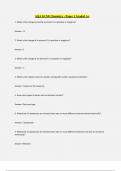
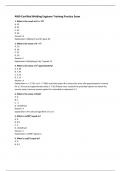
AQA GCSE Chemistry - History of the Atom 1. What is the term used to describe the number of protons present in an atom? Answer: The atomic number. 2. What is the number of electrons in an atom related to? Answer: The number of protons. 3. How do you calculate the number of neutrons in an atom? Answer: By subtracting the atomic number from the atomic mass number. 4. Who described atoms as solid spheres in the 19th century? Answer: John Dalton. 5. What discovery by JJ Thomson led him to modify his atomic model, introducing the concept of electrons? Answer: His measurements of charge and mass revealed the presence of smaller, negatively charged particles (electrons) within atoms. 6. Why is the "Plum Pudding" model named so? Answer: Because it depicted a ball of positive charge with electrons embedded within it. 7. What was the outcome of Rutherford's scattering experiments in 1909 that discredited the Plum Pudding model? Answer: The results showed that some alpha particles were deflected, disproving the model's predictions. 8. How did Rutherford's experiment prove the existence of a nucleus? Answer: The fact that some alpha particles bounced back, indicating a central, positive body (nucleus), was a key finding. 9. How did Bohr's work build upon Rutherford's model? Answer: Bohr proposed that electrons occupy fixed energy levels or shells, preventing them from collapsing onto the nucleus due to attractive forces. 10. What did Rutherford discover about the nucleus? Answer: He found that it could be broken down into smaller particles, leading to the discovery of protons. 11. Who discovered neutrons? Answer: James Chadwick. 12. What is the formula for calculating relative atomic mass? Answer: The formula involves dividing the mass of an isotope by its abundance, then dividing by 100.

Show more Read less


Whoops! We can’t load your doc right now. Try again or contact support.

Document information

Uploaded on
July 11, 2024
Number of pages
2
Written in
2023/2024
Type
Exam (elaborations)
Contains
Questions & answers

Subjects

Content preview

AQA GCSE Chemistry - History of the Atom
1. What is the term used to describe the number of protons present in an atom?


Answer: The atomic number.


2. What is the number of electrons in an atom related to?


Answer: The number of protons.


3. How do you calculate the number of neutrons in an atom?


Answer: By subtracting the atomic number from the atomic mass number.


4. Who described atoms as solid spheres in the 19th century?


Answer: John Dalton.


5. What discovery by JJ Thomson led him to modify his atomic model, introducing the concept of
electrons?


Answer: His measurements of charge and mass revealed the presence of smaller, negatively charged
particles (electrons) within atoms.


6. Why is the "Plum Pudding" model named so?


Answer: Because it depicted a ball of positive charge with electrons embedded within it.


7. What was the outcome of Rutherford's scattering experiments in 1909 that discredited the Plum
Pudding model?

Get to know the seller

Seller avatar
Reputation scores are based on the amount of documents a seller has sold for a fee and the reviews they have received for those documents. There are three levels: Bronze, Silver and Gold. The better the reputation, the more your can rely on the quality of the sellers work.
bestscores1 Kent State University
View profile
Follow You need to be logged in order to follow users or courses
Sold
12
Member since
1 year
Number of followers
0
Documents
1369
Last sold
6 days ago
ReadEase

Welcome to ReadEase, your ultimate resource for exam preparation. At ReadEase, we specialize in providing comprehensive study materials and resources to help you excel in your exams. Whether you're preparing for standardized tests, professional certifications, or academic assessments, our finely curated collection covers a wide range of subjects and levels. From practice tests and study guides to expert tips and strategies, we're here to support your journey to success. ReadEase is committed to availing high-quality educational content, helping you thrive and achieve your academic and professional goals. Have any questions? We're just a message away.

Read more Read less
4.3

4 reviews

5
2
4
1
3
1
2
0
1
0

Recently viewed by you

Why students choose Stuvia

Created by fellow students, verified by reviews

Quality you can trust: written by students who passed their exams and reviewed by others who've used these revision notes.

Didn't get what you expected? Choose another document

No problem! You can straightaway pick a different document that better suits what you're after.

Pay as you like, start learning straight away

No subscription, no commitments. Pay the way you're used to via credit card and download your PDF document instantly.

Student with book image

“Bought, downloaded, and smashed it. It really can be that simple.”

Alisha Student

Frequently asked questions