
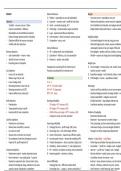
FINANCE External influences Budgets
1) Political – expectation to serve all stakeholders - Forecasts income + expenditure over year
Objectives 2) Economic – recession, sales + profit fall, sell cheap - Influenced by objectives, market research, negotiate
- Yardstick – measure success + failure 3) Social – constantly changing, 24/7 - Stretch abilities but achievable, low budgets demotiv
- Improve coordination + efficiency 4) Technology – communication, targets monitored - Budget holders check performance = variance analys
- Shareholders see if worthwhile investment 5) Legal – requirements influence objectives
- External changes beyond control, misleading 6) Environmental – ethical consumers, pressure groups Updating budgets
- Objectives difficult to measure accurately 7) Competition – prices, costs - Zero based budgets for start-ups, long, plan year
- Conflict with other objectives - Historical budgets quick, simple, assumes conditions
Internal influences unchanged (product not at same stage of lifecycle)
Revenue objectives 1) HR – training needs, cost minimalization - Fixed budgets = predict cash flow, certainty, not reac
> Sales maximisation – volume + value 2) Operational – efficiency, cost, lean production - Flexible = response to change (zero based budgeting)
> Specific increase in revenue 3) Resources – quality, value added
> Exceeding sales of competitor Budget types
Management accounting (info for internal users) 1) Income budget = revenue (price, cost, market resear
Cost objectives Financial accounting (info for external users) need to research + predict
> Lower cost raw materials 2) Expenditure budget = costs (materials, labour, marke
> Reduce wage cost per unit Profitability 3) Profit budgets = income – expenditure (viable)
> Lower wastage levels P=R–C
> Relocating business to low-cost site GP = R – VC (cost of sales) Advantages
> Reducing promotion cost (CPT) OP = GP – FC (expenses) - Control cash flow, predictions, ensure not overspend
> Improve efficiency by reducing VC PFTY = OP – taxes - Dept head delegate authority to budget holders = mo
- Assign responsibility – budgeters success/fail
Profit objectives Showing profitability - Establish priorities – large budgets indicate imp
> Maximisation - GP margin = GP / revenue x 100 - Coordinate spending + encourage investors
> Target specific increase in profit - OP margin = OP / revenue x 100
> Exceed profit of close competitors - Profit for the year margin = PFTY / revenue x 100 Problems of budgeting
- Compare to comp, over time, standard - Resentment between dept
Cash flow objectives - Restrictive – stop response to market changes
> Maintain min cash balance Improving profitability - Time consuming, less time understanding customer
> Reduce bank overdraft by x amount 1) Changing the price – profit margin, PED, comp - Unforeseen change, inaccurate budgets (inflation)
> Less sales on credit 2) Decreasing costs – EoS, profit margin, efficient - Managers not know enough about department
> Spread costs and income more evenly 3) Invest in fixed assets – expand scale, efficient, quality
> Set contingency fund levels (emergency source) 4) Increasing sales volume – demand by marketing, NPD Variance = budget figure – actual figure
- Important ST, profit important LT 5) Product development – attract customers, higher price - Performing worse/better than expected, know why
6) Marketing – attract customers, ↑ value, higher prices > Favourable = ↑ profit (rev > budget, costs < budget)
Investment objectives 7) HR – selection, recruitment, training, motiv, productivity > Adverse = ↓ profit (rev < budget, costs > budget)
> Replacement capital – replace depreciated asset 8) Improving quality – machinery, training - Adverse decisions = market, prices, promo, train, sup
> New investment – new capital goods ↑ capacity - Cumulative variance of revenue + costs
- Depends on expected return, interest rates, future Internal difficulties - External – comp, demand, economy, cost of material
demand, technological change, attitude to risk, spare - Changing the price – difficult to predict effect - Internal – efficiency, underest cost, price, comms
capacity, nature of production, competitors - Decreasing costs - ↓ wages ↓ morale, productivity, ↑ - Small variances = motiv (keep up), large = demotiv
1) Political – expectation to serve all stakeholders - Forecasts income + expenditure over year
Objectives 2) Economic – recession, sales + profit fall, sell cheap - Influenced by objectives, market research, negotiate
- Yardstick – measure success + failure 3) Social – constantly changing, 24/7 - Stretch abilities but achievable, low budgets demotiv
- Improve coordination + efficiency 4) Technology – communication, targets monitored - Budget holders check performance = variance analys
- Shareholders see if worthwhile investment 5) Legal – requirements influence objectives
- External changes beyond control, misleading 6) Environmental – ethical consumers, pressure groups Updating budgets
- Objectives difficult to measure accurately 7) Competition – prices, costs - Zero based budgets for start-ups, long, plan year
- Conflict with other objectives - Historical budgets quick, simple, assumes conditions
Internal influences unchanged (product not at same stage of lifecycle)
Revenue objectives 1) HR – training needs, cost minimalization - Fixed budgets = predict cash flow, certainty, not reac
> Sales maximisation – volume + value 2) Operational – efficiency, cost, lean production - Flexible = response to change (zero based budgeting)
> Specific increase in revenue 3) Resources – quality, value added
> Exceeding sales of competitor Budget types
Management accounting (info for internal users) 1) Income budget = revenue (price, cost, market resear
Cost objectives Financial accounting (info for external users) need to research + predict
> Lower cost raw materials 2) Expenditure budget = costs (materials, labour, marke
> Reduce wage cost per unit Profitability 3) Profit budgets = income – expenditure (viable)
> Lower wastage levels P=R–C
> Relocating business to low-cost site GP = R – VC (cost of sales) Advantages
> Reducing promotion cost (CPT) OP = GP – FC (expenses) - Control cash flow, predictions, ensure not overspend
> Improve efficiency by reducing VC PFTY = OP – taxes - Dept head delegate authority to budget holders = mo
- Assign responsibility – budgeters success/fail
Profit objectives Showing profitability - Establish priorities – large budgets indicate imp
> Maximisation - GP margin = GP / revenue x 100 - Coordinate spending + encourage investors
> Target specific increase in profit - OP margin = OP / revenue x 100
> Exceed profit of close competitors - Profit for the year margin = PFTY / revenue x 100 Problems of budgeting
- Compare to comp, over time, standard - Resentment between dept
Cash flow objectives - Restrictive – stop response to market changes
> Maintain min cash balance Improving profitability - Time consuming, less time understanding customer
> Reduce bank overdraft by x amount 1) Changing the price – profit margin, PED, comp - Unforeseen change, inaccurate budgets (inflation)
> Less sales on credit 2) Decreasing costs – EoS, profit margin, efficient - Managers not know enough about department
> Spread costs and income more evenly 3) Invest in fixed assets – expand scale, efficient, quality
> Set contingency fund levels (emergency source) 4) Increasing sales volume – demand by marketing, NPD Variance = budget figure – actual figure
- Important ST, profit important LT 5) Product development – attract customers, higher price - Performing worse/better than expected, know why
6) Marketing – attract customers, ↑ value, higher prices > Favourable = ↑ profit (rev > budget, costs < budget)
Investment objectives 7) HR – selection, recruitment, training, motiv, productivity > Adverse = ↓ profit (rev < budget, costs > budget)
> Replacement capital – replace depreciated asset 8) Improving quality – machinery, training - Adverse decisions = market, prices, promo, train, sup
> New investment – new capital goods ↑ capacity - Cumulative variance of revenue + costs
- Depends on expected return, interest rates, future Internal difficulties - External – comp, demand, economy, cost of material
demand, technological change, attitude to risk, spare - Changing the price – difficult to predict effect - Internal – efficiency, underest cost, price, comms
capacity, nature of production, competitors - Decreasing costs - ↓ wages ↓ morale, productivity, ↑ - Small variances = motiv (keep up), large = demotiv


