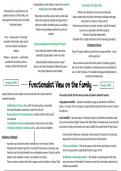
Functionalists see the family as one of the essential Case Study: The Nayar Tribe
building blocks for stable societies.
Functionalist’s concentrate on the - Women are allowed to marry several husbands
positive functions of the family, and They tend to see the nuclear family as the ideal - Nayar women have the right to terminate unhappy marriages
what good the family can do to benefit family for industrial societies and argue that it and choose to remarry if they want to
the whole society. performs positive functions such as socialising - Women have the duty to only her mother’s side of the family,
children and providing emotional security for can have no connection with the husbands
parents. - Women financially independent
Men – instrumental – financially
- Husband visits at night and leaves in the morning (reproduce)
provide for the family, take control
Parsons developed the Functional Fit Theory: Criticisms of Parson
in terms of power and decision
making In pre-industrial society families used to be Parsons’ forgets children create their own personalities – social
extended (3 generations under one roof) action approach
Women – expressive – emotionally
provide for the family, primary Industrialisation families became nuclear Parsons views assumes the family works in isolation ignoring
caregiver within the family unit (parents and their dependent children) because the role of other institutions in allowing primary socialisation to
they fitted industrial society better. occur in the first place. For example having paid employment to
provide the family home
Murdock (1949)
Parson (1959)
Argues that the nuclear family was universal and that it performed four The nuclear family fits the two key needs of modern industrial society:
essential functions:
Geographical mobility – industries constantly spring up and decline in different
- Stabilisation of the sex drive with the same partner, preventing places. It is easier for the compact two generational nuclear family to move to where
the social disruption caused by a sexual ‘free-for-all’ the jobs are
- Reproduction of the next generation, without which society could
not continue Social mobility – Because status in industrial society is achieved not ascribed, adult
- Socialisation of the young into society’s shared norms and values sons can now achieve higher statues than their fathers. Breaking away to set up their
- Meeting its member’s economic needs, such as food and shelter own nuclear family unit removes the status conflict that would result if they stayed
Over time the family saw a reduction in the amount of functions it carried out.
Criticisms of Murdock
Argued that the family now only performed two vital functions:
- Functions can be done by other institutions or non-nuclear families
Primary socialisation – The family passes on the norms and values of society
- Marxists and Feminists reject his ‘rose tinted’ harmonious consensus view.
to the new generation (specifically between ages of 0-3)
Feminists say the family benefits men and exploits women, Marxists say the
family meets capitalism’s needs, not members or society Stabilisation of adult personalities – The family is a relaxing place that takes
- There are some cultures which don’t appear to have families i.e Nayar Tribe away any stress or frustration. Prevents an over flow of emotion and serves to
stabilise personalities
building blocks for stable societies.
Functionalist’s concentrate on the - Women are allowed to marry several husbands
positive functions of the family, and They tend to see the nuclear family as the ideal - Nayar women have the right to terminate unhappy marriages
what good the family can do to benefit family for industrial societies and argue that it and choose to remarry if they want to
the whole society. performs positive functions such as socialising - Women have the duty to only her mother’s side of the family,
children and providing emotional security for can have no connection with the husbands
parents. - Women financially independent
Men – instrumental – financially
- Husband visits at night and leaves in the morning (reproduce)
provide for the family, take control
Parsons developed the Functional Fit Theory: Criticisms of Parson
in terms of power and decision
making In pre-industrial society families used to be Parsons’ forgets children create their own personalities – social
extended (3 generations under one roof) action approach
Women – expressive – emotionally
provide for the family, primary Industrialisation families became nuclear Parsons views assumes the family works in isolation ignoring
caregiver within the family unit (parents and their dependent children) because the role of other institutions in allowing primary socialisation to
they fitted industrial society better. occur in the first place. For example having paid employment to
provide the family home
Murdock (1949)
Parson (1959)
Argues that the nuclear family was universal and that it performed four The nuclear family fits the two key needs of modern industrial society:
essential functions:
Geographical mobility – industries constantly spring up and decline in different
- Stabilisation of the sex drive with the same partner, preventing places. It is easier for the compact two generational nuclear family to move to where
the social disruption caused by a sexual ‘free-for-all’ the jobs are
- Reproduction of the next generation, without which society could
not continue Social mobility – Because status in industrial society is achieved not ascribed, adult
- Socialisation of the young into society’s shared norms and values sons can now achieve higher statues than their fathers. Breaking away to set up their
- Meeting its member’s economic needs, such as food and shelter own nuclear family unit removes the status conflict that would result if they stayed
Over time the family saw a reduction in the amount of functions it carried out.
Criticisms of Murdock
Argued that the family now only performed two vital functions:
- Functions can be done by other institutions or non-nuclear families
Primary socialisation – The family passes on the norms and values of society
- Marxists and Feminists reject his ‘rose tinted’ harmonious consensus view.
to the new generation (specifically between ages of 0-3)
Feminists say the family benefits men and exploits women, Marxists say the
family meets capitalism’s needs, not members or society Stabilisation of adult personalities – The family is a relaxing place that takes
- There are some cultures which don’t appear to have families i.e Nayar Tribe away any stress or frustration. Prevents an over flow of emotion and serves to
stabilise personalities