

Lecture notes Unit 3.1.6 - Chemical equilibria, Le Chatelier’s principle and Kc (Chemistry)
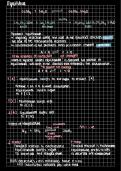
Chemical equilibrium occurs in a chemical reaction when the rate of the forward reaction equals the rate of the reverse reaction, resulting in no net change in the concentrations of reactants and products. At equilibrium, the system is dynamic, meaning the reactions continue to occur, but the concentrations of the reactants and products remain constant over time. The equilibrium constant, K c K c , is a numerical value that expresses the ratio of the concentrations of products to reactants at equilibrium, each raised to the power of their respective coefficients in the balanced chemical equation. For a general reaction: a A + b B ⇌ c C + d D aA+bB⇌cC+dD The equilibrium constant K c K c is given by: K c = [ C ] c [ D ] d [ A ] a [ B ] b K c = [A] a [B] b [C] c [D] d where [ A ] [A], [ B ] [B], [ C ] [C], and [ D ] [D] are the molar concentrations of the reactants and products at equilibrium. The value of K c K c provides insight into the position of equilibrium; a large K c K c indicates a reaction that favors products, while a small K c K c indicates a reaction that favors reactants.
Document information
- Study Level
-
A/AS Level
- Subject
-
A Level Chemistry
- Uploaded on
- July 1, 2024
- Number of pages
- 4
- Written in
- 2023/2024
- Type
- Lecture notes
- Professor(s)
- Abinaya
- Contains
- All classes


